Europe: Anti-Immigration Vs More Negative Demographics
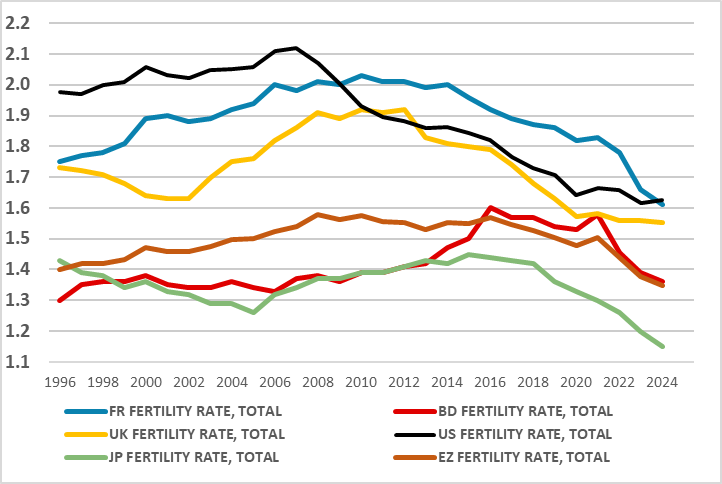
A significant demographic tremor is gaining speed and breadth - globally. Just as politics – certainly in the west - is framed around ending or at least reducing and controlling immigration, it seems that the populists at the helm of such thinking are not considering the ramifications of such a policy even amidst ever more unfavourable demographics (Figure 1). For it is increasingly the fact that the domestic natural population growths in many countries (ie births minus deaths) are low and falling, if not already negative, as fertility rates continue to fall. This increasingly reflects fewer couples forming and then staying together. This means that economies that wish to preserve, let alone see increased population have to resort to immigration, the very opposite of both populist thinking and electoral aspirations. The problem is made worse by if and when the tune on immigration shifts as the (tax-based) incentives to have more children is a populist remedy looking down the wrong avenue, there may be genuine competition for immigrants. This is made all the more possible by the fact that developing countries too are seeing shifting and negative demographic patterns.
Figure 1: Developed Economy Demographics More Worrisome as Fertility Rates Fall Further and Faster
Source; World Bank, Births per Woman
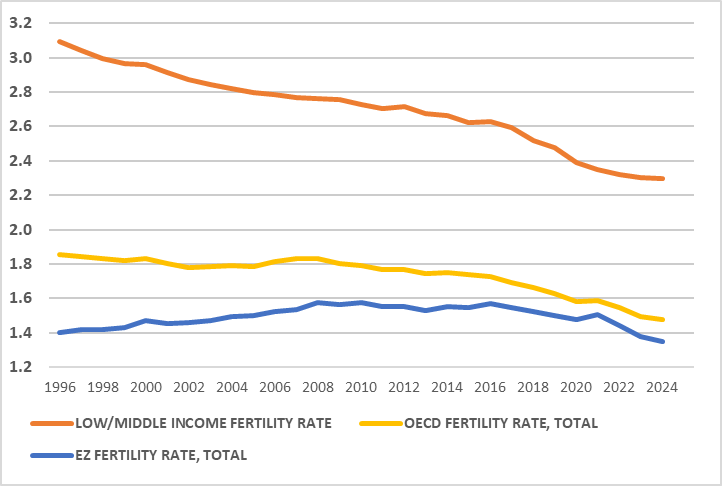
In fact, sinking fertility rates in western economies are now also being seen in the likes of Asia with all low/middle income countries see average fertility Rates falling toward the 2.1 ratio which keeps populations stable without immigration (Figure 2). But what is as worrying are the possible new and increasing causes for falling fertility rates that may make any reversal all the harder to achieve.
As the world economy grapples with high debt, the aspiration is to grow out of such restraints. But real economy growth, at least potential growth, is dependent upon a growing working population as well as productivity. As for the latter, there is case that AI may come to the rescue in shoring up productivity. But that is putting too many eggs in one basket as surely population growth is needed to both shore up workforce and overall population growth, not least the other end of the demographic tremor, namely rising life expectancy. NB: Japan’s stagnation since the 1990s is almost entirely explained by low birth rates that have shrunk its working-age population. And in the UK, population projections suggest that births minus deaths will turn negative this year, so that even with modest net migration the population and workforce may fall.
Notably, it is not just developed countries seeing fertility rates fall both faster than expected but also the possible increasing and novel means through which this is occurring – something a recent FT study highlighted. As the latter reports, it is the case that now in ‘two-thirds of the world’s 195 countries, the average number of children born to each woman (ie the fertility rate) has fallen below the “replacement rate” of 2.1, ie that which that keeps populations stable without immigration. In a third of countries, the average is now closer to one than to two’. And as noted above, falling fertility rates are evident more broadly globally and possibly surprisingly so. Indeed, amid the immigration battle in N America, it is noteworthy that Mexico’s fertility rate fell below that of the U.S. for the first time three years ago — as now has occurred in the likes of Brazil too.
Notably, high- and middle-income countries have been wrestling with demographic decline for more than half a century. While fertility rates have dropped ever more appreciably of late, the phenomenon has markedly accelerated in the past 10 years (Figure 1). As for the causes, they may be new and partly explaining those faster falls in fertility rates. Indeed, various analysis indicates that although many factors may be contributing to falling birth rates, the more recent plunge appears connected with our use of new and innovative technology, something that has suggested above has increased the speed of fertility deterioration but also its geographical breadth. Indeed, until recently, ultra-low and rapidly falling birth rates were primarily a concern for rich countries, but many developing countries now have lower fertility rates than much wealthier ones.
Figure 2: Developing Economy Fertility Rates Now Also Falling Further and Faster
Source; World Bank, Births per Woman
Indeed, it can be said there is a fertility issue that reflects frictions and frustrations that have much to do with modern lifestyles — including housing (costs and availability) as well technology and social networking. According to the FT analysis, as much as half of those countries’ decline in fertility rates since the 1990s can be explained by falling home ownership and a rise in young adults who live with their parents. There also seems to be far shorter periods before couples separate too, possibly a result of stress caused by current economic precariousness. But the new factor seems to be technology, this reflecting the fact that young people are doing more of their socialising on-line and as a result are less likely to meet new third-party people who may be possible future partners. In addition, on-line socialising may be causing excessive interpretation of what a future partner can offer meaning that many looking for romance find reality both understating, disappointing and onerous. Therefore, it now seems to be the case that while the world’s fertility rate went down previously because couples had fewer children, it is now instead due to there being fewer couples – and where the decline in births and coupling is much steeper among those with the least education and lowest incomes.
In fact, falling birth rates appear to be part of a broader phenomenon of young adults remaining single, locked in isolation and deteriorating wellbeing. Given the likely link to technology and social media, the best hope of reversing the trend may be to change our digital habits and not rely on tax based incentives and family-support rhetoric to encourage couples to have more children as the anti-immigration populist parties suggest – for as we have underlined, the problem is the growing lack of couples.