South Africa Inflation Hit 3.1% y/y in March but Pressures Signal Looming Spike
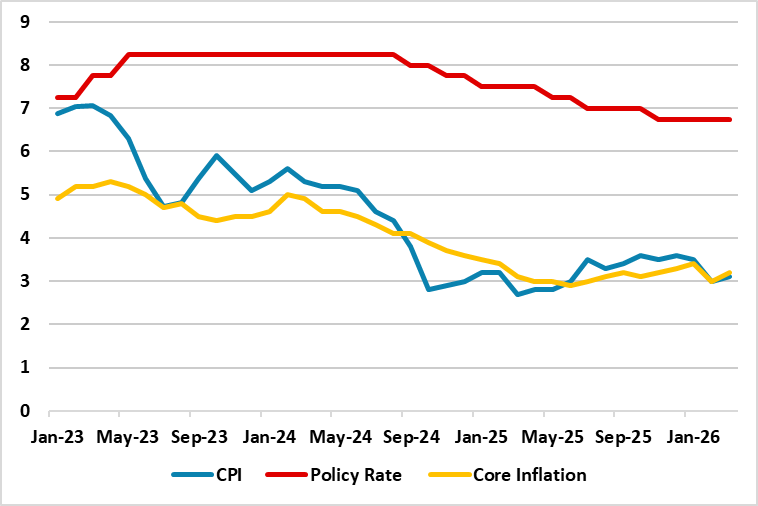
Bottom Line: Following the decline in headline inflation to 3.0% y/y in February, South Africa’s inflation rose to 3.1% y/y in March. On a monthly basis, prices increased by 0.6% and the main drivers behind the rise were housing, utilities and financial services. The surge was driven by a combination of higher energy costs, a weaker Rand (ZAR), rising food prices, and elevated fertilizer costs—stemming from the ripple effects of the U.S.-Israel-Iran conflict. We think an upward trend remains likely since the March data does not yet reflect April's spike in food and fuel costs as we expect inflationary pressure to intensify in the following months unless the conflict in Iran stabilizes.
Figure 1: CPI, Core Inflation (YoY, % Change) and Policy Rate (%), January 2023 – March 2026
Source: Continuum Economics
After cooling to 3.0% y/y in February—supported by the lagged effects of monetary tightening and a relatively stable Rand (ZAR)— South Africa’s inflation surged to 3.1% y/y in March. This uptick was driven by rising energy costs, a weaker ZAR, climbing food prices, and elevated fertilizer costs resulting from the conflict in Iran.
According to the StatsSA announcement, prices increased by 0.6% on a monthly basis and the main drivers behind the rise were housing and utilities along with food, and financial services. Six of the 13 major spending categories recorded increases including transport, education, and restaurants while food inflation eased slightly to 3.6%.
The ongoing Iran conflict continues to threaten South Africa’s inflationary outlook since the country imports most of its petroleum products and exposed to swings in global energy prices. (Note: According to sources, electricity tariffs went up by more than 8% in April, which will add further upward pressure on prices despite the government has temporarily reduced a fuel levy). While we anticipate inflation could partly ease in Q3/Q4 as the Iran conflict potentially subsides, the recovery will be gradual. (Note: We foresee average inflation will hit 3.8% and 3.5% in 2026 and 2027, respectively. SARB also predicts that the headline inflation to accelerate to around 4% soon, with fuel inflation of more than 18% in Q2).
Despite energy concerns following the outbreak of war in Iran, South Africa’s national utility, Eskom, announced on April 10 that the country has achieved 329 consecutive days without power interruptions. With only 26 hours of load-shedding recorded across April and May 2025, the stabilized power supply remains a positive buffer against inflationary risks.
We think the Iran conflict will remain a critical factor for the South African economy. Returning to the 3% inflation target range will likely be a slow process unless the conflict loses momentum, geopolitical risk premiums dissipate, and oil prices decline in line with shifting market dynamics. We think an upward trend remains likely since the March data does not yet reflect April's spike in food and fuel costs, and we expect inflation will significantly surge in April.