Low Inflation and No Loadshedding Continue to Support South African GDP Growth
Bottom Line: Department of Statistics of South Africa (Stats SA) will announce Q4 2025 GDP growth figures on March 3. Following a 0.5% q/q expansion in Q3 2025, we expect growth momentum to be sustained in Q4. This trajectory is supported by low inflation, improved consumer sentiment, a power cuts (loadshedding)-free Q4, and the impact of interest rate cuts. While the global environment remains uncertain and logistical constraints persist, we forecast that the South African economy will grow by 1.4% y/y in 2026.
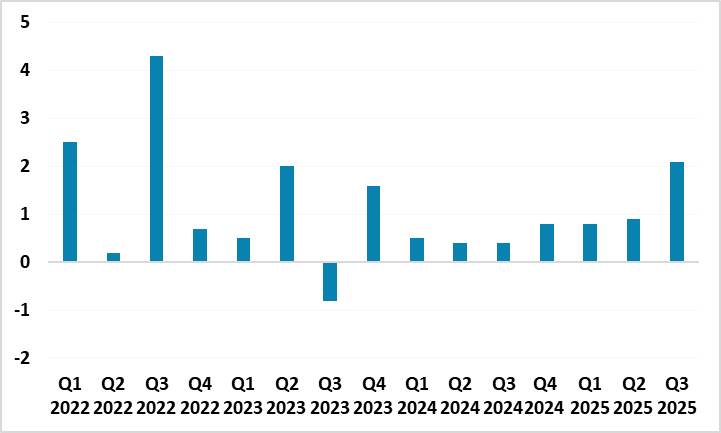
Figure 1: GDP Growth Rate (%, y/y), Q1 2022 – Q3 2025
Source: Continuum Economics
Department of Statistics of South Africa (Stats SA) will announce Q4 2025 GDP growth on March 3. After South African economy grew by 2.1% y/y in Q3 (0.5% q/q), we expect growth momentum to be sustained in Q4, supported by low inflation, improved consumer sentiment, a loadshedding-free Q4, and the impact of interest rate cuts despite uncertain global environment and logistical constrains.
We assess Q4 growth to be fueled by stronger performance in manufacturing and household consumption. Additionally, the absence of power was a key determinant of growth during this period. South Africa’s national utility, Eskom, announced on February 13 that the country has achieved 273 consecutive days of uninterrupted power supply, with only 26 hours of load shedding recorded in April and May 2025.
Lower oil prices and the suspension of load shedding continue to provide relief to businesses and households facing rising costs. Furthermore, we believe that the gradual inclusion of private sector participation in the rail and port industries (via the Transnet recovery) also supported economic expansion in Q4.
The National Treasury of South Africa holds an optimistic outlook for the growth trajectory with a 1.6% growth rate as of February 2026, largely attributed to the benefits of lower inflation and interest rate cuts. Both the International Monetary Fund (IMF) and the World Bank (WB) updated their projections in January 2026 to 1.4%, citing improved reform momentum and greater stability in the electricity and logistics sectors as key drivers.
We believe the economy will grow by 1.4% in 2026. We think that the growth momentum will continue to be supported by low inflation, improved consumer sentiment, fewer loadshedding, moderate oil prices and interest rate cuts. (Note: In the February 2026 Budget, National Treasury confirmed that debt is expected to stabilize at roughly 77.3% of GDP this year, a major milestone that will likely improve investor sentiment and support growth trajectory).