Continuum Economics
  • Search
  • About Us
  • Buy
  • Invite A Friend
  • My Basket
  • Articles
  • Calendar
  • Forecasts
  • Events
  • Data
  • Newsletters
  • My Alerts
  • Community
  • Directory
  • About Us
  • Buy
  • Invite A Friend
  • My Basket
  • Articles
    • All
    • Thematic
    • Tactical
    • Asia
    • EMEA
    • Americas
    • Newsletters
    • Freemium
    • Editor's Choice
    • Most Viewed
    • Most Shared
    • Most Liked
  • Calendar
    • Interactive
      • China
      • United States
      • Eurozone
      • United Kingdom
    • Month Ahead
    • Reviews
    • Previews
  • Forecasts
    • Forecasts
    • Key Views
  • Events
    • Media
    • Conference Calls
  • Data
    • Country Insights
    • Shadow Credit Ratings
    • Full CI Data Download
  • Newsletters
  • My Alerts
  • Community
    • FX
    • Fixed Income
    • Macro Strategy
    • Credit Markets
    • Equities
    • Commodities
    • Precious Metals
    • Renewables
  • Directory
  • My Account
  • Notifications Setup
  • Administration Panel
  • Account Details
  • Recent Devices
  • Distribution Lists
  • Shared Free Trials
  • Saved Articles
  • Shared Alerts
  • My Posts
Back
Published: 2026-04-21T06:54:56.000Z

UK Labor Market: Lower Jobless Rates Misleading, as Wage Pressures hit New Cycle -Low

5

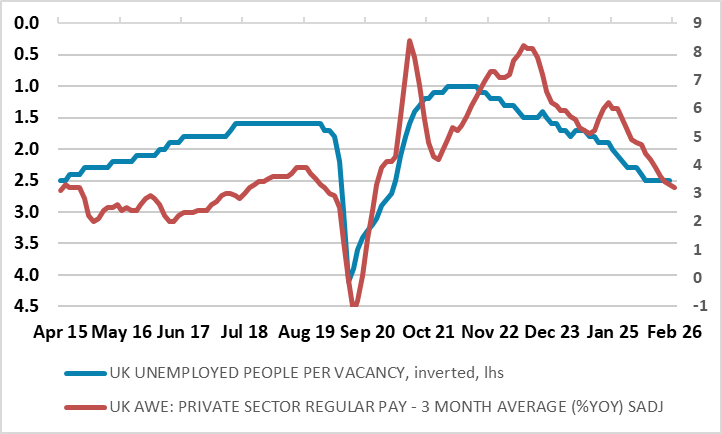
There are further signs that the labor market is haemorrhaging jobs both clearly and broadly with fresh falls in the more authoritative measure of jobs covering payrolls.  Indeed, private sector payrolls are still falling, down over 0.5 ppt in y/y terms.  Admittedly, headlines may be formed around a surprise fall in the jobless rate to 4.9% but this is in no way any sign of fresh tightening the labor market. Instead, it reflects a rise in in inactivity, possibly reflecting dashed hopes of finding a job.  This is not surprising given the further fall in vacancies.  Indeed, the ratio of vacancies to unemployed – perhaps a better guide of labor market tightness than the jobless rate as it reflects both the supply and demand for labor continues to trend lower (Figure 1).  As a result, it does seem as if this is at least partly behind the further fall in wage pressures.  Indeed, private sector regular earnings are now running at below 3%, the lowest since pandemic related pressures softened them in mid-2020. 

Figure 1: Labor Market Loosening Taking Toll on Wages
Source: ONS, CE

This private and regular measure of earnings is the barometer the BoE use to gauge wage pressures and is now running at a pace consistent with the 2% CPI target, this on the assumption of productivity growth of around 1%.  Admittedly the data reflect pre-Iran War dynamics and may not affect what will be divided BoE thinking.  But what is key is that private sector earnings are growing well below the 7%-plus pace seen before the Ukraine War started four years ago. 

Continue to read the article for free
Login

or

or

Topics
DM Central Banks
DM Country Research
Bank of England
Continuum Daily
Data Reviews
UNITED KINGDOM

GENERAL

  • Home
  • About Us
  • Our Team
  • Careers

LEGAL

  • Terms and Conditions
  • Privacy Policy
  • Compliance
  • GDPR

GET IN TOUCH

  • Contact Us
Continuum Economics
The Technical Analyst Awards Winner 2021
The Technical Analyst Awards Finalist 2020

© 2026 Continuum Economics

image