Turkish Economy Grew by 3.6% y/y in 2025
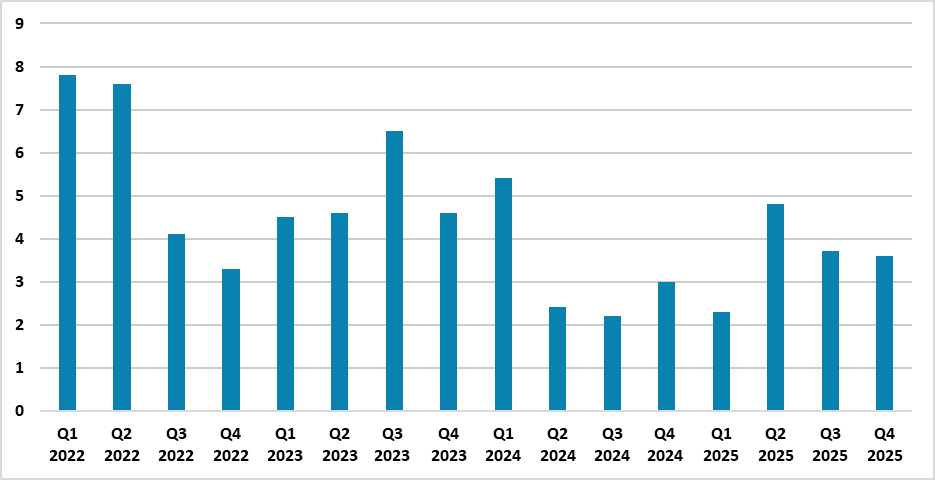
Bottom Line: The Turkish Statistical Institute (TUIK) announced Q4 2025 and full-year GDP growth for 2025 on March 2. Turkish economy expanded by 3.6% y/y in 2025 (3.4% y/y in Q4), underpinned by domestic demand while the main drag came from net trade as annual exports of goods and services declined by 0.3% in 2025, while imports rose by 4.9%. Looking ahead, we anticipate GDP growth will maintain a steady pace in 2026, supported by robust consumption while downside risks such as high interest rates and contractionary fiscal measures remaining strong.
Figure 1: GDP (%, YoY), Q1 2022 – Q4 2025
Source: Continuum Economics
The Turkish Statistical Institute (TUIK) announced Q4 2025 and full-year GDP growth for 2025 on March 2. Turkish economy expanded by 3.6% y/y in 2025, underpinned by domestic demand while the main drag came from net trade as annual exports of goods and services declined by 0.3% in 2025, while imports rose by 4.9%. This performance exceeded 3.3% 2025 growth target set in the Medium-Term Program (MTP). (Note: Turkish economy expanded 3.4% y/y in Q4 2025). A y/y breakdown of expenditure components showed that private consumption rose by 5.2% and investment surged by 5.4% while public consumption fell 0.9%. Additionally, gross fixed capital formation posted a remarkable annual increase and rose by 7%.
TUIK’s sectoral growth data demonstrated that construction hit the strongest annual growth in 2025 at 10.8%, followed by information and communication activities at 8%. The agriculture, forestry and fishing sector contracted by 8.8% due to adverse weather conditions.
Treasury and Finance Minister Simsek indicated on March 2 that increased demand from trading partners and improvements in financial conditions are expected to contribute to growth in 2026, assuming that risks stemming from geopolitical developments are temporary and uncertainties in global trade ease.
Looking ahead, supported by the anticipated positive impact of rate cuts and improving business sentiment; we expect GDP growth to maintain its momentum in 2026 driven by resilient household consumption, infrastructure projects, and government spending. However, growth will still be under pressure due to sustained high interest rates, contractionary fiscal measures, and stringent macroprudential policies aimed at curbing elevated inflation. These domestic headwinds are further compounded by a challenging global outlook and the ongoing geopolitical risks stemming from the Russia-Ukraine war and U.S./Israel attacks on Iran. We think Turkish authorities will try to strike a balance between disinflation efforts and economic growth in 2026.