April Inflation Hits 32.4% y/y: Iran Conflict Drives Steeper Monthly Pressures
Bottom line: Turkish Statistical Institute (TUIK) announced April inflation figures on May 4. After hitting 30.9% annually in March, Turkiye’s inflation accelerated to 32.4% y/y (4.2% m/m) in April as the economy remains under pressure from Iran war. April reading was driven by rising housing and transportation costs due to energy price hikes. We assess that inflation will likely remain above the Central Bank of Turkiye's (CBRT) upper forecast band by year-end, and it may be necessary for the CBRT to adjust its year-end inflation targets to more realistic levels to stabilize market expectations.
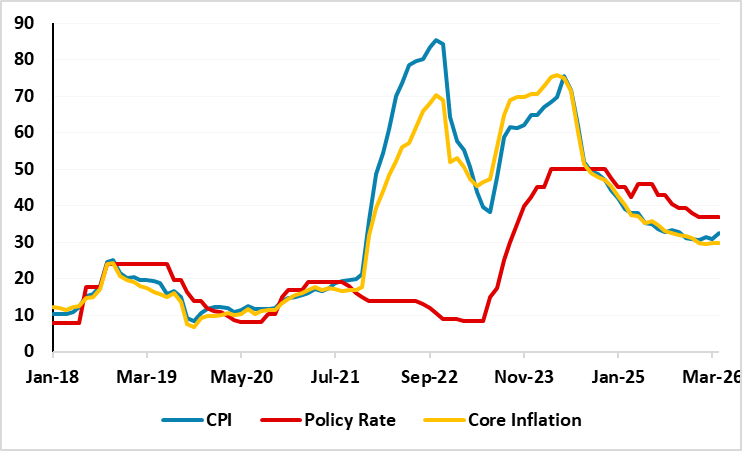
Figure 1: CPI, Core Inflation (YoY, % Change) and Policy Rate (%), January 2015 – April 2026
Source: Continuum Economics
After Turkiye’s inflation stood at 30.9% y/y in March, inflation increased to 32.4% in April as we expected due to upside-tilted inflation risks and surges in energy, transportation and agricultural input costs due to Iran conflict.
According to TUIK’s announcement on May 4, education prices recorded the highest annual increase with 50.6% YoY followed by housing prices were up by 46.6%. Annual food and non-alcoholic beverages prices also soared by 34.6% while transport prices increased 35.1% annually. Prices rose at a slower pace across a number of categories, such as footwear and clothing, which came in at 9.7% y/y in April.
Monthly inflation edged up by 4.2% in April while annual core inflation stood at 3.5% monthly and 29.9% annually. According to TUIK’s announcement, CPI in the three main expenditure groups with the highest weight; increased by 3.7% for food and non-alcoholic beverages, increased by 4.3% for transportation, increased by 8.0% for housing, water, electricity, gas and other fuels monthly. All these figures demonstrate worrying increase in inflation.
We think fragile and volatile cease-fire in Iran continues to threaten Turkish inflation outlook as it poses a threat to the Turkish economy particularly given the country’s heavy reliance on energy and fertilizer imports. Commenting on the impacts of surges in energy prices over the inflation trajectory, it is worth mentioning that the CBRT also said in its written Monetary Policy Committee (MPC) statement on April 23 that elevated energy prices exhibit notable volatility amid geopolitical developments and the resulting uncertainties. "The effects of these developments and domestic energy prices on the inflation outlook through the cost channel," the statement read.
It is interesting to see that CBRT maintains its official interim target of 16% and the forecast range between 15%–21% for the end-2026. Despite this, we assess that inflation will likely remain above the CBRT’s upper forecast band by year-end and it may be necessary for the CBRT to adjust its year-end inflation targets to more realistic levels as soon as possible to stabilize market expectations. Our average inflation forecast for 2026 stands at 28.4% due to fragile pricing behaviour, surging energy costs, stubborn food and services prices. For H2, the duration of the Strait of Hormuz closure will be a critical factor for Turkish inflation.