UK Politics – A Laboured Labour Election Ahead?
It is somewhat ironic that as markets (particularly gilts) fret over a shift to the left causing less fiscal prudency, it is actually the centre of the Labour party that is fermenting the most uncertainty. (Now Ex) Secretary Streeting has yet to make a formal bid to challenge PM Starmer for the leadership (both being to the right of the party), with speculation being the former does not have enough parliamentary support. But if he does we would argue that any such ensuing election may yet be some weeks away, a period through which already slow policy making may at least seem to draw to a halt. The question is the extent to which those that would determine the timing of any vote realise that a quick election between Starmer and Streeting but without the party’s (not just the left’s) darling (ie Burnham) would set the seeds for even deeper and more protracted party divides ahead. If so, that would either handicap policy making further or lead to (potentially more expensive policies) that attempt to address such divisions.
Figure 1; How The Possible Runners Are Faring
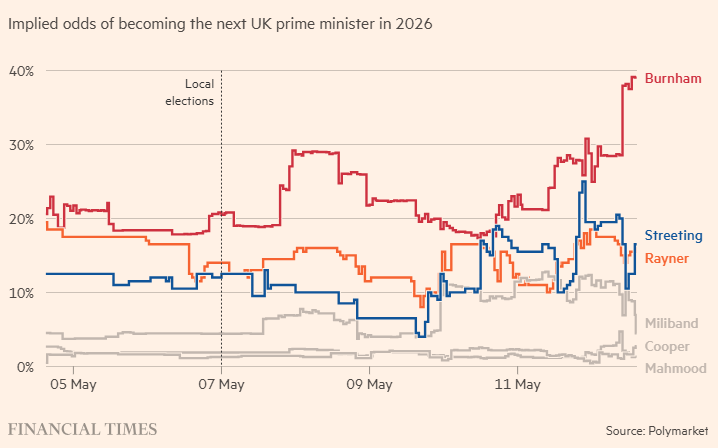
Labour has come close to leadership and PM challenge before. In the late 1960s/early 1970s, long-standing PM Wilson clearly had fomenting discontent among his front benches, but managed to divide the two main camps led by Callaghan and Jenkins by playing them off against each other. This is a tactic that Starmer may already be attempting
Regardless, despite not having been used, the Labour Party does have a mechanism to unseat a PM from its party. What is needed is 20% of the party's MPs to back an alternative candidate and with some 403 Labour MPs, the support of 81 would be needed. Even more notably, this alternative candidate can be a stalking horse as once a leadership election is triggered, other candidates could join the contest if they also have 81 backers. PM Starmer would not need to do any of this as sitting leader and PM he would be automatically on the ballot paper if he chose to stand and would continue as prime minister up to and during any contest.
But the big question is, if a series of candidates make it to the ballot paper, ie three new candidates would represent 60% of the parliamentary party and thus would suggests Starmer would be in a minority. Admittedly, this is not the whole story as the actual voting would include all party members (not just MPs) and affiliated trade union supporters who would rank the candidates in order of preference – and there have been clear times when the wishes of party members have been at odds with that of its MPs (ie Corbyn election). This process continues until one candidate receives more than 50% of first preferences, as then they will be declared the winner – NB after every ballot the candidate with the lowest showing drops out.
The timetable for the leadership ballot would be decided by Labour's decision-making body known as the National Executive Committee (NEC). – NB the last leadership election process took some six weeks. Left-leaning Andy Burnham’s backers are understood to be lobbying the NEC to hold an extended leadership election to give him time to return to parliament; he now being Mayor of Manchester. His supporters are calling for a nomination period long enough for him to win a by-election. Such a move could stretch the contest to about three months, drawing out the chaos as possible policy impasses facing the party. The NEC blocked Burnham’s last attempt to re-enter parliament but, with the PM’s influence over the NEC having waned, there does seem to shift to making and/or awaiting a Burnham candidacy. This may be even more so, as Streeting’s apparent problems in getting 80 MPs to support his candidacy may be something other aspirants also find equally difficult – the exception being Burnham.
In fact, PM Starmer may be more prepared leave office on an elongated timetable both to get parts of yesterday’s King’s Speech passed but also to appear more statesmanlike. But also we would argue that if it wants to maintain the image of fair and durable lection result, the right of The party needs to take on the left’s best and more favoured candidate.
Will it change much – possibly given that Starmer is both unpopular and whose dithering and U-turns have held back policy shifts – although PM changes in the recent past have done little to restore support either short or medium term. As for Starmer’s record, it could be said that it is the huge MP majority that he has had has held him back as his party’s MPs have been more willing to rebel given limited chance of this forcing a general election, this triggering what have been a least 13 major U-turns.
As for policy shifts, both the left and right may want to loosen fiscally but scope to do so is eroding given ramifications of Iran War and the rise in gilt yields f late – every 1 ppt adds GBP 12 bln to borrowing 4-5 years out. In this regard, the gilt market is acting less as policing force and more as judge in passing out sentences. Much may also depend on who becomes Chancellor – it appears that the far from fiscally loos Ed Miliband fancies the jobs, the question being the extent to which his green credentials instead win out. The other critical issue is how any new PM would fare on the world stage – would Trump treat him with even more disdain given that no forms general election had voted he or she in?