DM Money Supply and Private Sector Debt/GDP: Not Enough Borrowing?
· The surge in U.S. household wealth from the post GFC boom in equity and house prices has meant household lending has been subdued but not hitting consumption. The AI infrastructure lending boom needs to be watched in the coming years, especially with the U.S. easing capital ratios.
· EZ lending trends have been subdued by the end of ultra-low interest rates; numerous major crisis (COVID/Ukraine war) and ECB reluctance to ease capital ratios. Lending will likely remain modest in the wake of this year’s ECB rate hikes.
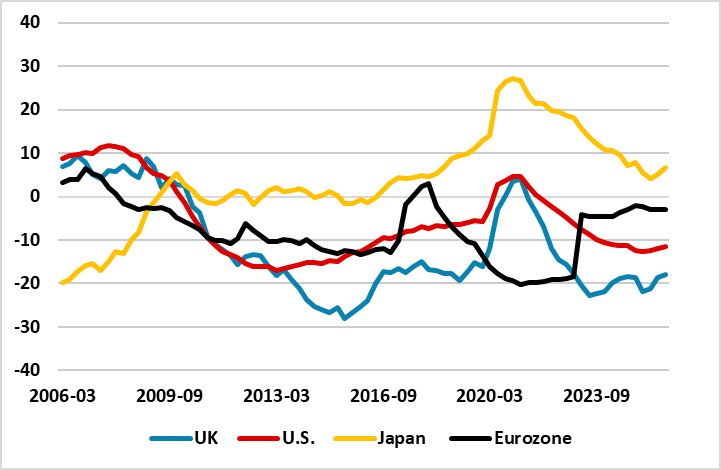
· UK is suffering from a deficiency of credit growth looking at BIS credit gap measure (Figure 2). Though the BOE FPC is easing capital and liquidity ratios we are not sure that this will be enough given more major shocks in the UK than elsewhere (Brexit and Tax hikes). The surge in the UK government debt/GDP could have caused some crowding out as well. Once energy prices ease in 2027, we see the need for BOE easing to sustain credit trends and nominal and real GDP.
With Fed Chair Warsh focusing on money growth, what is happening in big DM countries to money and credit/GDP ratios?
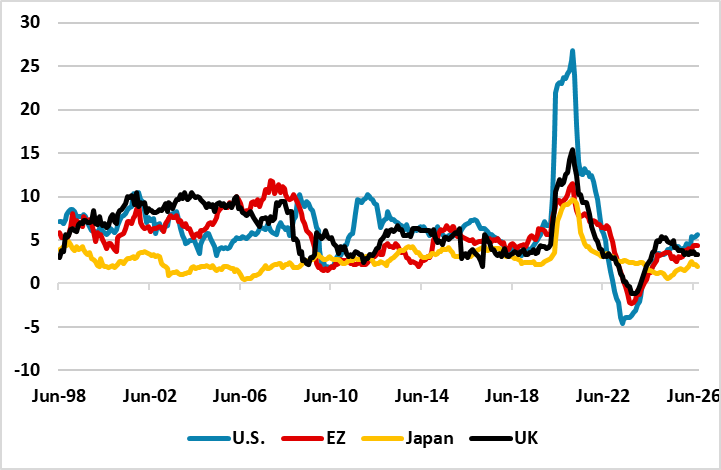
Figure 1: Big DM M2 Money Supply Growth (Yr/Yr %)
Source: Datastream/Continuum Economics
Fed Chair Warsh has made clear that money matters, though noting a benign trajectory for M2 – broader measure are higher though (here). Though we are not monetarists, we do take account of money and credit/GDP in our economic and policy assessments. M2 growth in the EZ, Japan and UK is more subdued than the U.S., which is of broad interest in nominal GDP trajectories.
Additionally, BIS credit gap measures suggest none of the big DM is suffering from excess credit (Figure 2). In the U.S. case it is also worth looking at other balance sheet dimensions in the shape of the huge surge in household net wealth. Since the 2008 crisis, equity and house values have boomed and produced a windfall surge in wealth. This has helped sustain U.S. consumption without lending, as the top 20% of households by income and wealth dominated consumption. The Dallas Fed research shows that a major U.S. equity market correction would be a bigger threat to consumption than higher policy rates/yields or rising unemployment.
Figure 2: Big Credit-GDP Gap Private Sector (actual v trend %)
Source: BIS/Continuum Economics
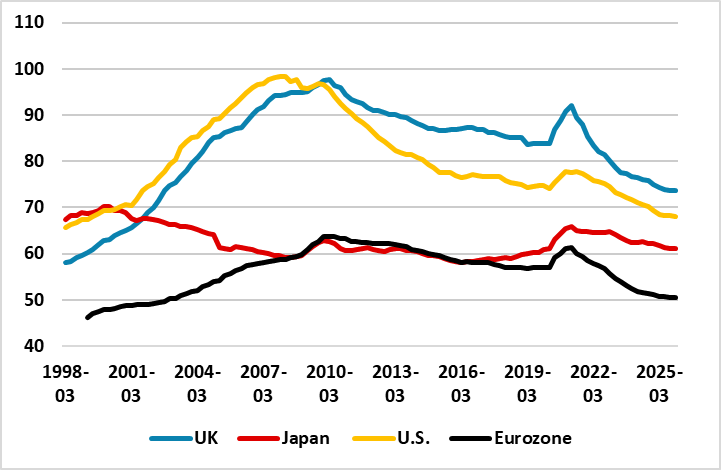
This wealth effect is one of the reasons why the U.S. household debt/GDP ratio continues to trend downwards (Figure 3). Certainly the health of the U.S. banking system suggests that a credit supply problem does not exist. Credit supply should also be helped in the coming years by the Fed, OCC, FDIC easing of capital ratios (here). Even so, the U.S. K shaped economy is straining lower to mid-income households and this is a headwind to credit demand in the U.S.
Figure 3: Big DM Household Debt/GDP (%)
Source: BIS/Continuum Economics
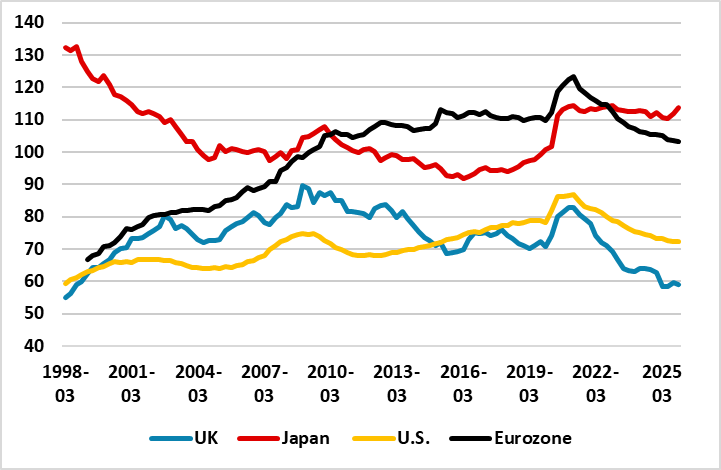
In the EZ, households have enjoyed higher net wealth to GDP, which reduces credit demand – though the wealth increase is less than the U.S., as U.S. households have higher percentage ownership of equities in their net wealth. Even so, ECB research (here) has also highlighted a K shaped phenomenon, with low to middle income households hit by the COVID and Ukraine war price shocks in real wage terms – that have hurt confidence and lifted precautionary savings. This has not translated into higher demand for non-mortgage credit, while the end of ultra-low interest rates in 2022 has seen a more subdued EZ housing market (mortgage lending is a modest 3%). However, the ECB bank lending survey has at times shown a caution among banks to lend. This could be the higher frequency of major shocks in recent years, but we also suspect that the more rapid shrinkage of the ECB balance sheet than the Fed has restrained credit supply. Additionally, post GFC regulation, capital and liquidity ratios increases have made banks more cautious in the EZ (and UK), which has also been a headwind to credit supply and money supply/credit trajectories – though non-financial corporate debt/GDP (Figure 4) has held up better in the EZ than households. The ECB in the past has been reluctant to cut capital ratios (here), though is trying to simplify post GFC regulation.
Figure 4: Non-Financial Corporate Debt/GDP (%)
Source: BIS/Continuum Economics
In terms of the UK, the BIS credit gap measure (Figure 2) suggests that the UK is suffering from a deficiency of credit growth. Credit supply has had the same headwind as the EZ in the shape of post GFC capital and liquidity ratios that could be eased somewhat. However, the bigger issue appears to be credit demand looking at Figure 3 and 4 re household and NFC credit/GDP ratios in the last decade. The UK has not only been hit by COVID and the Ukraine war, but also Brexit (evident in trade and business investment data) and higher trend tax rates as part of the fiscal consolidation exercise. The BOE FPC is reducing Tier 1 capital benchmark by 1% to 13% and updating leverage and buffer rules to stimulate lending (here). We are not sure that this is enough, given the UK lending deficiency. This lack of credit growth is one of the reasons that we see little 2nd round effects from the Iran war energy price shock and we feel lower energy prices in 2027 will allow the BOE to cut interest rates. Though the UK budget on October 28 is unlikely to see major new fiscal tightening, 2027-28 already sees fiscal tightening due to previous announced tax measures and a slowdown in government expenditure growth.
Could the surge in the U.S./EZ and UK government debt/GDP since 2007 have caused some crowding out of private sector lending as well? We feel that this could be at play as well from two perspectives. Firstly, the increase in government debt since 2007 has been substantive caused by higher frequency of crisis such as the GFC/COVID crisis and in Europe the impact of the Ukraine war. Secondly, fiscal stimulus provided by governments has also been a more common choice, with Trump 1.0 and 2.0 and Biden happy to provide stimulus measures and reluctant to undertake subsequent fiscal consolidation. In the EZ ex Germany and UK, voters also understand that government have to undertake multi-year fiscal consolidation, but this is at a modest pace. In the U.S. fiscal consolidation remains unlikely, even if the Democrats win the House and the Senate.