Bank of Canada - Policy seen appropriate under baseline assumptions, but risk may lean to upside
The Bank of Canada left rates unchanged at 2.25% as expected and Governor Macklem sees policy as appropriate under a BoC baseline that assumes oil prices evolves according to market expectations and US tariff rates remaining unchanged. This supports our view for steady BoC policy through 2026, though Macklem added that policy may need to be nimble given unusually elevated uncertainty. The BoC is prepared to move in either direction, but tightening later in the year is probably a greater risk than easing.
Oil prices are assumed to decline to around $75 per barrel by the middle of next year and if that happens CPI, which increased to 2.4% in March from, 1.8% in February, is seen peaking at around 3% in April and easing back to the 2% target by early next year. Independent of the oil shock, CPI is due for an acceleration in April due to the April 2025 abolition of the carbon tax lifting the base.
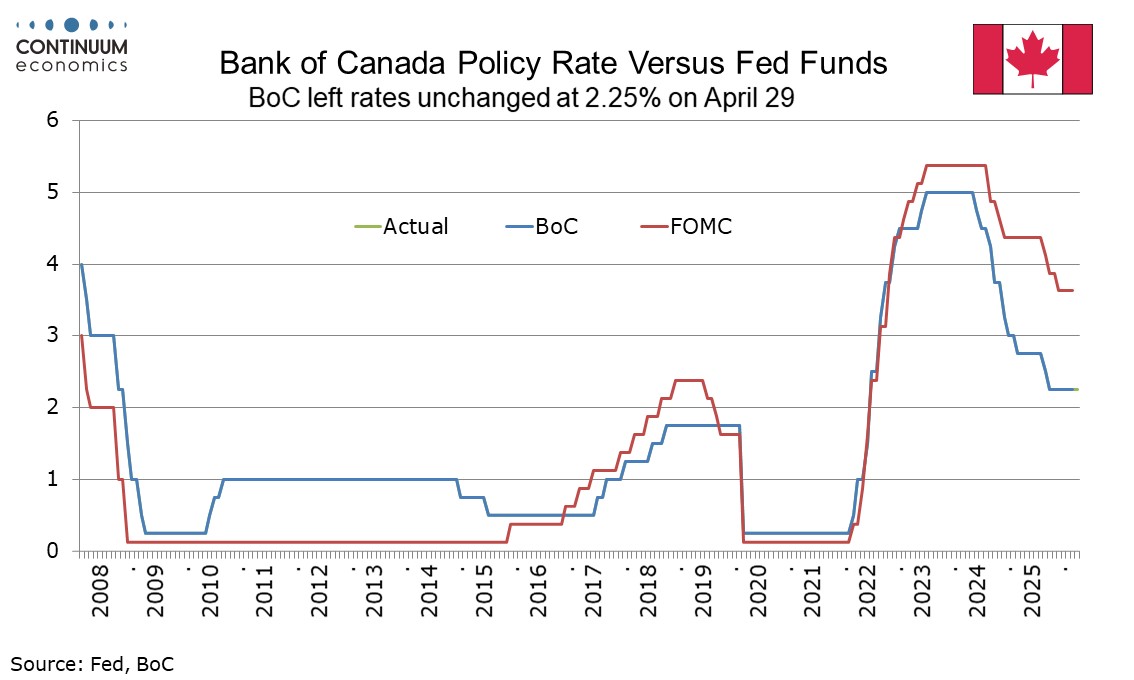
With core inflation falling the BoC is not overreacting to the oil shock, so far seeing little evidence of feed through to broader prices, and agreed to look through the war’s immediate impact on inflation. However they are committed to not allowing persistent inflation to develop. Macklem stated that if this happens there may need to be consecutive increases in the policy rate. This is certainly a significant risk if oil prices accelerate further and on a more sustained basis than in the BoC’s baseline, but a near term move looks unlikely given a limited feed through so far to core CPI.
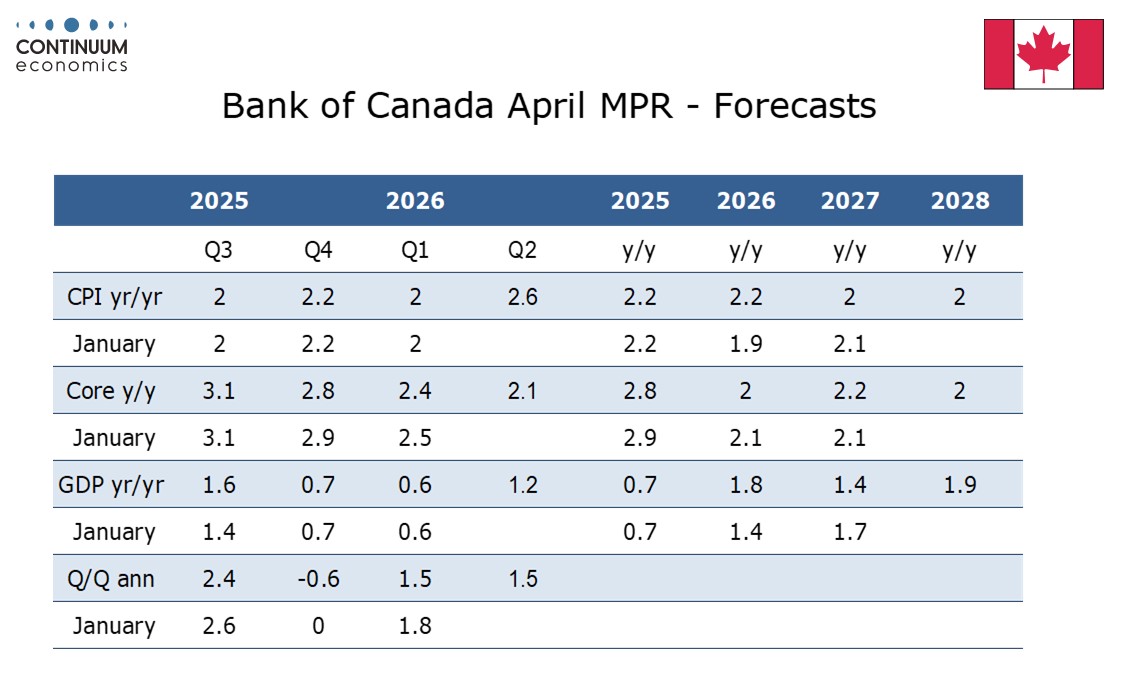
Higher oil prices are seen boosting Canadian national income even as consumers are squeezed and the BoC sees the growth outlook as little changed from January. On a Q4/Q4 basis 2026 has been revised higher and 2027 revised lower, but on an annual basis GDP is seen rising by 1.2% in 2026, 1.6% in 2027 and 1.8% in 2028. This is seen as slightly above potential, allowing a gradual absorption of excess supply. Oil prices are not the only uncertainty. Macklem stated that if the US imposes significant new trade restrictions, the BoC may need to ease policy. This is however probably less of a risk than sustained strength in oil pushing the appropriate policy rate higher.
Macklem recognizes there are many possibilities and the BoC is ready to respond as needed, though he stated moves are likely to be small if the economy evolves in line with the BoC outlook. Our view is still that rates will remain at 2.25% through 2026 but that in 2027 rates will be nudged up to 2.75%, with moves in Q2 and Q3. This would put rates back in the midpoint of the 2.25-3.25% range the BoC sees as neutral. If there is a move in 2026, either direction is possible, but tightening is probably the greater risk. Long term however, Senior Deputy Governor Rogers sees trade tensions as a bigger threat to the economy than higher oil prices.