FX Daily Strategy: Europe, January 27th
Australian CPI Expected to be Hot
No change with early 2026 data awaited for FOMC
Bank of Canada Rate level still appropriate
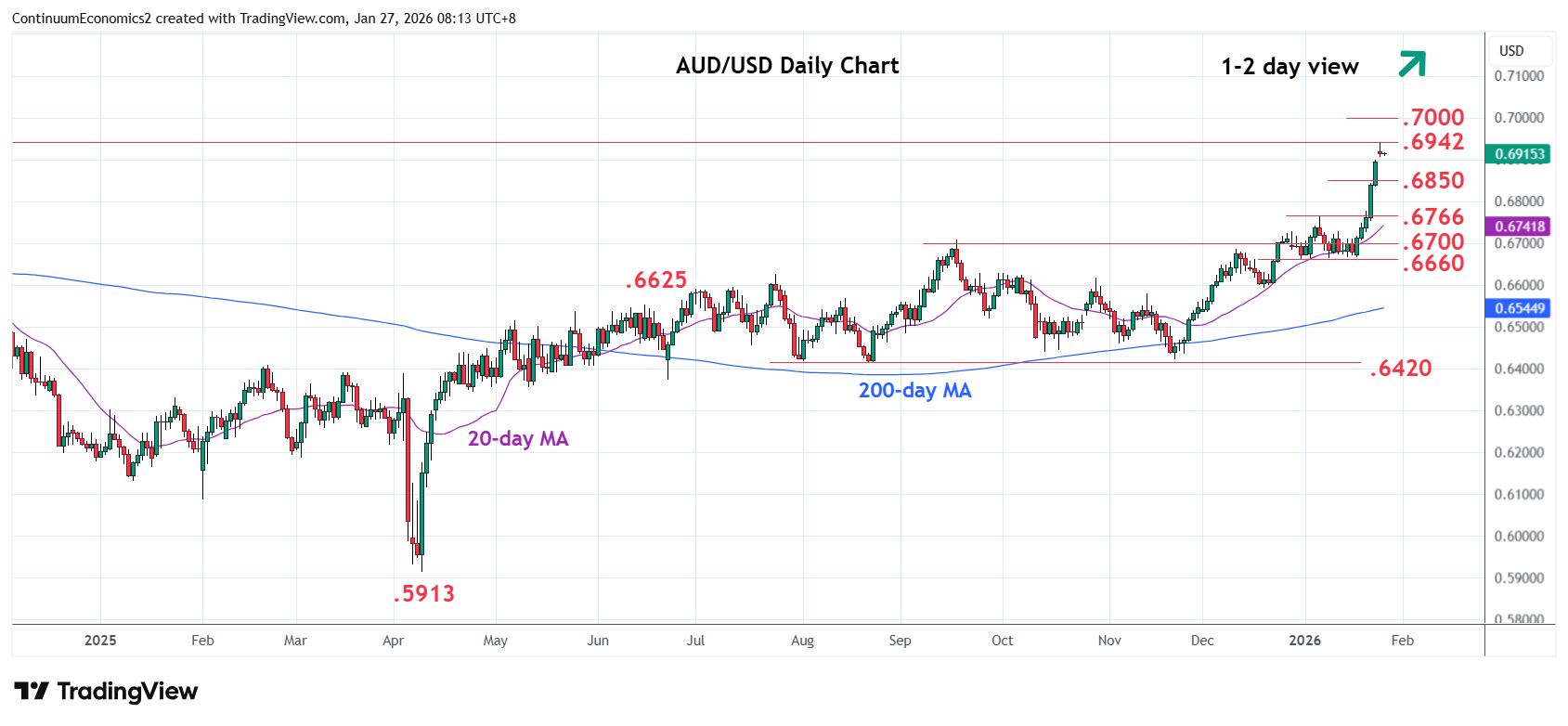
The Australian CPI is expected to remain hot for Q4 2025. While we also see Australian inflation to be above target range, there is a good chance the Q4 CPI will not be that much higher than Q3. Trimmed mean CPI, on the other hand, should be carrying more weight and could sway the RBA towards taking a more hakwish stance. Though, we believe the probability is low.
On the chart, the pair is consolidating test of the .6942 resistance as prices unwind overbought intraday and daily studies following strong gains from the .6660 support. However, pressure remains on the upside and a later will open up room for extension to .6960, a 50% Fibonacci level, then the .7000 figure. Meanwhile, support is raised to the gap at the .6900 level and Friday's high. Below this will see room for deeper pullback to support at the .6850/.6800 congestion. This area now expected to underpin and sustain strong gains from the recent November swing low.
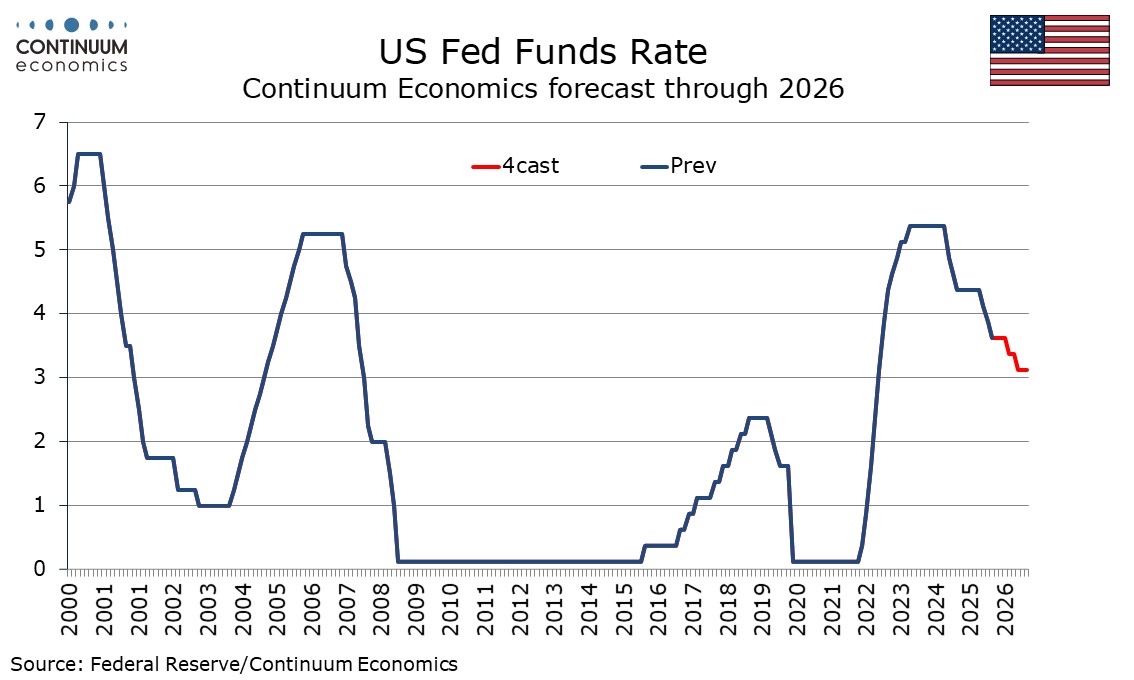
The FOMC meets on January 28 and rates look set to be left at 3.5-3.75%, and while rates are likely to move lower in 2026, they are unlikely to give many hints over what is likely in March, with future decisions dependent on data. The FOMC will not update its economic forecasts or dots at this meeting. We expect only one dissenting vote, with dovish Governor Stephen Miran likely to call for a 50bps easing. This will signal broad support for Chair Jerome Powell at the FOMC, despite pressure from President Trump for lower rates. The voting line up will change, with hawks Hammack and Logan, moderate Kashkari and the slightly dovish Paulson replacing the recently hawkish Schmid, Goolsbee and Musalem, as well as moderate Collins. The net effect of this on policy decisions will be marginal.
The statement will be fine-tuned to take recent data into account, but few other changes are likely. December’s statement described growth as moderate. Given a stronger than expected Q3 GDP and positive signals on Q4 any fine-tuning will be positive but cautiously so. Job gains remain quite slow, but December’s unemployment rate of 4.4% was unchanged from September. December’s statement stated unemployment had edged up from September. December’s statement noted that inflation had moved up since earlier in the year. It now appears to be stabilizing, though the FOMC is likely to continue describing it as somewhat elevated.
All this will allow the Fed to take a cautiously optimistic view on both growth and inflation, suggesting no urgency for any policy change. The Fed will be watching for incoming data. While any change from the currently fairly flat labor market picture would be noted, it is inflation data that is likely to be of most significance. Recent years have tended to see a pick up in Q1. If that occurs this year, the Fed may pause into Q2, as is our expectation, though further progress on inflation would raise confidence that inflation is heading back towards target. We do not expect easing in March, but it is unlikely to be ruled out. At the press conference, Powell will face many questions about the future of the Fed. He will choose his words carefully, but will stress the importance of Fed independence.
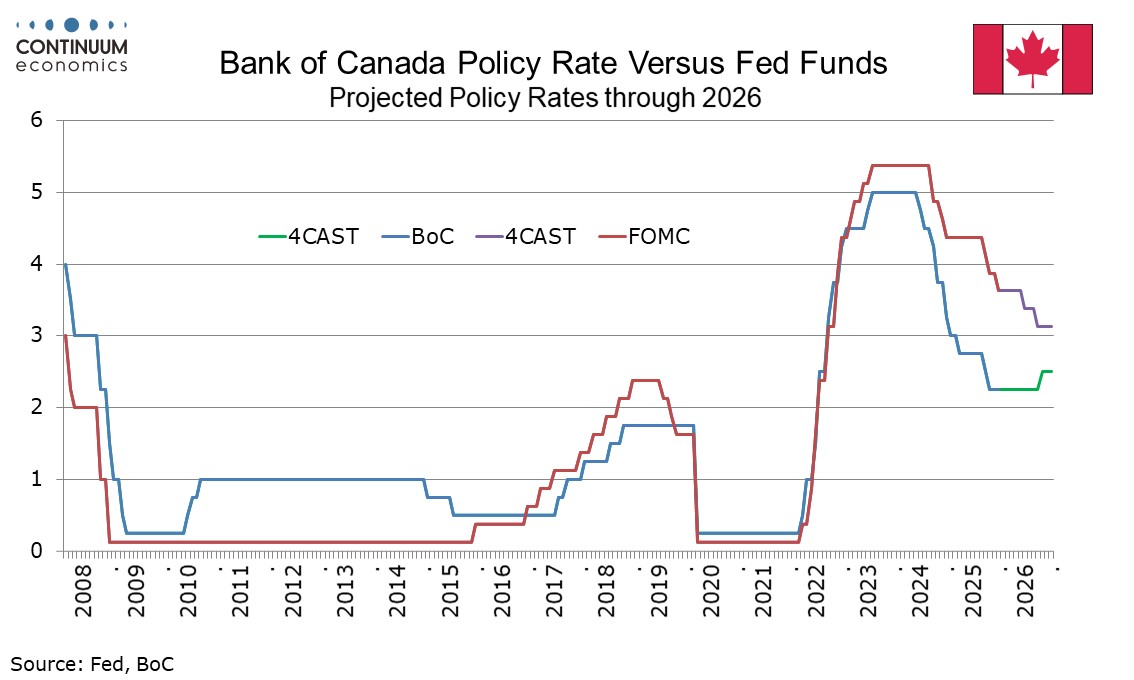
The Bank of Canada looks highly likely to leave rates unchanged at 2.25% on January 28 and reiterate that rates are at about the right level if the economy evolves as expected, while adding that uncertainty remains elevated. We expect that the next BoC move will be a modest tightening, but this will not be seen until Q4. Easing before then is possible if geopolitics gives the economy a fresh hit. After easing to 2.25% in October, putting rates at the bottom of the BoC’s neutral range of 2.25-3.25%, the BoC stated that if the economy evolved in line with its October projection, it saw policy at about the right level to keep inflation close to 2% while guiding the economy though this period of structural adjustment. This was repeated at the December meeting, when rates were left unchanged.
This meeting will be of most interest for updated economic forecasts. Since October’s forecasts ere made we have seen Q3 GDP significantly exceed the BoC’s expectations with 2024 also revised significantly higher, though we expect that the BoC will expect a modest correction lower in Q4 and a moderate start to 2025. We expect revisions to 2026 and 2027 GDP forecasts will be modest, but overall the economy is looking a little stronger than the BoC had expected. CPI has exceeded the BoC’s expectation in Q4, though their core rate, as measured by the average of CPI-Median and CPI-Trim, was a little softer than expected. The Q4 acceleration in overall CPI is in part due to a sales tax holiday a year ago inflating the base, and that will continue in early Q1, though the BoC was aware this was coming when it made its forecasts in October. In April the year ago base will be boosted as the abolition of the carbon tax in April 2025 drops out of the base, and that’s should see overall and core CPI rates converging. The BoC has reason to feel a little more optimistic about underlying inflation than in October, and may trim its 2026 and 2027 projections. We expect they will now look for the 2.0% target to be reached in 2027, which in October it saw at 2.1%.
A slightly stronger growth view than in October but a slightly softer inflation view suggests that despite the surprises seen in data since October, the BoC will not need to change its view that rates are at about the right level. High uncertainty given the geopolitical environment, with Greenland and the upcoming USMCA negotiations both carrying significant risks for Canada, will mean that the BoC will reiterate that if the outlook changes it is prepared to respond. Our central view has the economy in late 2026 seeing growth back in line with potential and inflation getting close to target, with a 25bps tightening in October and another in 2027 to put rates in the middle of the neutral range. However, a shock that damages the outlook sufficiently to see the BoC resuming easing is a significant risk.