DM ex U.S.: Weathering Higher Energy Prices
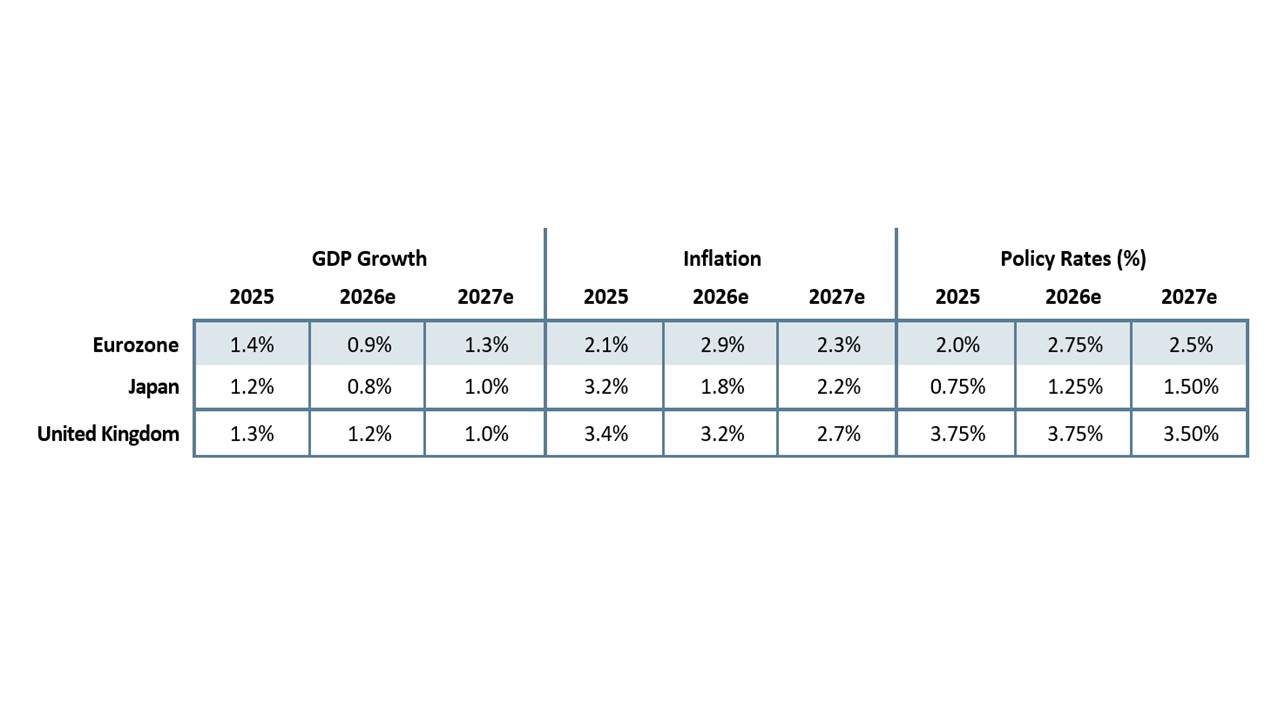
· EZ. We expect the Eurozone economy to remain resilient in coming quarters despite the ongoing energy shock. Household consumption growth should strengthen into 2027, supported by a recovery in real wage growth and by favourable employment increases. Increased defence and infrastructure spending and gradually strengthening profits are also expected to underpin business investment. We expect inflation to continue rising in coming months but with no sign of second round effects. The ECB is likely to hike one more time to end this year at 2.75% and to remain on hold for most of next year before cutting to 2.5% towards the end of the year.
· Japan. The lagged feedthrough of the Iran war energy price shocks points to further upward pressure for CPI inflation with a peak likely Q1 2027 around 2.6-2.8%. However, the economy is mixed with exports/production helped by a weak JPY and the AI boom but households weak. The policy rate is also getting close to BOJ neutral rate estimates of 1.75%. All of this suggests to us that the BOJ is unlikely to pick up to a quick tightening pace suggested in the money market. We remain of the view that the next 25bps hike will likely arrive April 2027 to 1.50%. Surging JGB yields and corporate/household loans are a 2nd extra monetary tightening. By H2 2027 this will be enough to delay a hike to 1.75% until 2028.
· UK. The economy has held up well in H1 2026 but prospects for the remainder of the year are less bright given a number of troubling headwinds; ongoing global tensions, rising inflation, and constrained public finances will affect households and business in coming months. Inflation has been largely an energy story so far with little sign of pressures building elsewhere. The labour market remains fragile and wage growth remains under control. Inflation expectations also remain anchored. We have kept our call for no hike this year though that is dependent on the outlook for energy prices. November will be a close call.
Our Forecasts
Source: Continuum Economics
Eurozone
Growth: Improving Consumption and investment to provide some support
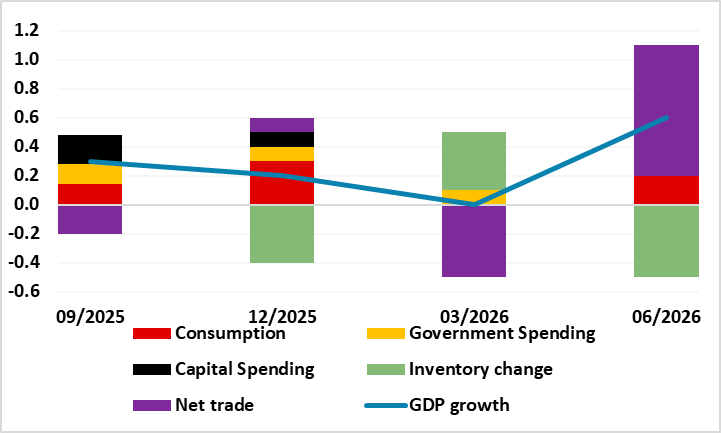
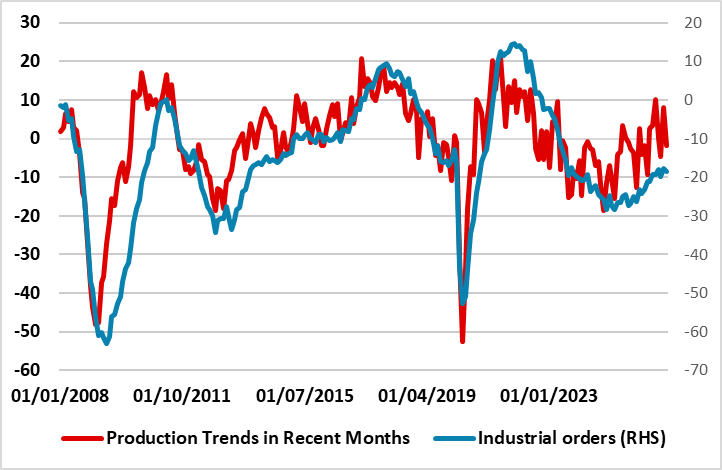
The eurozone economy has weathered the energy shock remarkably well since the start of the middle east conflict, partially as the gas price shock is nowhere near the scale of 2022. As an energy importer, the eurozone economy was expected to be particularly affected and early sentiment indicators seemed to back that view. The domestically facing services PMI contracted in April, May and June with business sentiment also slowing noticeably. Since then both indicators have recovered well and actual GDP figures showed a strong recovery in Q2 although that was boosted by an outsized increased from Ireland (10.2% q/q gain). Even excluding this volatile contribution, the Eurozone economy has proved to be resilient. Momentum in the industrial economy has picked up well and the service sector has shaken off the initial weakness.
We expect the Eurozone economy to remain resilient in coming quarters despite the ongoing energy shock. Private consumption is likely to see renewed headwinds from the hit to real incomes though German fiscal spending is expected to continue to support a recovery in the eurozone’s biggest economy, and this should remain a key pillar supporting the region.
Figure 1: EZ GDP Growth and Components
Source: Datastream/CE
Looking ahead, household consumption growth should strengthen into 2027, supported by a recovery in real wage growth (as inflation wanes), by favorable employment increases and, to a lesser extent, favorable wealth effect. Household savings remain elevated but could decline over time as uncertainty recedes and precautionary intentions for saving wane.
After recent weakness, business investment is also expected to pick up supported by improving demand and by digitalisation efforts reflecting rapid global advances in AI. Increased defence and infrastructure spending and gradually strengthening profits are also expected to underpin business investment. Externally, the Eurozone economy will see net trade (exports minus imports) weigh on overall growth this year as exports remain subdued, reflecting persistent euro area competitiveness challenges as well as U.S. tariffs and the overall appreciation of the euro since the end of 2024.
Fiscal spending has also been supportive this year in cushioning the impact on business and households but the fiscal stance will change in 2027 and 2028. According to the ECB Economic Bulletin (Issue 4) the “projected loosening in 2026 is mainly attributable to government investment and fiscal transfers, with the increase in investment primarily reflecting high defence and infrastructure spending, as well as projects under the Next Generation EU (NGEU) programme. The tightening in 2027 and 2028 is mainly explained by non-discretionary factors” (i.e. fluctuations in growth, interest rates and so on).
Figure 2: Industrial Sector Recent Production and Orders
Source: Datastream/CE
Despite the Eurozone’s recent resilience against external shocks, the economy still faces challenges with limited fiscal and monetary policy support next year, leaving it vulnerable to future disruptions. The recent sharp rise in natural gas prices is a significant near-term threat, although the region has reduced its reliance on gas mitigating the risk of severe shortages. Political dynamics in 2027 will also be crucial, with elections in major economies (including France) potentially leading to a shift towards right-leaning policies. This could impact areas such as climate policy, migration, and defence, potentially increasing fiscal pressures and the political landscape.
All that said, our new forecasts show upward revisions to growth such that we now expect the EZ economy to grow by 0.9% this year (from a previous projection of 0.4%) and 1.3% in 2027 (1.1% before) given a much better outturn in H1 2026 but also given the underlying momentum in the economy.
Inflation: No sign of Second Round Effects of Rising Inflation Expectations
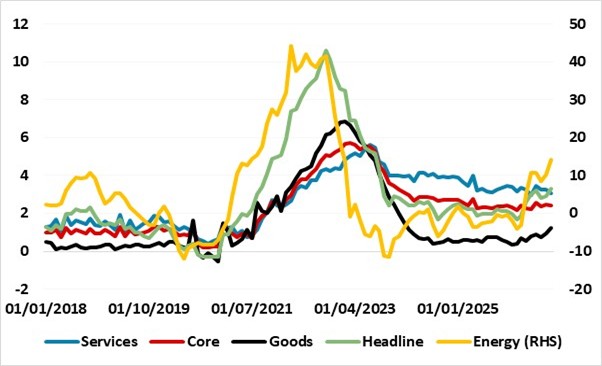
The energy shock has led to an upgrade of our inflation forecasts and we now see annual headline inflation averaging this year at 2.9% (previously 2.5%) and in 2027 at 2.3% (1.8% before). Headline annual inflation has already picked up from its June low of 2.8% to reach a three year high of 3.3% in August with the increase driven almost entirely by energy, although goods inflation has also picked up somewhat. We expect inflation to continue to rise over the coming months as existing price pressures are passed on to consumers, reaching a peak above 3.5% in Q4 2026.
Figure 3: EZ Inflation by Main Category
Source: Datastream/CE
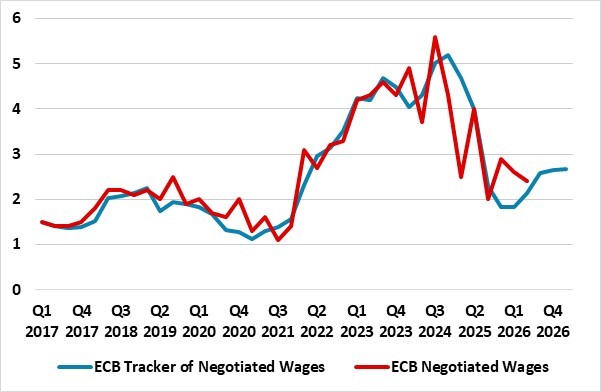
For the ECB the main concern is that this largely energy driven shock spreads to other categories within the CPI basket, or leads to rising inflation expectations and higher wage demands, or second round effects. The ECB’s index of Negotiated Wages is not showing any impact from the energy shock while the Bank’s forward looking Wage Tracker (Figure 4) has recently picked up but remains contained and lower than in 2025.
Figure 4: ECB Negotiated Wages and the ECB Tracker of Negotiated Wages
Source: Datastream/CE
Nevertheless, the ECB is keen not to repeat the mistakes of the previous inflation surge in 2021-22 when the Bank was criticised for its slow reaction. That episode also started with higher energy prices, but the causes for the inflationary surge were different. Back then a combination of pandemic-related supply shortages, along with strong post lockdown demand, as well as super higher gas costs and fiscal support pushed up inflation rapidly. By contrast, the current rise in inflation has so far been driven almost entirely by higher energy costs. Recent comments by two ECB members have highlighted the surge in natural gas prices noting that costs could climb higher if supply is disrupted again or if an unusually cold winter meets already low inventories.
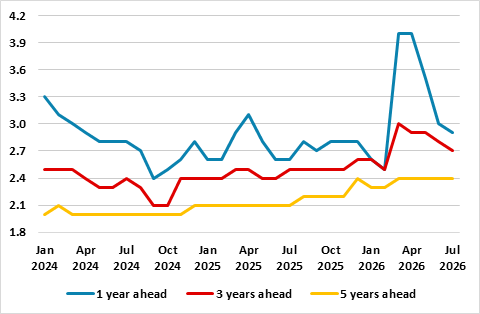
There is also little evidence that higher energy costs are translating to higher inflation expectations at this stage. One-year expectations have picked up since the start of the war but these shorter horizon rates tend to be highly sensitive to sudden surges in oil and food prices because households and businesses associate daily fuel and grocery costs with future inflation. Longer term expectations are more important because if these de-anchor central banks risk losing their grip on inflation dynamics eventually forcing harsher rate hikes to regain control. Longer term expectations have remained anchored since the start of the conflict. But if high energy prices persist for an extended period of time that could increase the risk that second round effects take hold. Therefore, part of the ECB response so far has been to reinforce its institutional credibility.
Figure 5: Long Term Inflation Expectations Remain Contained
Source: ECB/CE
Policy rates: ECB Almost Done
We now expect the ECB to increase policy rates one more time to end this year at 2.75% and to remain on hold for most of next year before cutting to 2.5% towards the end of the year. Lifting rates to 2.75% in Q4 2026 would take the ECB above the upper band of its estimated neutral rate of 1.75%-2.5% and hence into restrictive territory.
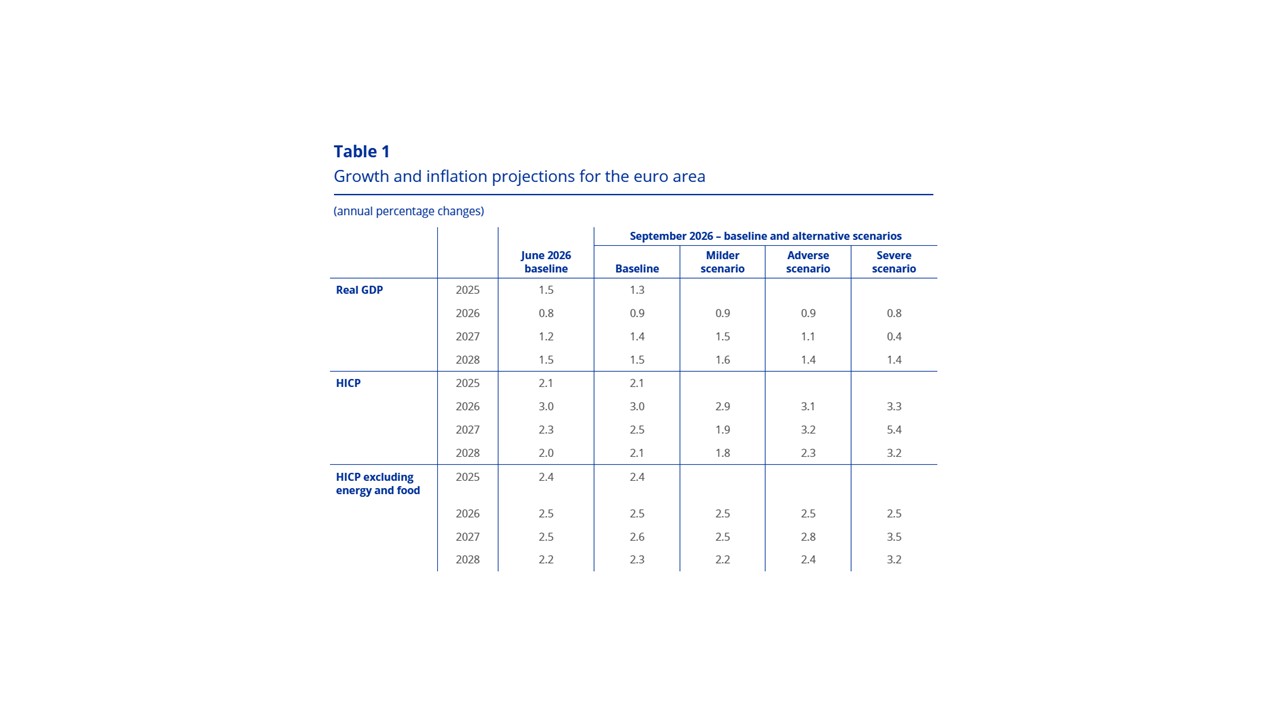
When the ECB prepared its September projections for growth and inflation (summarised below) it did so based on a number of assumptions. In particular, the ECB's staff projections are conditioned on a 3-month Euribor rate of 3.0% in 2027 and 2028, which would imply two more hikes from the current 2.5%, but even factoring in this the Bank still forecasts core inflation to be 2.3% in Q4 2028, above the Bank’s target. The average oil price assumption used in the ECB’s September forecasts for this year is USD 89.5 per barrel (pb) and that’s been broadly in line with actual pricing so far (to September). For 2027 and 2028, the ECB expects oil prices to evolve in line with futures prices and to show a decline to USD 78pb and USD 74pb.
Figure 6: ECB September Projections – Baseline Scenario
Source: ECB/CE
Back at the start of the conflict, and with an eye to past oil shocks, ECB President Lagarde said that how the ECB would respond would depend on two factors; the duration of the oil supply disruption and the extent of the pass-through of energy prices to broader inflation.
Our new baseline scenario (here) sees a high chance (of 60%) that a new ceasefire deal can be reached in Q4 2026 or Q1 2027 which would allow more shipping to pass through the Strait of Hormuz. If that proves to be the case then inflation would actually prove to be “transitory” and short lived and hence would not require the ECB to go all the way to 3%.
UK: BOE Alert to Second Round Effects
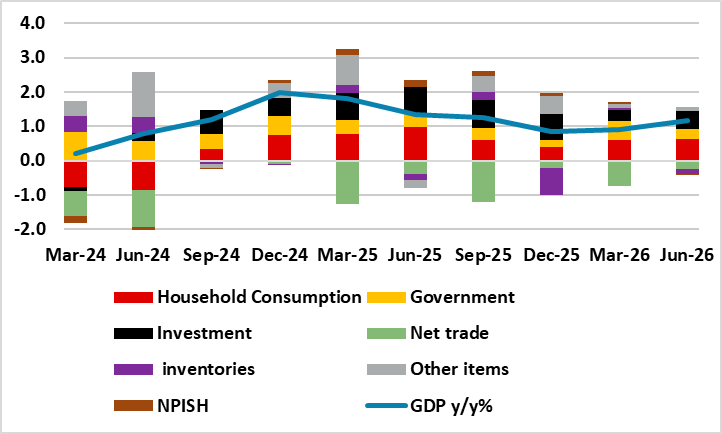
The UK economy recorded decent growth in the first half of this year but prospects for the remainder of the year are looking less bright given a number of troubling headwinds. Ongoing global tensions in the Middle East, rising inflation, and constrained public finances will affect households and business in coming months. Signs of a slower economy are evident in the labour market with employment falling (according to HMRC data), unemployment rising, and businesses cautious about adding new staff. All this is leading to a slowdown in private sector wage growth and a squeeze in real incomes.
Consumption has held up well until now and while July's monthly GDP was a positive surprise and driven by AI, the figures masked a contraction in consumer-facing services like retail, as households seemingly began pulling back on non-essential goods. High interest rates of 3.75% and frozen tax thresholds implemented in recent budgets continue to act as a slow burn on disposable incomes, leading a majority of consumers to remain highly cautious about big-ticket purchases. Headline inflation has trended higher since its recent low of 2.6% in June to 3.1% in August and further increases are expected as energy costs feed through.
A further potential hit to household pockets (and inflation figures) will be the increase in January’s energy caps (the limit set by regulator Ofgem on what suppliers can charge). Ofgem will officially announce the specific price cap rates for the January–March 2027 period in late November 2026, following the close of the assessment period on 18 November 2026. The hike, if it goes ahead, would see a typical household’s annual energy bill leap by roughly 25% and likely push headline inflation above 3.5%.
Figure 7: GDP and Contributions from Main Components (Y/Y% and percentage points)
Source: Datastream/CE
Inflation has been largely an energy story so far with little sign of pressures building elsewhere. Services inflation, which is closely watched by rate-setters as a gauge of domestic price pressures, has remained steady; wages are the largest operating cost for service businesses, making rising pay the main driver of service sector inflation. Food inflation has also been benign but that could change over time as the increase in fuel and fertilizer prices push up food costs with a lag of several months. The labour market remains fragile, the unemployment rate is rising and wage growth remains under control. Inflation expectations also remain anchored.
The BOE remains alert to the possibility that the ongoing energy driven increase in inflation does not lead to a wage-price spiral. The Bank is still visibly reluctant to hike rates, partly because there’s no sign of second-round effects, and partly because rates are more restrictive than in other economies – particularly with the degree of tightening priced into financial markets.
But at the September policy meeting, the BOE made it abundantly clear that it’s getting harder not to act. It said that at current energy prices, inflation is likely to narrowly top 4% early next year, albeit briefly. But if that forecast is maintained at the November meeting - because energy prices have failed to come down - then it is more likely that the Bank will lift rates. Just as the Bank notes, if the US-Iran conflict persists for an extended period, and the risk of second-round effects increases, it is likely that policy may have to be tightened. We have maintained our call for rates to remain at 3.75% this year but this view is predicated on oil and gas prices moving lower through Q4 2026. We expect the November decision to a be close call. Our current forecast is then for the Bank to remain at 3.75% until mid-2027 with a cut to 3.5% only in Q3 of next year.
Japan
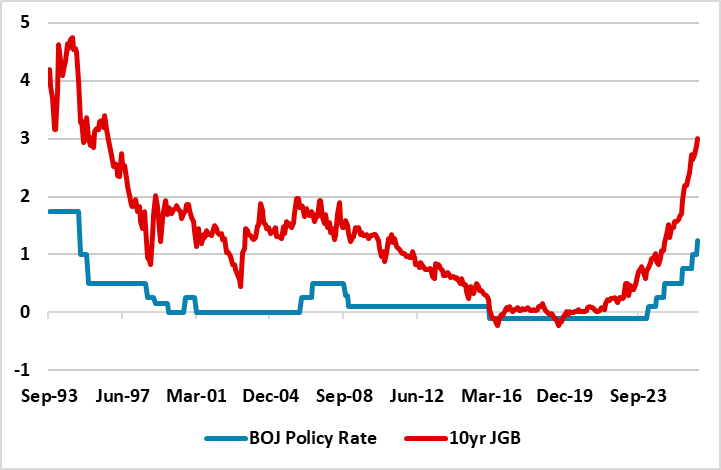
BOJ voted 7-2 for a 25bps hike to 1.25%, but neither the statement or Ueda press conference suggest a pick-up in the tightening pace. The economy and inflation remain more important than the JPY in BOJ decisions. Though Ueda did sound a little more concerned about underlying inflation overshooting the 2% target, no precommitment were made in terms of future policy rises. Going forward the BOJ did not provide clear forward guidance, but this is standard in the immediate aftermath of a rate hike. In the absence of clear guidance, the market views the prospects for further rate hikes as highly likely given the broader energy shock hitting Japan from the Iran/U.S. war. A further 25bps hike to 1.50% is discounted at the January 2027 BOJ meeting, then 25bps hikes in June and October 2027 to 2.00% according to the money markets.
Figure 8: BOJ Policy Rate and 10yr JGB yields (%)
Source: Datastream and Continuum Economics
However, back months OIS are getting distorted by the rise in long end yields rippling back to the short end and so OIS likely overestimate policy rate expectations. Additionally, the BOJ will also become more careful, as the policy rate reaches the middle of the estimated neutral rate band. BOJ researchers have previously estimated a range of 1.0-2.5% with a middle of 1.75%, which appears reasonable. A recent BOJ paper has an average estimated real neutral policy rate of -0.19% (here), which with a 2% inflation target is also consistent with a nominal neutral policy rate around 1.75%.
The GDP picture is also mixed. Net exports are holding up well, which is likely partially due to the super weak JPY. However, it also reflects the global AI boom spill over to benefit Japanese semiconductor manufactures. The consumption picture in contrasts has been softer, with the Q2 GDP data reflecting the initial impact of higher energy prices. Though government support for households will help, H2 CPI Yr/Yr inflation will likely push still higher and this will be a drag on real wages and also consumption into 2027. The government are also restrained by higher JGB yields in terms of the ability to deliver new fiscal stimulus in 2026. Therefore the mixed GDP forecast of 0.8% for 2026 and 1.0% for 2027.
In terms of CPI inflation, businesses have not fully passed on cost increases and further upward pressures is likely in H2 2026 and we see Yr/Yr CPI inflation pushing up to 2.6-2.8% by early 2027. PPI at 7.6% is not far from the 2022 peak at 10.6%. However, our baseline for the straits of Hormuz remains for a 2nd ceasefire deal to bring energy prices back down in 2027. For 2027, this means a lower quarterly profile of Yr/Yr inflation after the Q1 peak and will help soothe BOJ concerns. It is also not clear that companies will pass through higher CPI inflation into wage inflation in the 2027 wage round, given the squeeze of profitability from the energy crisis. Additionally, we still see scope for the Japanese Yen to appreciate from very low levels in the next 3-12 months.
All of this suggests to us that the BOJ is unlikely to pick up to a quick tightening pace suggested in the money market. We remain of the view that the next 25bps hike will likely arrive April 2027 to 1.50%. A further 25bps hike to 1.75% is possible in autumn 2027, but is not our baseline view due to the steepening yield curve caused by aggressive BOJ QT. Surging JGB yields and corporate/household loans are a 2nd extra monetary tightening. Normally a tightening cycle see less of a rise in 10yr JGB yields than has been seen (Figure 1), but BOJ QT remains at 6% of GDP. This is huge supply for the market to absorb and put further upward pressure on JGB yields. The BOJ has not yet reached the point that it will do a U turn on QT. By H2 2027 though this will be enough to delay a hike to 1.75% until 2028.