Strait of Hormuz Scenarios
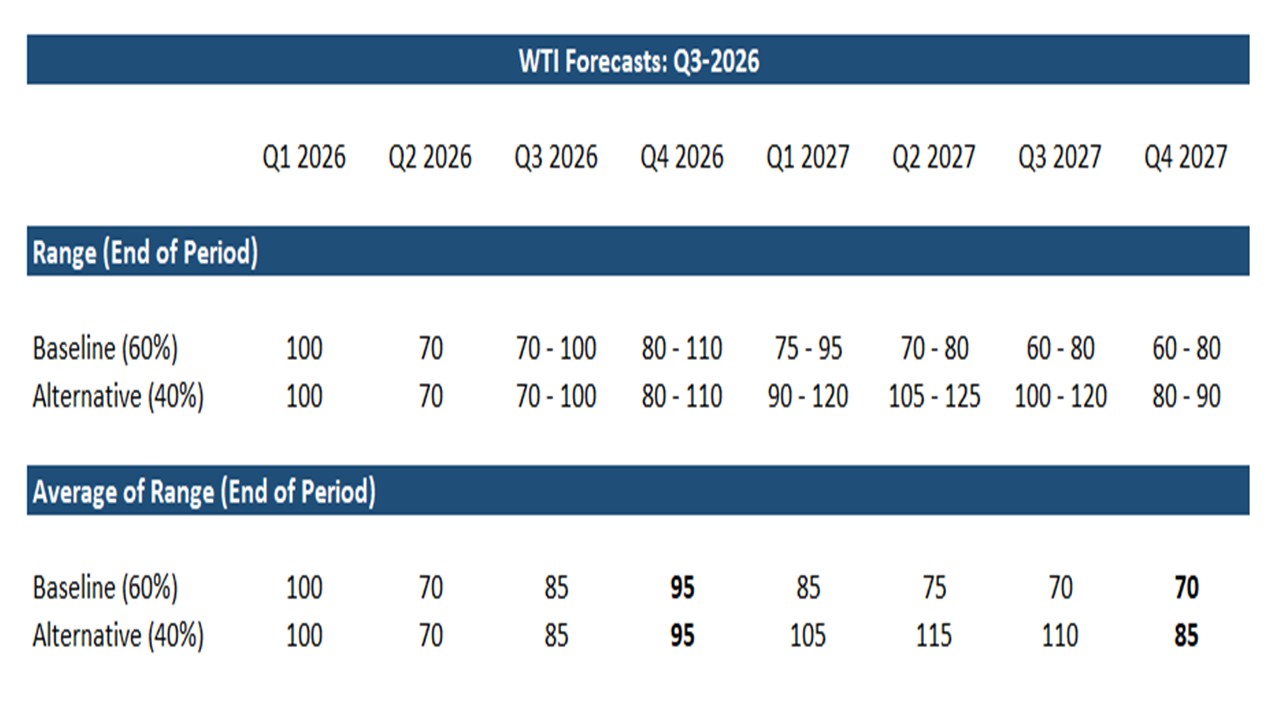
Our new baseline (60%) is for a new ceasefire deal into Q4 2026 or Q1 2027 that allows more shipping to pass through the Strait of Hormuz. We feel that economic pressure on Iran remains intense and that Iran will want to lift the U.S. blockade on its energy shipments and export revenue. The Trump administration has more acute political pressure, as the prolonged high level of gasoline and diesel prices is further hurting the Republicans before the mid-term election. The alternative scenario (40%) is that some of Iran hardliners objectives (having a frozen war to stop another full scale attack and try to build a nuclear weapon) could mean that they are unwilling to reach a further ceasefire deal until well into 2027 or at all. Figure 1 outlines are revised WTI oil price forecasts.
With the Islamabad Memorandum lapsed since August 16th, what are the scenarios for the Strait of Hormuz?
Figure 1: WTI Oil Price Projections (USD)
Source: Continuum Economics
June MOU between Iran and the U.S. has expired, as Iran attacked ships in the Strait of Hormuz triggering targeted military strikes in July and occasionally thereafter. Hardliner opposition in Iran was one driver, but the MOU was already fragile on proposed tolls and Lebanon, but what happens in the coming months?
Analysis of Iran hardliners objectives show a mixture of reasons. Firstly, a desire to keep the U.S. in a low level conflict, which will stop a further full scale attack by Israel or the U.S. This objective could stretch into Q4 2026 and 2027, with Iran hoping for a lame duck Trump administration and fracturing of opinion in Israel. Secondly, a view that Iran needs to get a nuclear weapon to provide a great deterrent against future attacks. Such an objective would stretch throughout 2027 and mean intermittent military strikes throughout the year. It is worth remembering that the Iran/Iraq stretched for many years, after the initial intense fighting in 1980-81. Finally, hardliners believe that their negotiating hand has been strengthened by the intermittent strikes to get a better ceasefire deal, including the U.S. giving Iran the ability to charge tankers in the future.
This makes for a smaller landing zone for a deal, but our new baseline (60%) is for a new ceasefire deal that allows more shipping to pass through the Strait of Hormuz. We feel that economic pressure on Iran remains intense and that Iran will want to lift the U.S. blockade on its energy shipments and export revenue. The Trump administration has more acute political pressure, as the prolonged high level of gasoline and diesel prices is further hurting the Republicans in the opinion polls before the mid-term elections. It remains highly likely that the Republicans will lose the House, but could now risk losing the Senate given the scale of unpopularity of the Trump administration. However, President Trump ego may mean that he becomes more conflicted and unable to agree a deal, the closer that the November 3 mid-term election date approaches. If the deal risks being seen as a climbdown, this could stall Trump’s willingness to agree a deal.
In this new baseline, a ceasefire deal could come after the U.S. mid-term election but before end Q1 2027. It would likely be a partial rather than full reopening of shipping traffic. This could extend the period of low shipping flows through the Strait of Hormuz. Iran may also have the ability to impose a fee on ships later in the year, but shipowners would likely pay this and it would add marginally to the cost of oil. Finally, a number of countries have stopped production and restarts could take months rather than days. So far demand destruction, plus a rundown of inventories, have helped to cap the increase in oil prices, but now lower inventory levels could mean this is more difficult going forward. Our new baseline oil trajectory is in Figure 1 take all of these factors into account.
Alternative scenario (40%). Some of Iran hardliners objectives could mean that they are unwilling to reach a further ceasefire deal until well into 2027 or at all. Iran knows that the Trump administration is very reluctant to restart a full scale war with Iran and that intermittent ceasefire talks are enough to see the Trump administration restraining Israel. Iran would suffer economically, but driven by the multi-year objective to have a frozen war to stop another full scale attack and try to build a nuclear weapon. This alternative scenario also has risks. For example, a frustrated Trump could order a partial strike on Kharg island or Israel attack nuclear facilities again. In Figure 1, we outline the alternative scenario oil path for WTI.