2025 Q4 Country Insights Scores to Download in Excel
The Country Insights Model is a comprehensive quantitative tool for assessing country and sovereign risk by measuring a country’s risk of external and domestic financial shocks and its ability to grow. The access to our full range of scores across 174 countries corresponding to the fourth quarter of 2025 is now available.
The scores file allows for comparison with other periods and ranking for all countries across the headline indicators and are available as easily accessible time series.
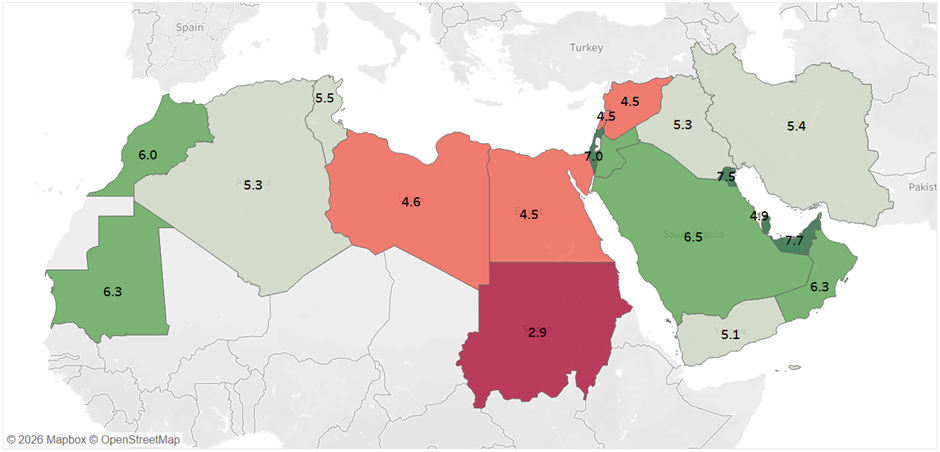
The Country Insights model generates three composite indexes: Investment Attractiveness (IAI), Sovereign Risk (SRI), and the Country Strength (CSI). The CSI is based on four underlying pillars, namely external adjustment capacity, institutional strength, medium-term growth prospects, and social inclusion. Together, these dimensions capture a country’s macroeconomic fundamentals, growth trajectory, and socio-political resilience. Figure 1 illustrates the SRI ranking for selected MENA economies, where a rank of 10 represents the strongest performance and 0 the weakest.
Figure 1: Sovereign Risk Index for Selected MENA Economies
Source: Continuum Economics
The SRI reveals a clear stratification across MENA economies, with a small group of high-resilience countries at the top, a broad middle tier of moderately exposed sovereigns, and a tail of structurally fragile states. The strongest performers are the Gulf heavyweights i.e., United Arab Emirates, Kuwait, and Qatar, alongside Israel, all of which post SRI scores around or above 7, indicating low overall distress risk relative to regional peers. A second cluster, including Saudi Arabia and Oman, remains comfortably above the regional median but exhibits slightly weaker aggregate resilience. The middle of the distribution is populated by economies such as Morocco, Jordan, Tunisia, Algeria, and Iraq, whose scores suggest moderate vulnerability and more limited policy buffers. At the lower end, countries including Egypt, Lebanon, Libya, Syria, Yemen, and especially Sudan stand out for materially lower SRI readings, indicating elevated likelihood of financial distress. Overall, the index highlights pronounced intra-regional divergence: while parts of the Gulf exhibit sovereign profiles comparable to advanced economies, several North African and conflict-affected states remain positioned at the high-risk end of the spectrum, underscoring the structural heterogeneity of sovereign resilience across MENA.
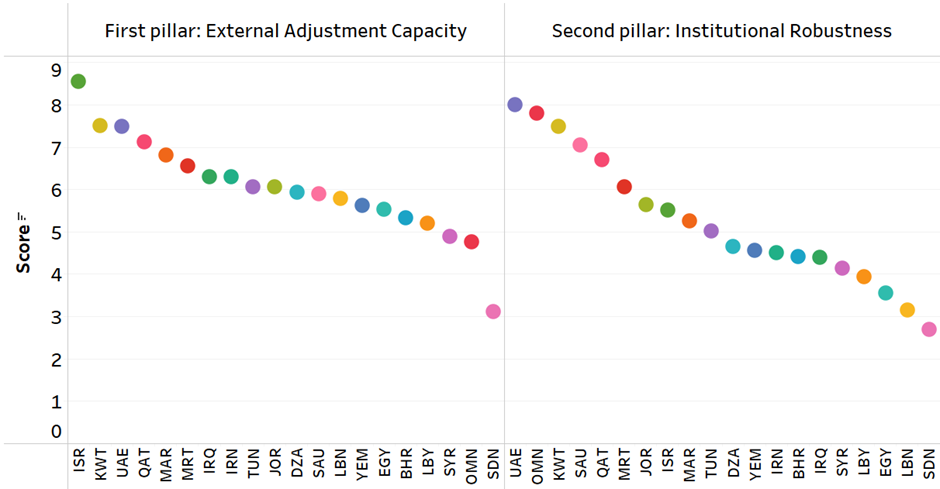
Figure 2: SRI Pillar Scores for Selected MENA Economies
Source: Continuum Economics
A decomposition of the SRI into its two constituent pillars highlights a clear structural contrast across the region (Figure 2). In the Gulf, particularly in United Arab Emirates, Qatar and Kuwait, strength in the first pillar is overwhelmingly driven by exceptional reserve buffers and sustained current account surpluses, which anchor external adjustment capacity despite more moderate scores in trade diversification or macro-financial flexibility. In these oil-exporting economies, liquidity depth and sovereign balance sheet strength act as the dominant stabilizing forces. By contrast, several middle-income importers such as Morocco and Jordan exhibit more balanced but less spectacular external profiles, where reserve adequacy and external debt metrics are solid but not transformative. On the institutional side, divergence is even more pronounced. Countries at the top of the regional distribution benefit from comparatively strong fiscal policy frameworks, credible monetary settings, and contained domestic political risk, whereas lower-ranked sovereigns, including Egypt and Lebanon, are held back by weak monetary credibility, institutional fragility, and elevated political risk. In the most fragile states, such as Sudan and Yemen, both pillars are undermined simultaneously, reflecting limited external buffers alongside deeply constrained institutional capacity. Taken together, the pillar analysis underscores that while oil wealth strongly supports external resilience in parts of the region, institutional quality ultimately determines whether that liquidity translates into durable sovereign strength.