Big EM Currencies: No U.S. Yield Pressure
· Our view remains that major EM currencies outlooks are being driven by relative domestic fundamentals versus the U.S. No major tensions are being seen from rising U.S. Treasury yields and Fed tightening fears. H2 2026 will likely see the choppy EM FX conditions continue against the USD.
· If Lula wins the Brazil presidential election then questions over multi-year fiscal consolidation will grow, but interest rate differentials will remain wide and we see USDBRL at 4.95 end 2026 with a Lula victory. Elsewhere, our forecast remains for USDCNY to 6.65 by end 2026, as China authorities allow some nominal exchange rate appreciation versus the USD (here).
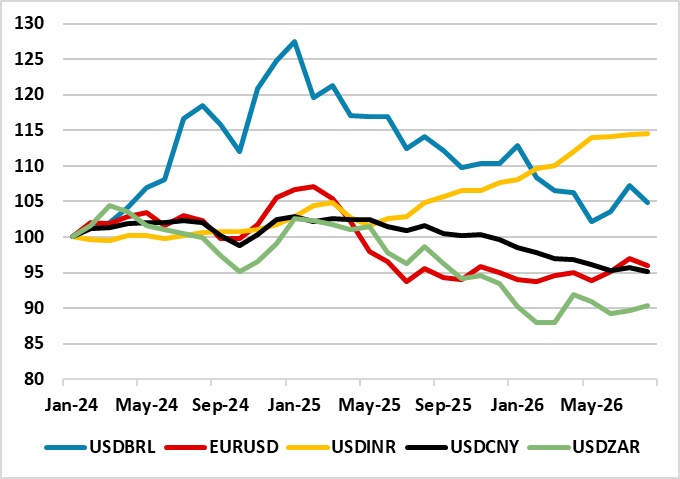
Figure 1: Exchange Performance versus the USD (Index Jan 2024 =100)
Source: Datastream/Continuum Economics
Rising U.S. Treasury yields on Fed tightening fears have helped to keep the USD firm against DM currencies, but what about major EM currencies? Most major EM currencies have also seen some choppiness against the USD since the start of the Iran war (Figure 1), but we would not be overtly concerned by these movements. The wider context is that most major EM currencies have appreciated against the USD over the past 2 years, except for the India Rupee (INR). The South Africa Rand (ZAR) has shown a major rerating due to rating agencies approval of fiscal consolidation, while high interest rates have driven the Brazilian Real (BRL) higher. INR depreciation has attracted a lot of publicity in India, but in reality the pace is slow and reflects the higher inflation trajectory than the U.S.
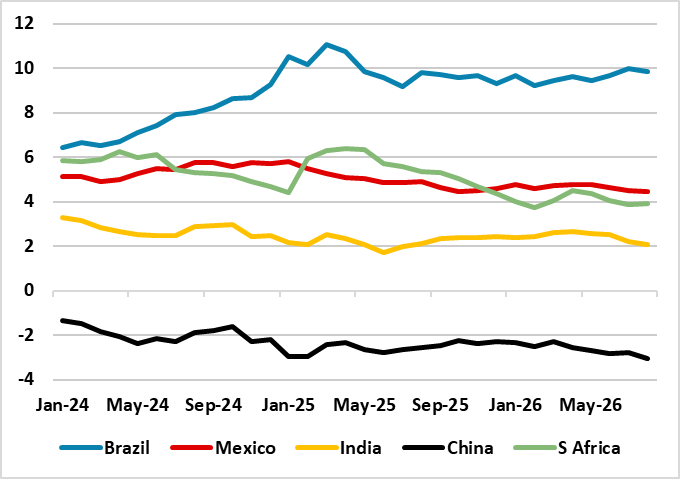
Figure 2: 10yr Government Bond Yield Spread v U.S. Treasuries (%)
Source: Datastream/Continuum Economics
10yr government bond spreads also reinforce the view that rising U.S. yields are not causing tension for major EM’s (Figure 2). Spreads have not shown a major widening in 2026 and in some cases spreads have seen big EM’s outperform 10yr U.S. Treasuries (e.g. China and the U.S.). Key external metrics are also not showing pressure (Figure 3). Brazil current account (C/A) deficit is large but not acute and the BRL is being sustained by wide interest rate differentials. Other countries C/A are much better than 2013 and the EM Fed Taper tantrum – we will do a separate piece on China large C/A surplus in the coming days. Net international investment positions are reasonable aside from Brazil and in S Africa/China case is healthy. Exchange rate undervaluation exists for China and overvaluation for Brazil using the IMF external sector review estimates for 2025 real effective exchange rate gaps, with the rest around fair value.
Figure 3: Key External Metrics – Select EM
| Current account/GDP | Net International Investment Position (% of GDP) | IMF Staff REER Gap (%) | |
| Brazil | -2.9 | -49 | 11 |
| China | 3.8 | 21 | -21 |
| India | -0.9 | -7 | -8 |
| Indonesia | -0.1 | -19 | -1 |
| Mexico | -0.4 | -35 | 0 |
| S Africa | -0.5 | 28 | 1 |
Source: IMF External Sector Review July 2026
All of this underlines our view that major EM currencies outlooks are being driven by relative domestic fundamentals versus the U.S. H2 2026 will likely see the choppy EM FX conditions continue against the USD, with our baseline view remaining that the Fed will not tighten (here) and that Trump wants lower oil prices and hence a new ceasefire (here) and that the USD will thus be choppy. Our forecast remains for USDCNY to 6.65 by end 2026, as China authorities allow some nominal exchange rate appreciation versus the USD (here).
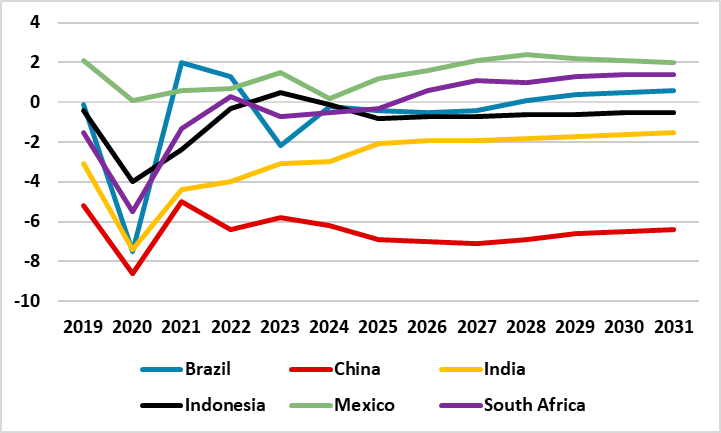
For other big EM’s it is a question of domestic monetary policy, cyclical economics, but also fiscal policy. As we highlighted in the recent EM sinner and saints article (here), the clearest EM fiscal sinner is Brazil, given its tax revenue/GDP ratio is already very high and requires politically sensitive expenditure cuts after the October presidential election to increase the primary surplus (Figure 4) to stabilize the government debt/GDP trajectory and get real bond yields down. S Africa also needs to maintain fiscal consolidation to avoid backsliding and end up in the fiscal sinner camp again, with high real yields. In terms of EM fiscal saints, no clear winner exists among the big countries. Mexico government debt/GDP is moderate compared to EM and DM debt sinners, but long-term political interference issues are curtailing the scale of furthering yield spread narrowing versus the U.S.
Figure 4: Primary Fiscal Balance to GDP (%)
Source: IMF Fiscal Monitor April 26/Continuum Economics
The Brazilian central bank now looks like it will pause in Q4, which leaves the focus on the election outcome. Lula has gained further ground and is 8-12% ahead in 1st round polls, as Flavio Bolsonaro’s numbers took a hit in June with the release of audios which show him asking Brazilian banker Daniel Vorcaro, who is accused of fraud, for USD12 million to produce a movie about his father. If Lula wins then questions over multi-year fiscal consolidation will grow, but interest rate differentials will remain wide and we see USDBRL at 4.95 end 2026 with a Lula victory and 4.75 end 2027. However, at these levels the BRL will be overvalued multi-year and prone to major profit-taking on any moderate or major bad news.
Meanwhile, though we are comfortable with the Mexican political situation, USMCA negotiations will likely prompt a further wave of MXN correction into the autumn and we forecast 17.65 on USDMXN by year-end – especially as short-term interest rate differentials are now narrow. The August 5 RBI meeting left the impression that the RBI is reluctant to hike from 5.25%. Combined with EM equity flows still being diverted to AI plays in Taiwan/S Korea and China, we see further slow INR decline in H2 2026 and still forecast 97.60 on USD/INR by end 2026.