U.S. Equity-Treasury Strains and Correction Risk
· Equity investors have taken note of higher U.S. Treasury yields, but the influence of the AI boom and corporate earnings is greater. Nevertheless, the U.S. equity market valuation means that it is stretched currently versus the U.S. Treasury market and could be hurt by moderate bad news. Examples of moderate bad news would be Open AI IPO getting delayed from the autumn into 2027; moderate bad news from the one of the hyperscalers, which causes an amplified correction due to shrinking free cash flows in the sector or thirdly slowing consumption growth outside the top 20% of U.S. households producing a lop sided U.S. economy that see non tech sector corporate earnings hurt.
The U.S. Equity market has not cracked in the face of rising U.S. Treasury yields? What happen next?
Figure 1: 12mth Fwd S&P500 P/E Ratio and 10yr Real U.S. Treasury Yield Inverted (Ratio and %)
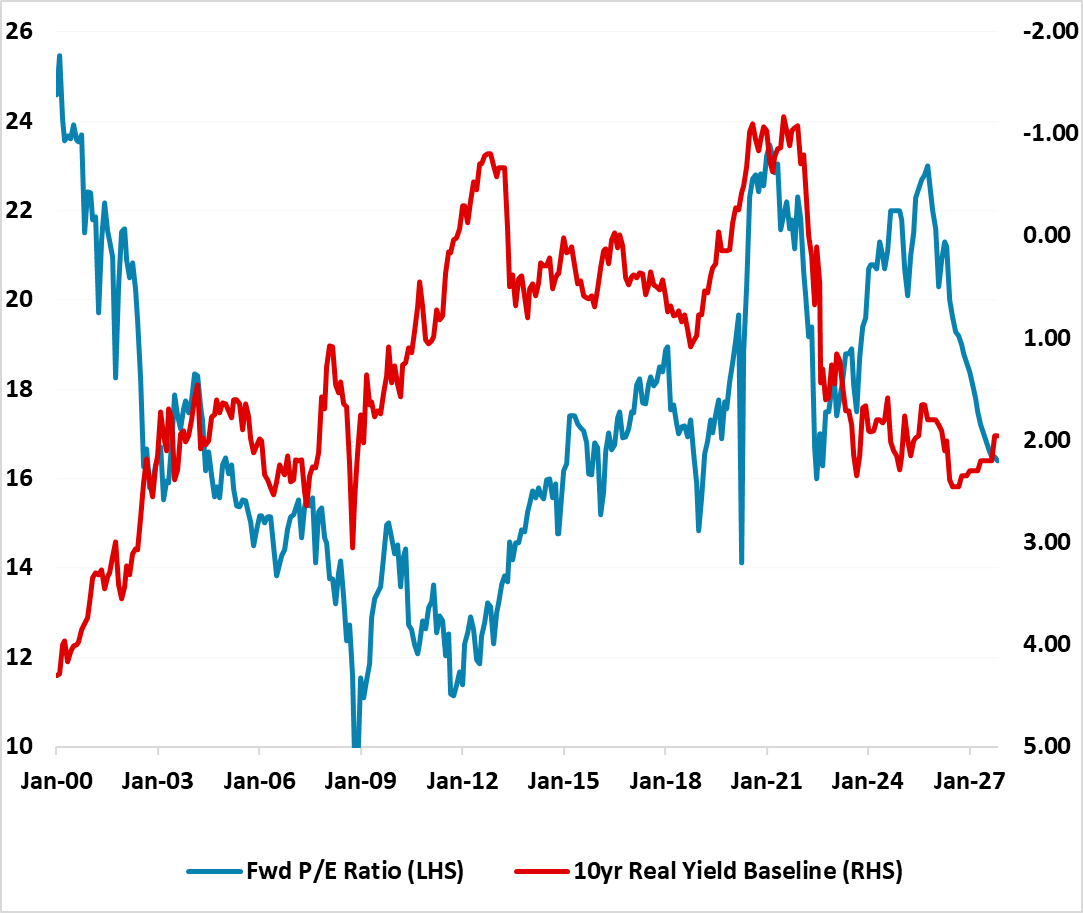
Source: Continuum Economics with forecasts to end 2027 for 10yr real bond yields and fwd P/E ratio.
The U.S. Equity market is treading water in the face of higher 10-30yr U.S. Treasury yields and rising fears that the Fed could tighten in September or October by 25bps – though 25bps is only fully discounted in December and a further 25bps in April 2027. A couple of points are worth making.
· AI Boom and corporate earnings resilience. Equity investors have taken note of higher U.S. Treasury yields, but the influence of the AI boom and corporate earnings is greater. Anthropic is expected to IPO in October, with reports suggesting it’s run rate revenue is up 650% YTD. In turn this fuels the boom in data centre building/cloud computing; semiconductors and the whole AI change. AI is the epicentre of the corporate earnings growth with the S&P500 expected to see a 33% rise in earnings for 2026 and 16% in 2027. Non tech earnings are not growing as explosively, but crucially macro indicators suggest no dramatic slowdown for moderate growth outside of the booming tech sector. The fwd P/E ratio has actually come down over the summer, as 2026 corporate earnings have exceeded the rise in the market (Figure 1). This then means the bullish story can be extended. Expectations for 2028 are also for double digit growth. This means that the current high 12mth fwd P/E ratio comes down in 2027 and gets closer to inverted 10yr real U.S. Treasury yields (Figure 1).
· Fed small tightening. The other issue is that Fed tightening expectations are small to modest. 50bps in the money market, with some economists (including CE here) arguing for 25bps only. Fed Chair Walsh at Jackson Hole appeared to signal a hike, but this is not the beginning of a cycle with the Fed Funds rate already above neutral and fiscal policy likely to be deadlocked after the mid-term elections. Some in the equity market also feel a move will not arrive September, which prompts talk that the Fed is only sending a signal on policy and not being aggressive. Expectations also remain rife that Trump will reach another ceasefire agreement with Iran and lower energy prices (our baseline see here). Finally, 10yr breakeven inflation have hardly moved meaning the rise in nominal yields is real yield driven and thus less likely to trigger persistent Fed tightening.
· Correction risks. Nevertheless, the U.S. equity market valuation means that it is stretched currently versus the U.S. Treasury market. The U.S. equity market has shown an ability to ignore minor to modest bad news, but a 5-10% correction could still be triggered in the next few months by moderate bad news. Examples of moderate bad news would be Open AI getting delayed from the autumn into 2027. Open AI revenue growth has been less explosive than Anthropic and any delay in the IPO would cause concern about the assumptions underlying data center/cloud computing and semiconductor orders. A 2nd risk factor to corporate earnings is that further declining free cash flows of the tech sector causes the risk of more volatility from any earnings missing from hyperscalers and the AI chain. The 3rd risk is macroeconomic in the shape of slowing consumption growth outside the top 20% of U.S. households. Median income to low income households are struggling with cost of living pressures and this risks a further slowdown in consumption. This does not mean a recession, but could produce a lop sided U.S. economy that see non tech sector corporate earnings hurt.