Taiwan: China Coastguard Quarantine Risks Grow
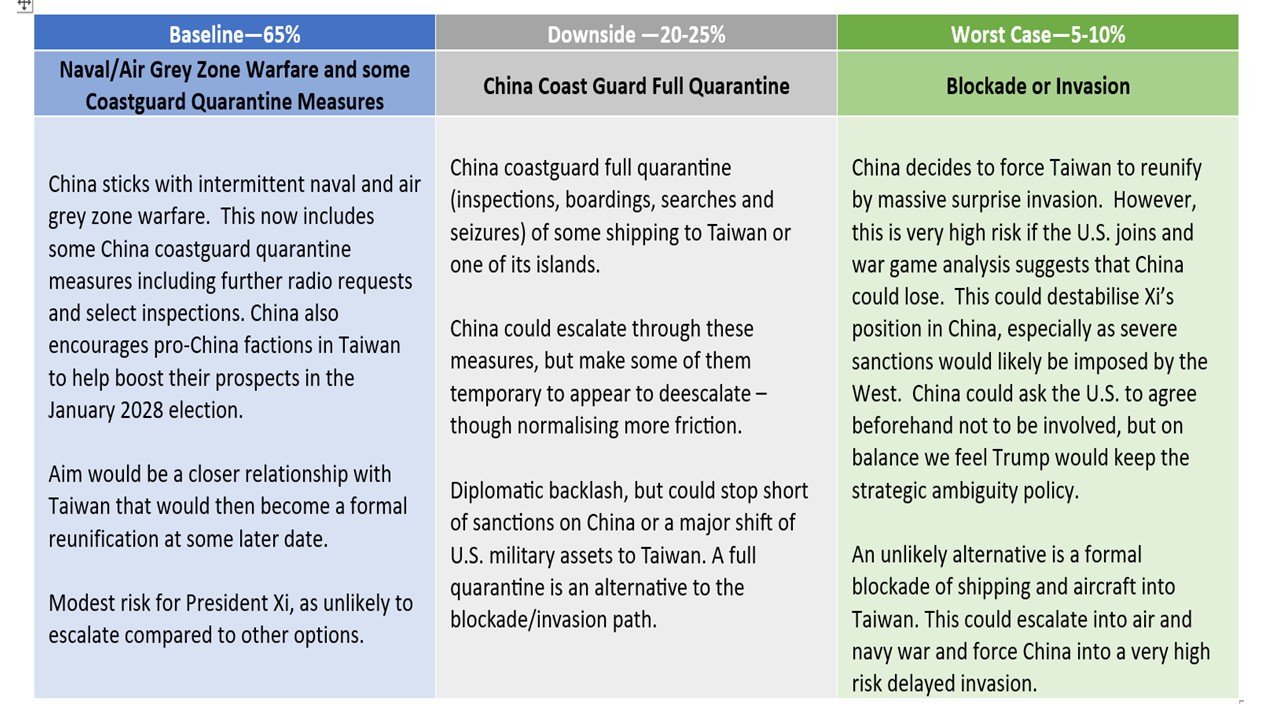
· Given China’s coastguard recent actions, we now raise the probability of a full quarantine of Taiwan shipping to 20% versus 10-15% in 2027/28 (Figure 2), with the probability of some further measures beyond radio requests now above 50% in 2027/28 and in our baseline. Quarantine measures could be against Taiwan as a whole or one of its islands. Financial markets would put some risk premia on Taiwan and other regional assets fearing that further partial quarantine measures could be followed by a full quarantine and then a blockade and invasion.
· Full quarantine would trigger a diplomatic backlash, but could stop short of sanctions on China or a major shift of U.S. military assets to Taiwan. A full quarantine is an alternative to the blockade/invasion path, (rather than a step towards invasion). An invasion remains 5-10% probability, given the high risks.
China’s coastguard has stepped up activity east of Taiwan and also been asking certain vessels by radio about their destination port. What next?
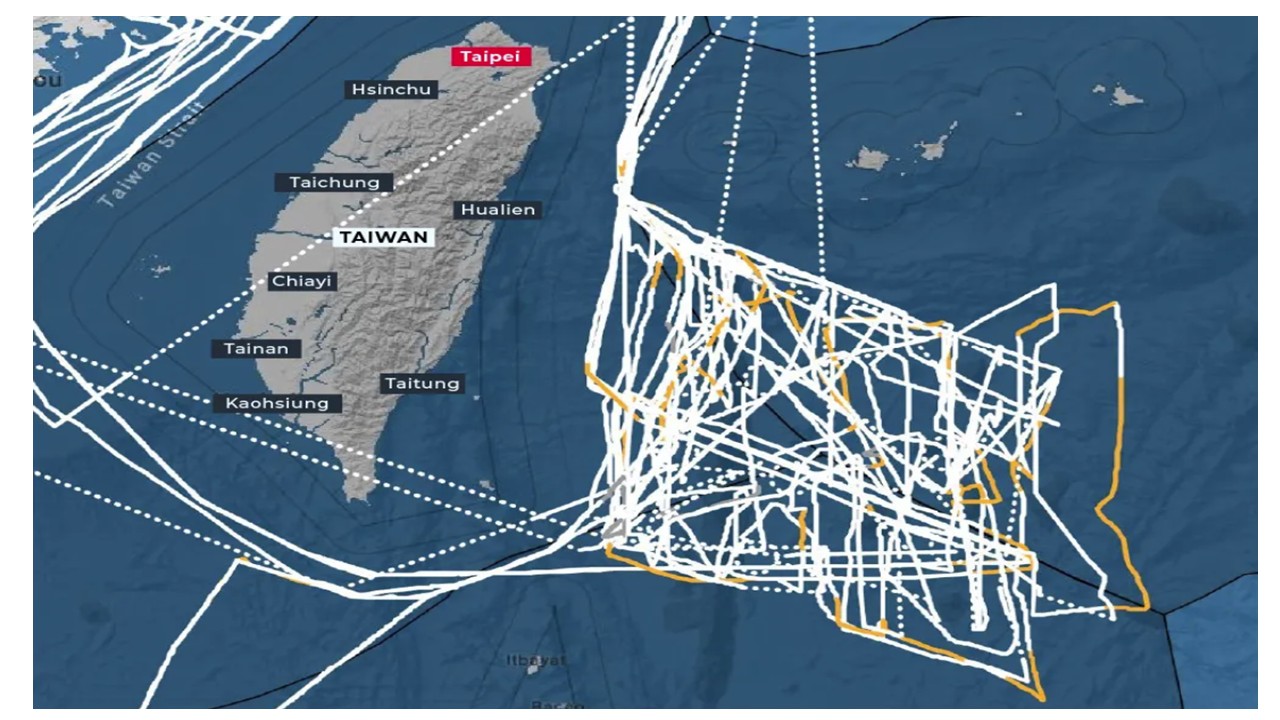
Figure 1: China’s Coastguard Activity East of Taiwan (June 1-July 20)
Source: Al Jazeera (here)
China is turning up the temperature around Taiwan with reports that Chinese coastguard vessels have been asking certain shipping vessels by radio about their destination port in Taiwan. Alongside this, there has been more intense coastguard shipping movements east of Taiwan (but below Japan’s Okinawa chain Figure 1). What will happen next?
In some ways, this could be regarded as a step-up in the grey warfare by China on Taiwan, as China’s navy and air force exercises have consistently played out war games against Taiwan. This grey warfare is designed to pressure Taiwan, but fall short of triggering direct military action from Taiwan. It could also be China testing the water, with the U.S. distracted by Iran and the Straits of Hormuz and also a show of force to Japan after tensions over Japan’s self-defense policy. One option is that further light radio requests could be intermittent for certain vessels in the coming months. China views the coast guard as a civilian force rather than a military force, and thus more able to interfere without a backlash. However, it could see a further escalation in the coming months, to more Chinese coastguard interference and include inspections, boardings, searches and seizures, progressively restricting Taiwan’s maritime trade. If all four extra measures occur this should be viewed as a full quarantine of Taiwan’s shipping, with some measures temporary and reversed if it prompts too much international backlash.
We had previously attached a 10-15% probability to a full quarantine of Taiwan occurring in 2027/28 and thought that the risk was really after the January 2028 election. However, given China’s actions, we now raise a full quarantine of Taiwan shipping to 20% (Figure 2), with the probability of some further measures beyond radio requests now above 50% in 2027/28. Quarantine measures could be observed in Taiwan as a whole or one of its islands (as occurred in the 1950s).
China could be taking the views that a lame duck Trump after the November mid-terms would not really respond – especially after the troubles of the Iran war in 2026. China’s grey warfare measures in the past have tended to be in small incremental steps, which would suggest the next step is inspections but not all the measures in a full quarantine (inspections, boardings, searches and seizures).
Figure 2: Taiwan Scenario 2027/28
Source: Continuum Economics
We feel that President Xi would try to avoid upsetting President Trump ahead of their meeting December 14-16 at the G20 summit at Trump National Doral Miami and a potential state visit to the U.S. on September 24. Even so, it is now possible that China’s coastguard could do inspections on some shipping around Taiwan later this year and highly likely in 2027, though stopping short of a full quarantine. What would be the reaction?
Diplomatic protests would likely occur, which China would deflect and ignore. Sanctions may not be triggered by only some quarantine measures in contrast to a full blockade of shipping movements by China’s navy in and out of Taiwan. Financial markets would put some risk premia on Taiwan and other regional assets fearing that further partial quarantine measures could be followed by a full quarantine and then blockade/invasion.
However, we are keeping the probability of blockade and invasion at 5-10% (Figure 2). Select quarantine measures are a substitute for a full blockade, which remains unlikely as it reduces the element of surprise before an invasion and allows the U.S. military to shift aircraft carrier groups closer to Taiwan. An invasion remains 5-10%. For President Xi, an invasion is too high risk, as war game analysis suggests that China could lose if the U.S. become militarily involved (here). Defeat would be seriously destabilizing for Xi and the Communist Party. It is also worth remembering that Xi wants China ready for the option of a regional war by 2027, but full military capability by 2035. The probability would be higher in 2027/28, if Xi was able to convince Trump to abandon the strategic ambiguity policy.
Our baseline (Figure 2) for 2027 and 2028 remains that China maintains their existing air and naval grey zone warfare, with some intermittent and light quarantine measures (e.g. radio requests and inspections of certain vessels). Light quarantine measures stop short of a full quarantine and increases pressures on Taiwan and are at a lower risk of a backlash. This stick would be accompanied by the carrot of warm relations with Taiwan opposition parties to encourage a change in Taiwan voters’ attitudes. January 2028 will be a pivotal date with parliamentary and presidential elections.