Taiwan: Low Invasion Risk Post Trump Visit
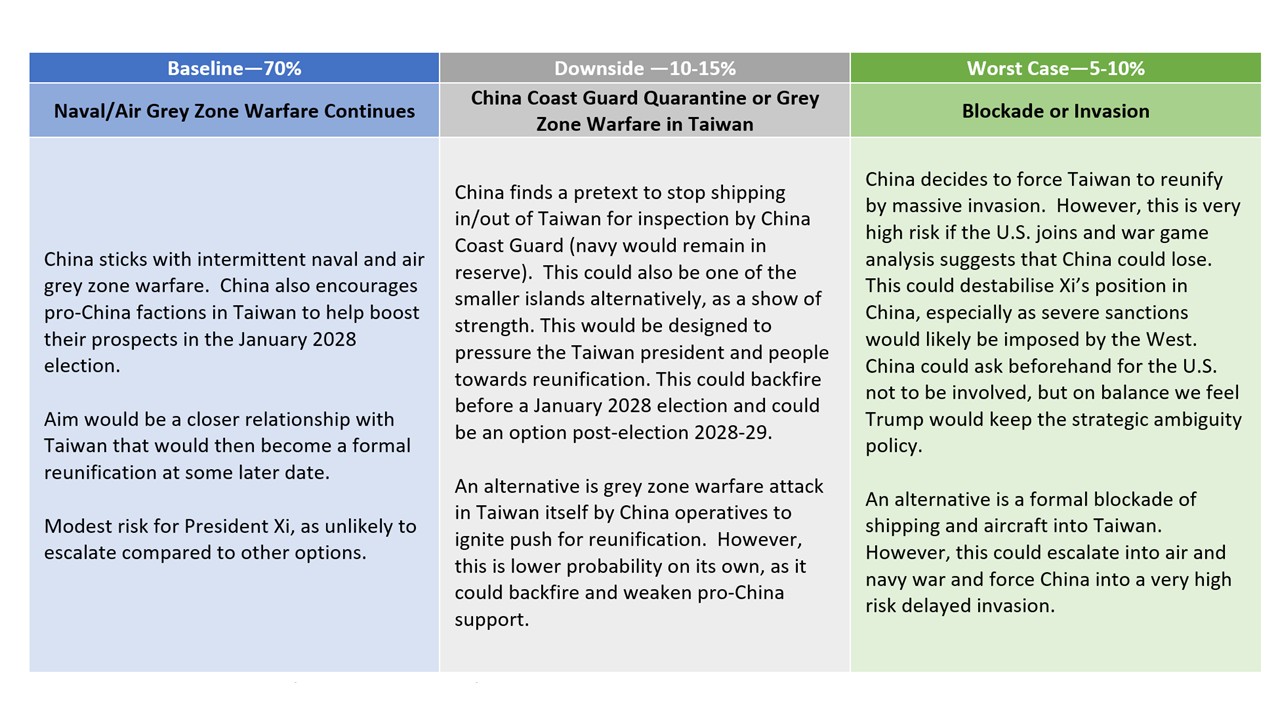
· The most likely option for China is to continue the air and naval grey zone warfare around Taiwan, combined with support for pro-China factions in Taiwan’s parliament to build pressure for reunification at some stage. This stick and carrot approach is our baseline (Figure 1). With invasion or formal blockade being too high risk for President Xi (with the U.S. maintaining a strategic ambiguity policy), an alternative option (10-15%) from 2027 onward would be a temporary China Coast Guard quarantine and inspection of some shipping to/from Taiwan.
President Trump visit to China has seen a less friendly tone towards Taiwan. What will happen next?
Figure 1: Taiwan Scenario 2027/28
Source: Continuum Economics
President Trump visit to China in May has seen a less friendly attitude towards Taiwan. Though Trump claimed that the Taiwan policy had not changed, he noted that he was against Taiwan independence and that December USD11bln of military purchases could be delayed. Could this embolden China and led to a full scale invasion in 2027?
While President Xi will be pleased with the shift of tone, the U.S. strategic ambiguity policy is still in place. Though Xi could gamble that Trump may not come to support Taiwan in the event of a war, Xi is cautious and not a gambler. Trump’s tech friends will also warn him that a China takeover of Taiwan could curtail or stop advanced semiconductor exports to the U.S. and derail U.S. leadership in AI. Many politicians in Washington also remain biased to strategic restraint toward China, beyond Trump’s desire for a trade deal. With concessions likely on Iran, Trump cannot abandon the strategic ambiguity policy. He could take a more friendly tone to Taiwan in the future!
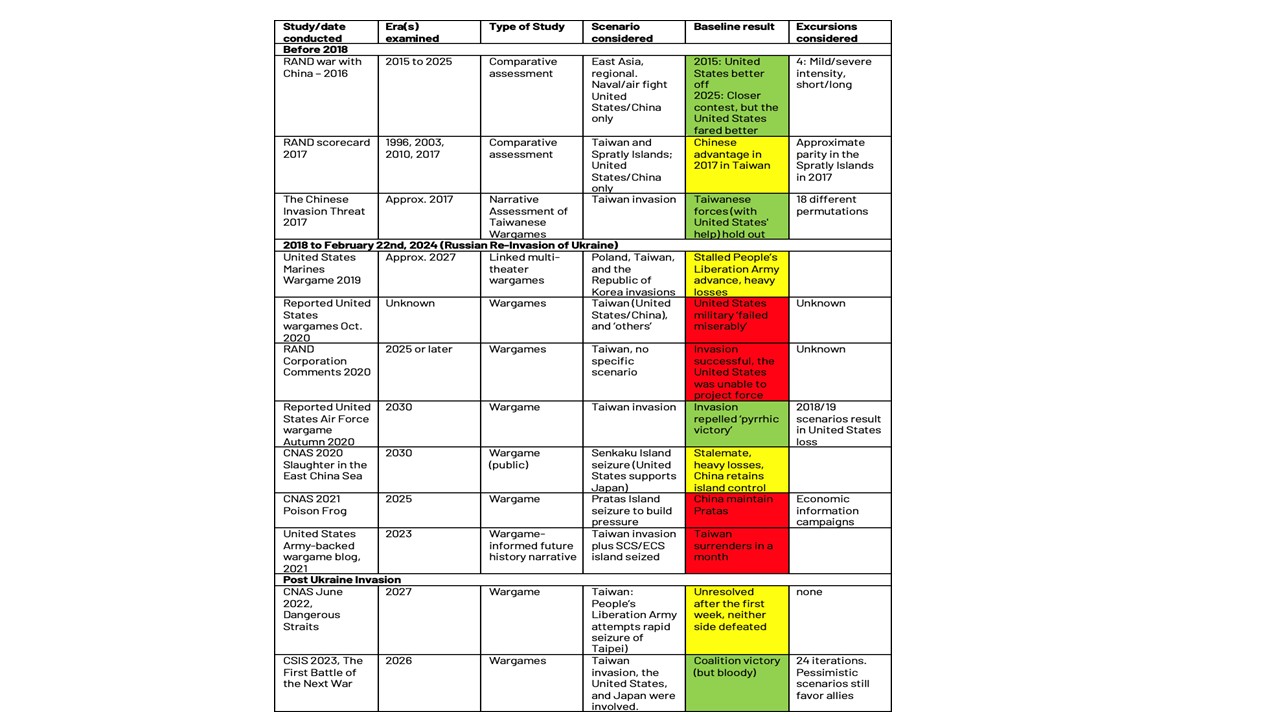
For President Xi, this makes an invasion (Figure 1) too high risk, as war game analysis suggests that China could lose if the U.S. become militarily involved (Figure 2). Defeat would be seriously destabilizing for Xi and the Communist Party. It is also worth remembering that Xi wants China ready for the option of a regional war by 2027, but full military capability by 2035. 2049 is also the 100th anniversary for the communist party and is seen to be a date to achieve reunification. A blockade is also very high risk, as it could spiral into a China/U.S. military clash. The U.S. may not break a blockade by force or counterattack China’s armed forces in the invasion scenario, but Xi cannot be confident about the Trump administration not reacting without a formal understanding that the U.S. will not get involved. Military strategists note that the U.S. has a crucial advantage in advanced submarines, which could seriously hurt China’s navy. Even a quick successful China invasion would still have severe adverse consequences on China economy, currency and financial markets, as Russia found out with the invasion of Ukraine. Additionally, though opinion polls in Taiwan show voters oppose invasion and would prefer the status quo, they do signal a majority of voters expect reunification at some stage. This gives China the opportunity to encourage pro-China and reunification factions within Taiwan. January 2028 is a pivotal date with parliamentary and presidential elections.
Our baseline (Figure 1) for 2026 and 2027 remains that China maintains the existing air and naval grey zone warfare, which is low risk for China. This stick would be accompanied by the carrot of warm relations with Taiwan opposition parties to encourage a change in Taiwan voters attitudes. We have the probability of an invasion or full blockade in 2027 at 5-10%, but have the temporary China Coast Guard quarantine option now lower at 10-15% -- this could be Taiwan as a whole or one of its islands, as occurred in the 1950s. The probabilities are likely lower in 2026/27, as Xi could try to convince Trump a couple of times in 2026/27 to weaken the strategic ambiguity policy. Even a temporary quarantine could backfire before the crucial January 2028 election and the risks are greater after the election.
Figure 2: Taiwan War Game Scenarios
Source: CIMSEC (here)