EZ Inflation Jumps - Still Energy Driven
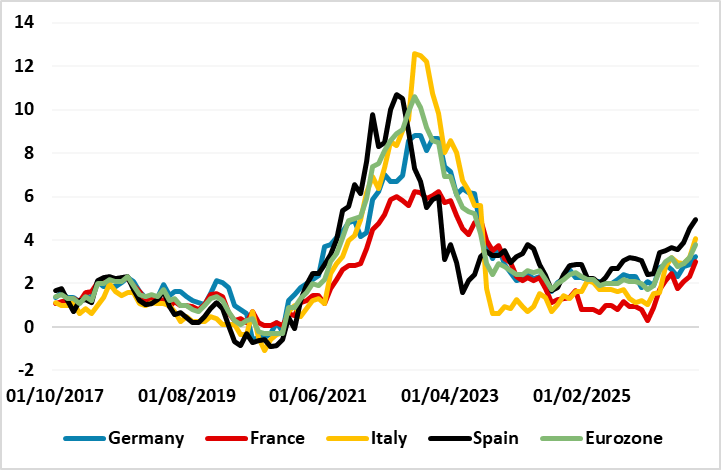
Although headline inflation for September was higher than expected at 3.8%, when consensus forecast 3.2%, the narrative does not change. This is still an energy driven increase in inflation. The breakdown of overall inflation into major components showed that energy was the largest contributor to the headline rate (1.7 percentage points of the 3.8% increase) with services contributing another 1.5pps – that share has been steady for the past year. Core inflation which excludes volatile items such as energy, food, alcohol and tobacco was also contained at 2.5% y/y, suggesting there is little evidence of broad-based inflation increases. Headline inflation is still expected to rise further to around 4% by the end of the year.
The surge in EZ inflation was already evident in national figures earlier this week with energy also the main driver. France, in particular, saw on the largest increases in headline inflation, rising from 2.4% to 3%, given that the government has not introduced broad-based reductions in fuel taxes or prices. It has instead opted for targeted household support measures which don’t directly reduce measured inflation. The rise in global oil prices has therefore passed through more directly to French inflation.
As we pointed out in our EZ inflation preview (Link) weak demand and a soft labour market are limiting wage pressures and companies’ ability to raise prices, particularly in services. At this stage, a broad-based increase in inflationary pressures appears unlikely.
The response from the ECB has been fairly muted with Lagarde sounding somewhat dovish earlier this week, pointing to limited second-round effects and already tighter financial conditions. Finnish central bank chief Olli Rehn also noted that the rise in long-term interest rates “will slow growth and reduce the pass-through of the energy shock to other prices and wages" underlying the fact that the recent projections for growth and inflation continue to be subject to “very high, pervasive uncertainty."
Figure 1: Inflation by Eurozone Country (%Y/Y)
Source: Datastream/CE