Eurozone Economy Remains Resilient in Q3 - Headwinds Ahead?
The economy expanded more than expected in Q3, rising 0.4% q/q from 0.6% before, with the Eurozone aggregate benefitting from Ireland’s large and volatile growth rate. Most of the larger member countries experienced weak quarter on quarter growth, with Germany’s economy increasing 0.2%, Italy’s stagnant at 0% and France contracting by 0.1%. Only Spain managed a decent rise of 0.6%. Excluding Ireland from the aggregate, the Eurozone grew 0.2% q/q with Ireland’s 5.5% q/q growth heavily influenced by multinational accounting activity and hence less indicative of underlying economic conditions.
No breakdown of the overall figure into expenditure components is available in this flash GDP estimate but several factors explain the economy’s ongoing resilience. In Germany, government spending on defence and infrastructure is boosting growth while the economy has also benefited from the closure of the Strait of Hormuz as orders were redirected from Asia to Europe. Spain also continued to expand at a solid pace, outperforming the wider currency area amid resilient consumption and employment growth.
In Italy, Istat, the statistics office noted that growth was driven by a positive contribution from domestic demand (gross of inventories) but offset by a drag from net exports. In France, the economy has been suffering for most of year even before the recent surge in government bond yields. Today’s contraction follows zero growth in Q2 and -0.2% q/q in Q1. France’s weak growth is likely to worsen the country’s fiscal dynamics as budget negotiations continue ahead of next year’s election.
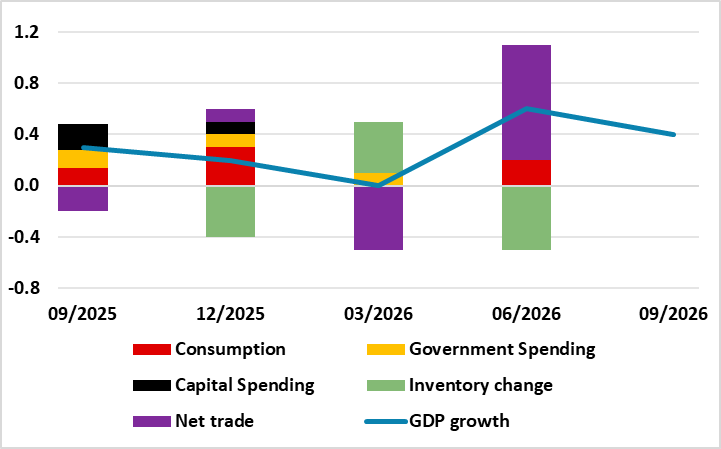
Can the Eurozone economy remain resilient? Business surveys have pointed to further growth for the eurozone in the final quarter of 2026. That said, global oil prices currently remain above US110 a barrel amid continued concern over supplies while the market fears that the conflict in the Middle East could escalate once the US midterm elections are out of the way. With Eurozone growth still decent and inflation expected to rise further in the near term, the ECB is expected to raise interest rates in December. That will take its toll on housing and broader investment plans. Higher gas prices are also likely to hurt in the winter months while low water on the main waterways remains a threat to industrial supply chains and production.
Figure 1: Eurozone Real GDP and Expenditure Components (Q/Q%)
Source: Datastream/CE