From Hanging Chads to Hanging By a Thread – ‘Alternative’ US Election Risk Scenarios
* Without being alarmist, the market arguably needs to factor in the risk that the elections do not proceed smoothly to a clean conclusion. At the moment, there is no risk premia
* The markets hope that the destination is some degree of gridlock and thus reduction in extreme policy (albeit with mixed mkt implications coming from fiscal restraint)
* However, there are clear risks - on an escalating scale - standing in the way of an unrestricted, uncontested outcome. That makes for a potentially complex, more uncertain environment
* If risks materialise, volatility may be cheap; and the dollar needs to decide whether to smile or frown.
If you look at the options future curves, you’d be forgiven for thinking there is ‘nothing to see here’. An Iran war dragging on, with the US on the worst side of a standoff, and a run in to US mid-terms where the ‘activity’, rhetoric and signalling have been anything but normal or reassuring.
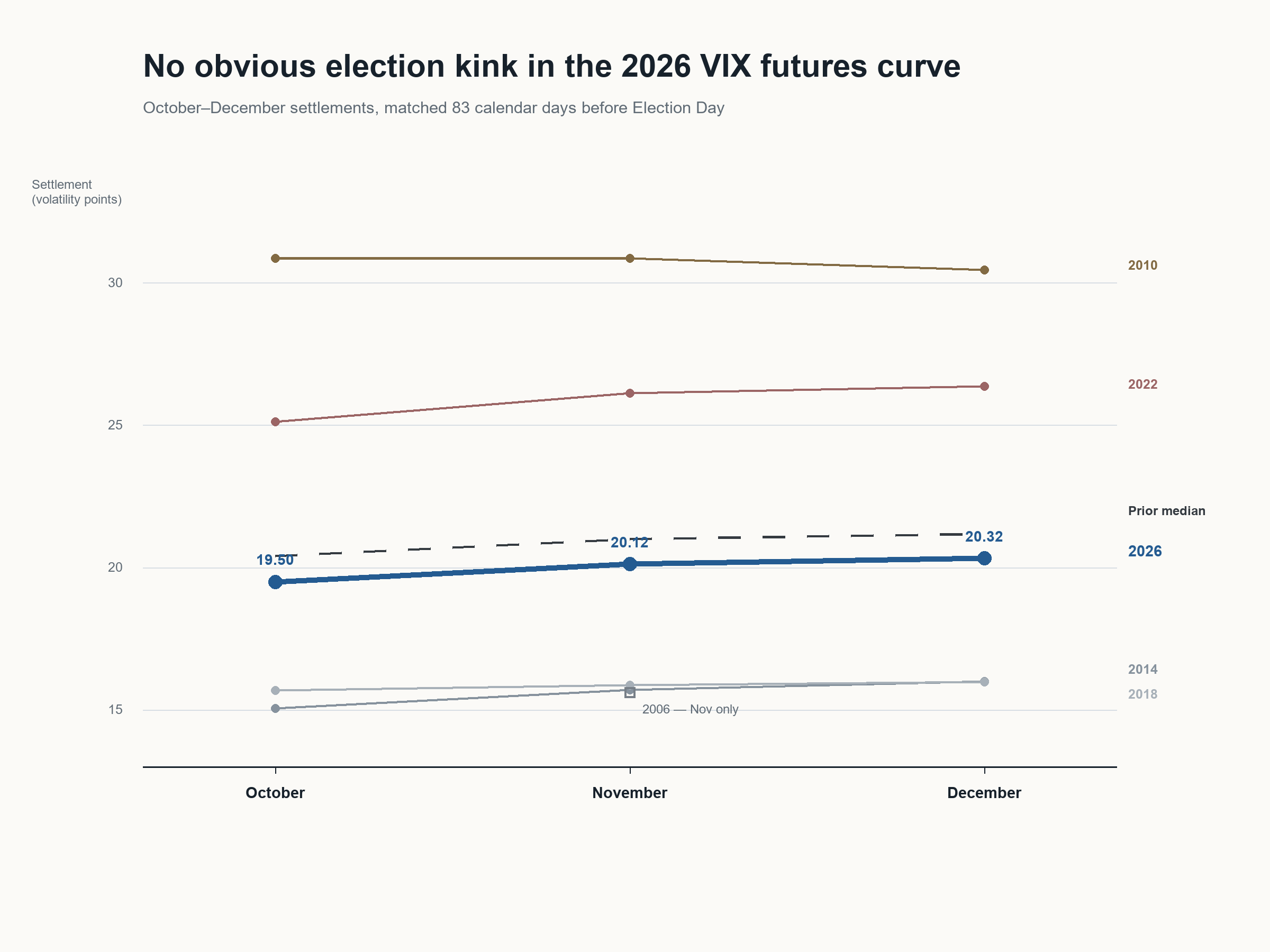
The VIX curve for instance is very much on or below average for this point into a midterm, through what is usually the high seasonal period, with no additional elevation or ‘election hump’ at all on show to capture any further event risk.
Figure 1: US VIX curve over the election period
Source: CBOE ; CE
In some respects, that is entirely logical. The market has got used to ‘looking through politics’ - and unusual risks of any kind - as the US ‘buy the dip’ risk rally continues on regardless. The wall of worry you don’t want to be left standing at the bottom off.
Indeed, the market’s dream scenario is a midterm result that delivers some degree of gridlock and neuters the scope for erratic executive policy, albeit with the more nuanced implications for markets regarding the fiscal outlook. That is, a restricted ability for further big beautiful bills to keep the historically unprecedented pro-cyclical fiscal accommodation pumping full blast might be a relief for US Treasuries, but would be a boost-turned-drag for growth.
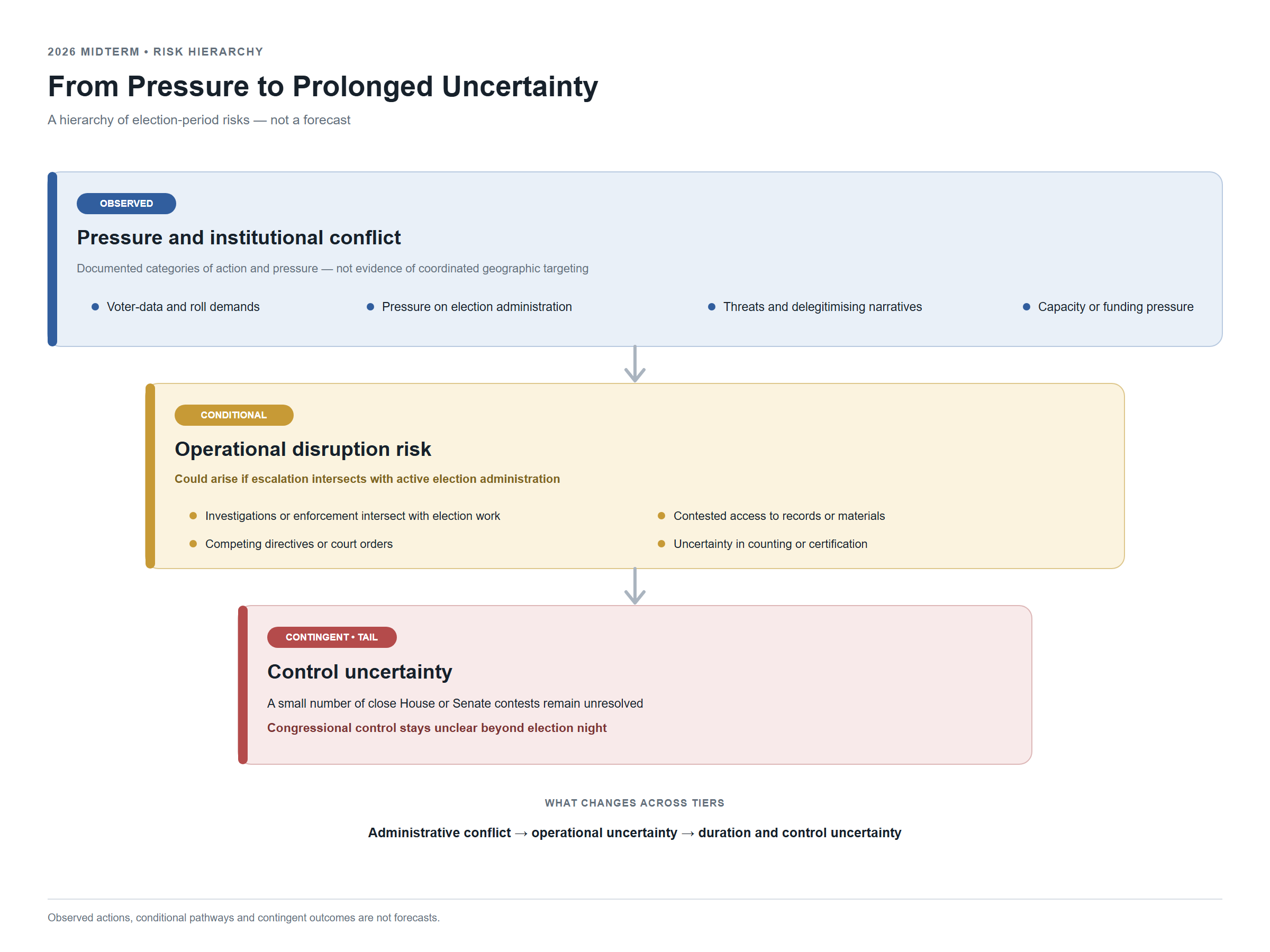
Standing in the way of that possible comforting destination is the potential for an uncertain, uncomfortable journey however. In terms of an escalation ‘risk ladder’, it’s perhaps sensible to break the scenarios down into ‘current, concrete, already happened’; operational risks that are more or less likely; and then more extreme tail risks that are more alarmist but don’t exist in a vacuum.
Figure2: A risk ladder from current action, to operational, to tail risk?
Source: schematic representation of risks from pressure to prolonged logjam
At the foot of this ladder, the noises have not been reassuring. Federal agencies have sought sensitive voter information from states; ICE investigators have obtained individual voter files from local election offices; Reuters et al have documented threats of legal consequences for state election officials and attempts to condition federal funding on changes to voting practices; the leadership of the Election Assistance Commission has been removed; in Fulton County, federal agents seized ballots and records from the 2020 election as part of a renewed, unilateral investigation. The recent presidential address also out the blue sought to relitigate the false claims around the last presidential election and voter fraud, front running a clearly intended midterm narrative.
Courts have blocked or narrowed several initiatives of course, including parts of its mail-voting and citizenship-verification programme but this doesn’t necessarily put the 'noise' to bed.
A recent MAGA podcast kite flew the idea of a declaration of an election emergency to impose the desired voter restrictions (Trump’s reply: Let me just say stranger things have happened. I’ll leave it at that). The concept looks ill-founded in law, but ‘flooding the zone’ with actions to create concern, confusion and administrative friction has been a known strategy.
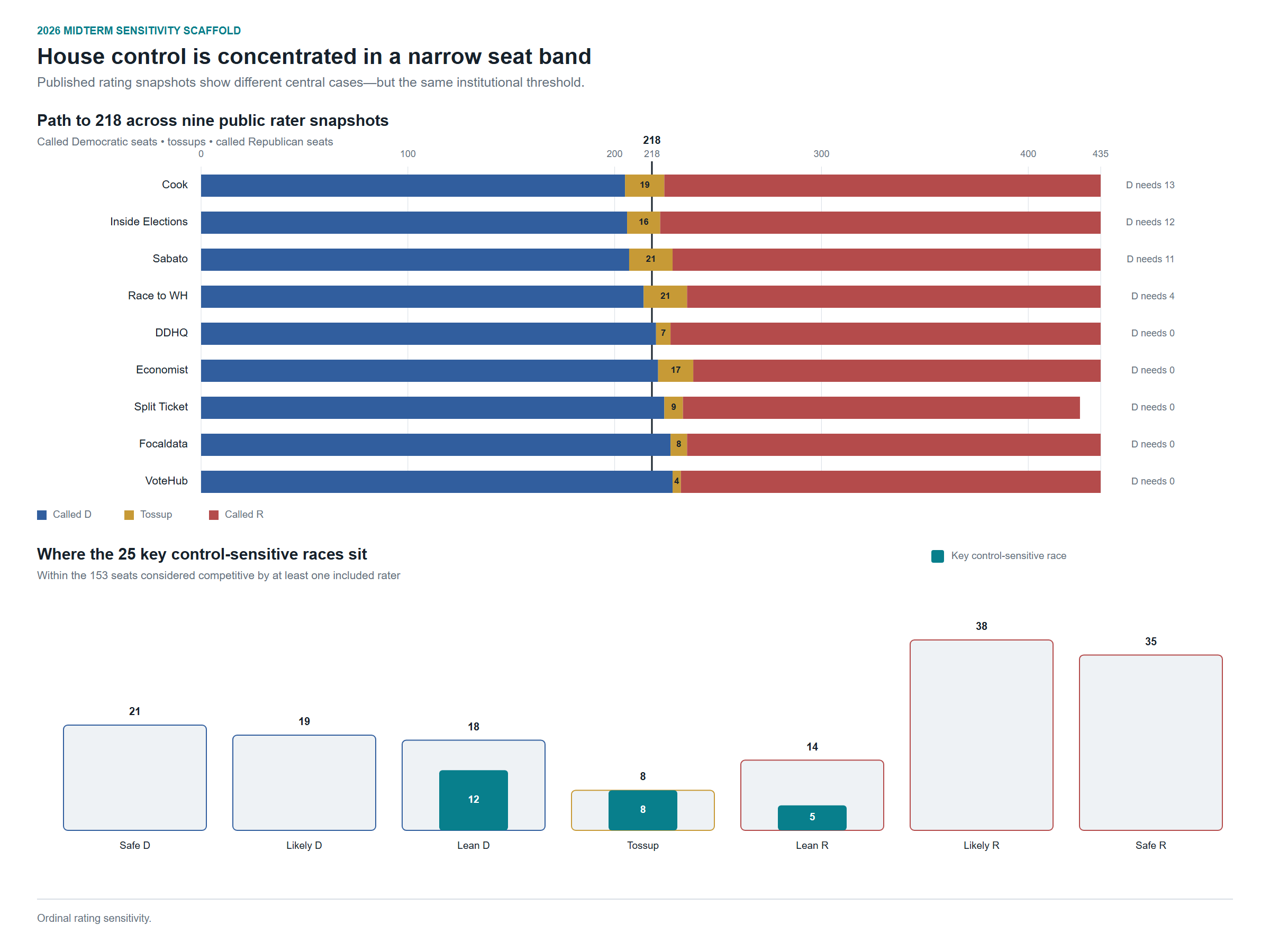
Figure3: Key House contests
Source: Public election-rater classifications, compiled from named publishers online
Between established fact end and ‘tail risk’ end of more extreme interventions, comes a range of actions into an out of the results that could make a close contest, particularly in the Senate, hard to quickly resolve. Voter information can superficially platform immigration or election-fraud “investigations”; that in turn can generate subpoenas and competing claims and demands over records; disputes over voter eligibility, machines or election materials can launch conflicting proceedings. The transition through the count and certification could prove anything but smooth.
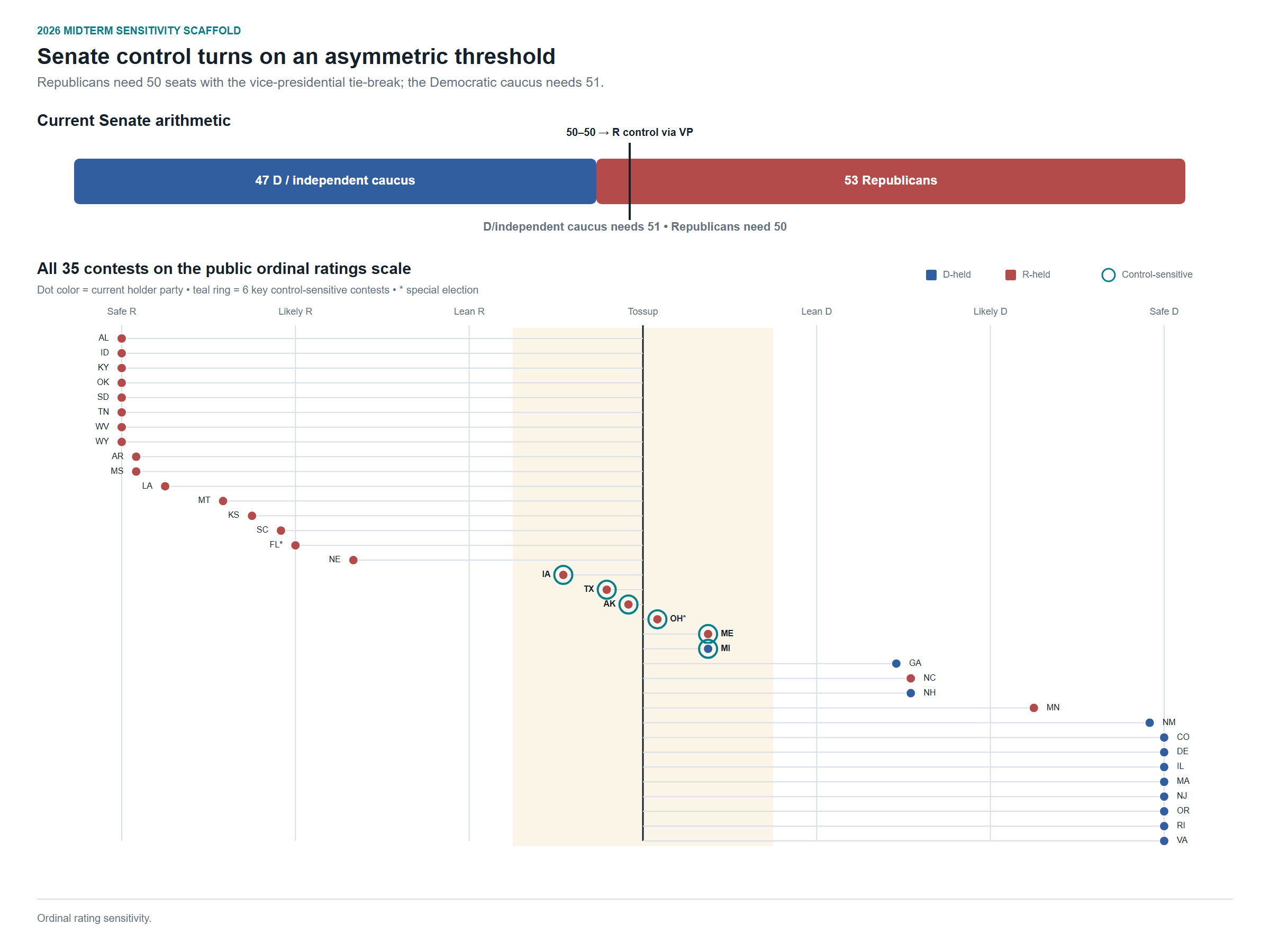
Comparing public election-rater classifications (figures 3 and 4) and focusing on contests that on average are deemed to be close to “a tossup”, or where ratings disagree, highlights how a relatively small number of results being obstructed, delayed or contested could be disproportionately impactful. In other words, the focus is the “fragility” of the election’s smooth conclusion, as well as the predicted results themselves.
Figure 4: Key Senate ‘tossup’ contests
Source: Public election-rater classifications, compiled from named publishers online
Looking at the details more concretely, betting odds currently give the Democrats with over an 80% chance of taking the House. The Senate is seen as close to 50-50 in probability, though in terms of seats the Democrats require 51 versus their current 47 (including two allied independents) with Vice President JD Vance having the casting vote in the event of a tie. While the House may still come down to a few close seats, Trump may be resigned to losing it. He is more likely to contest any close races in the Senate, which will be more important to him, as it is the Senate that must approve his appointments.
Democrats need a net four gains to take the Senate. North Carolina looks likely. Maine was also looking likely before a scandal forced a late change in the Democratic candidate, but still probably leans Democratic. Ohio and Alaska look close as does, to a lesser extent, Iowa. Texas is also a pick up opportunity with the Republicans having replaced the incumbent senator with a more MAGA-friendly candidate. A fifth pick up could be useful for the Democrats with Pennsylvania’s Democratic Senator John Fetterman not a reliable vote for them, while a sixth would allow the Democrats to lose one seat they currently hold. Here Republicans are particularly targeting Michigan after a close left versus center Democratic primary saw the former narrowly prevailing. That the Democrats need to prevail in nearly all the close races and odds are close to even illustrates Trump’s current unpopularity, but also raises the possibility that overturning the result in one state could make a big difference. That would pose a big temptation to Trump. Any challenge could take weeks, or even months, to resolve.
Figure 5: Most betting odds have the Senate race roughly 50-50
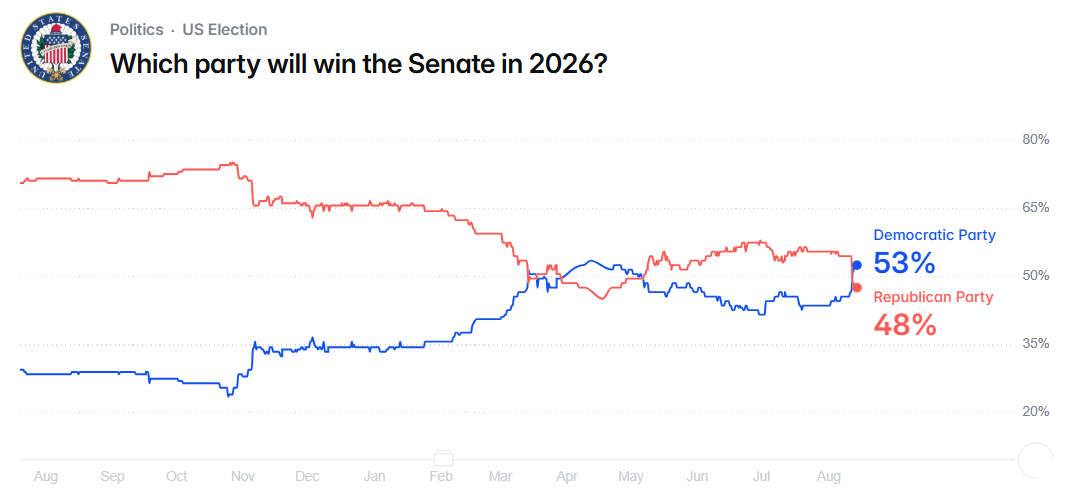
Source: Polymarket
In short, while nobody wants to be alarmist or conspiracy theory focused, the market nonetheless does need to consider the range of possibilities that stand in the way of a “normal” path to what many had hoped would be a US Treasury supportive (if more nuanced wider market) outcome.
A result anywhere from messy through to “constitutional crisis” would make for a much more complex environment, even if it doesn’t guarantee a specific market outcome. For FX in particular, the decision point would become more acute around where to sit on the spectrum of positive ‘USD smile’ (risk and volatility spike perversely USD supportive) versus ‘frown’ (reduced trust in US status coming back to the fore and thus increased dollar negative hedging, as seen early in the Trump second term).
The more basic question might be simply whether those currently running portfolio risk should view the uncertainty, and potential breadth of possible volatility scenarios over this period, as making current volatility pricing a relatively cheap hedge.