Strains bring financial conditions into the eurozone mix
* French stress and ECB Lagarde comments switch focus to the tightening in financial conditions
*Past studies show material impact from significant episodes...
* ...with possible implications for core bond demand, ECB pricing and the wider appetite for risk across FX and markets.
While the narrative has been dominated for most of the year by the ‘no-brainer’ need to tighten against the risk of supply-price pressures feeding into broader inflation, alongside the spillover from global AI-infused growth and financial boosts, recent stresses have started to shift the focal point.
France’s bond and CDS blowouts have shifted attention to the monetary and financial impact of spread widening, especially through this more unusual semi-core channel. Meanwhile, Lagarde’s comments at the IMF mark a significant tone change that switches attention to how the rise in long-term rates and tighter financing conditions could restrain growth and inflation pass-through more than envisaged in the September forecasts.
Together, these developments suggest that financial conditions have become a more material and harder-to-model influence on the outlook and policy equation. There are no exact templates for the current combination, but a few ECB studies help give some shape to the problem.
Figure 1: Financial conditions have sharply tightened since Aug
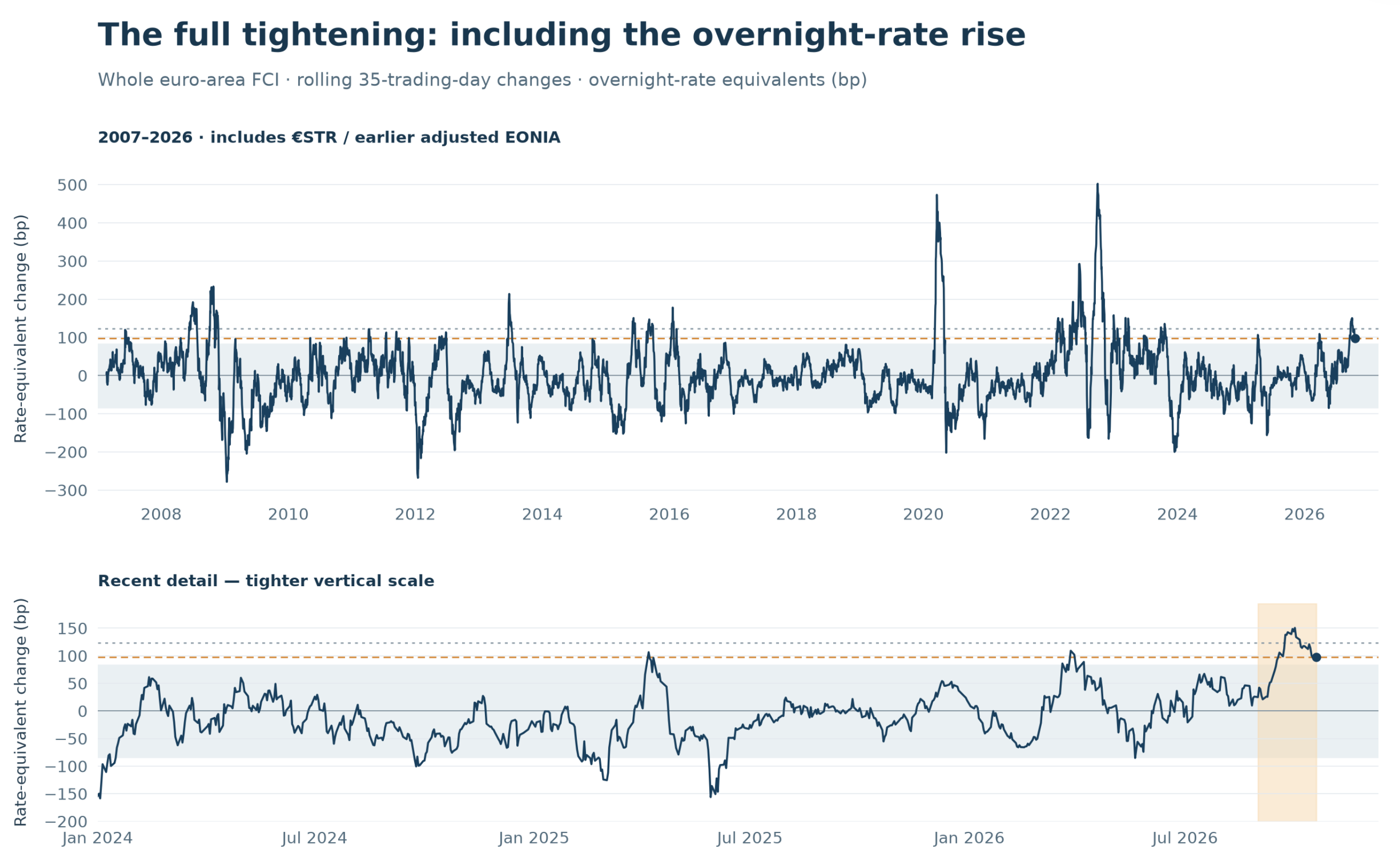
Source: Bletzinger, Martorana, Mistak ; WP/3193
One is a relatively new financial conditions model from an ECB working paper. Using its coefficients allows one quantification of the recent setback and a illustrative translation into ‘overnight-rate-equivalent’ terms. From end-August, the index tightened by around 100bp equivalent - top end for comparable non-crisis period changes since 2007.
Around ¼ pp came from the observed overnight-rate rise, as a result of the last hike, leaving roughly just under ¾ pp from other components. Equities and corporate spreads contributed just over ½ pp, nominal and real rates 35bp~, and sovereign spreads 6bp. The weaker effective euro provided an offset of about ¼ pp.
Figure 2: Mixed contribution to tightening, not including unmodeled France-specific factor
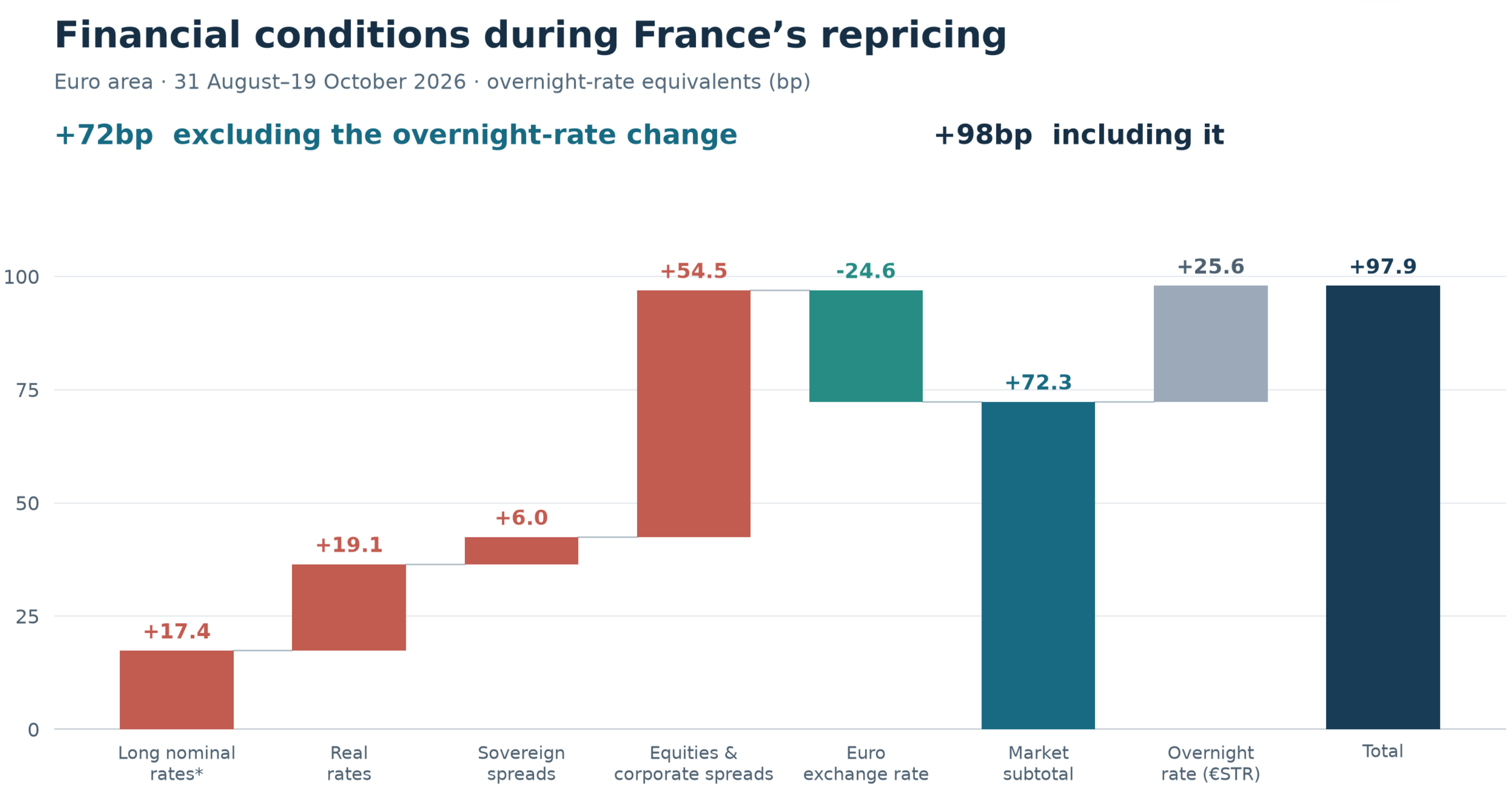
Source: Bletzinger, Martorana, Mistak ; WP/3193 ; translated from FCI to o/n rate terms
The sovereign component uses GDP-weighted 2s and 10s spreads over OIS, so avoids the distortions of a purely periphery-centric measure. Even so, it cannot fully describe the uneven distribution of tightening or channel France’s specific indirect ‘stress episode’ contributions.
Other ECB work provides some context for the wider market effects. One study estimates a euro-area sovereign-stress shock scaled to widen the periphery–core 10yr spread by about 10bp, so parallel rather than a clean map. Associated impulse responses include equity declines of roughly 2–3%, a two-point rise in equity volatility and an initial (fading) EUR/USD decline of around 1%.
Figure 3: ECB’s Lane has discussed transmission mechanisms to rates, lending, banks
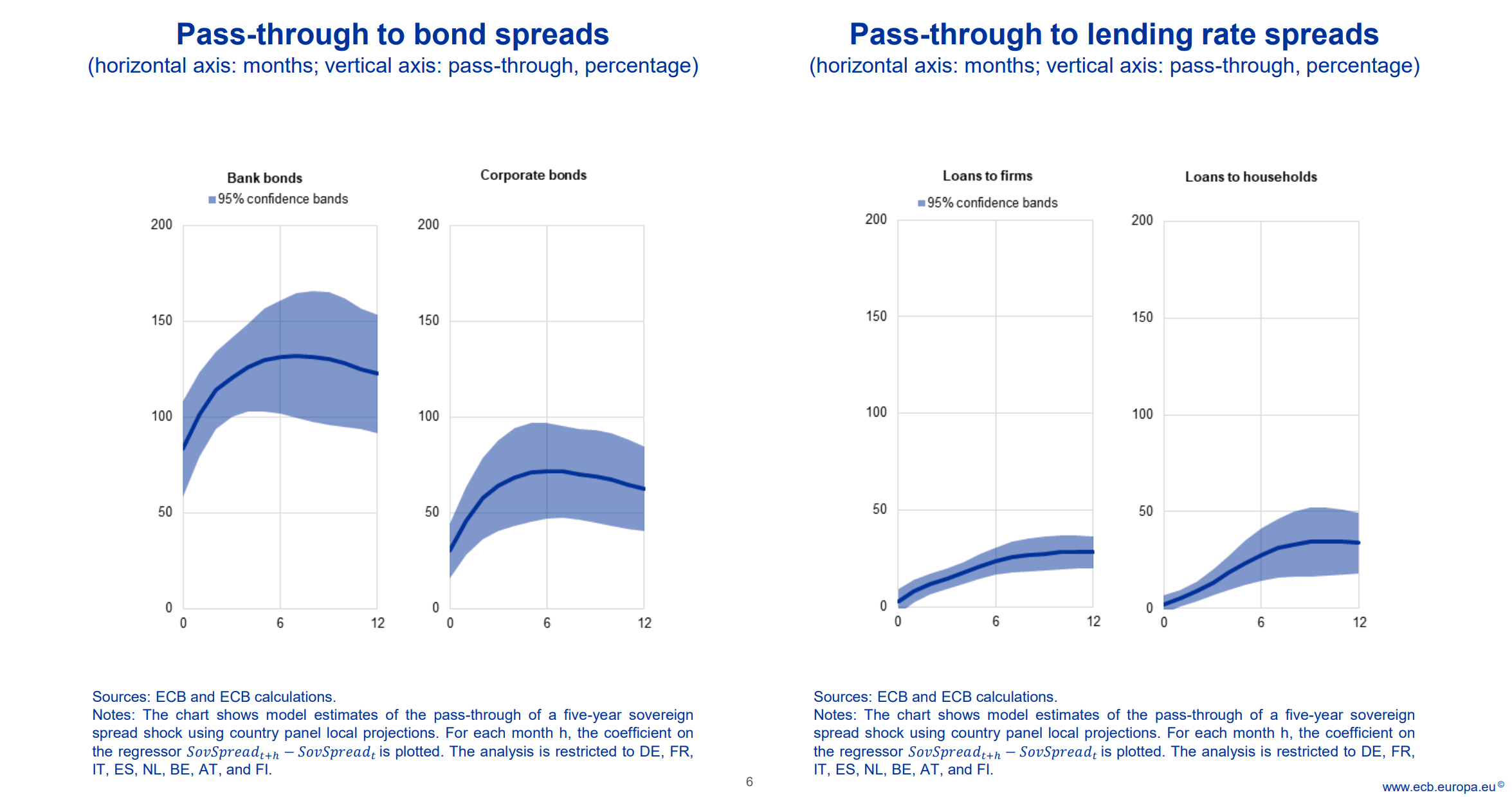
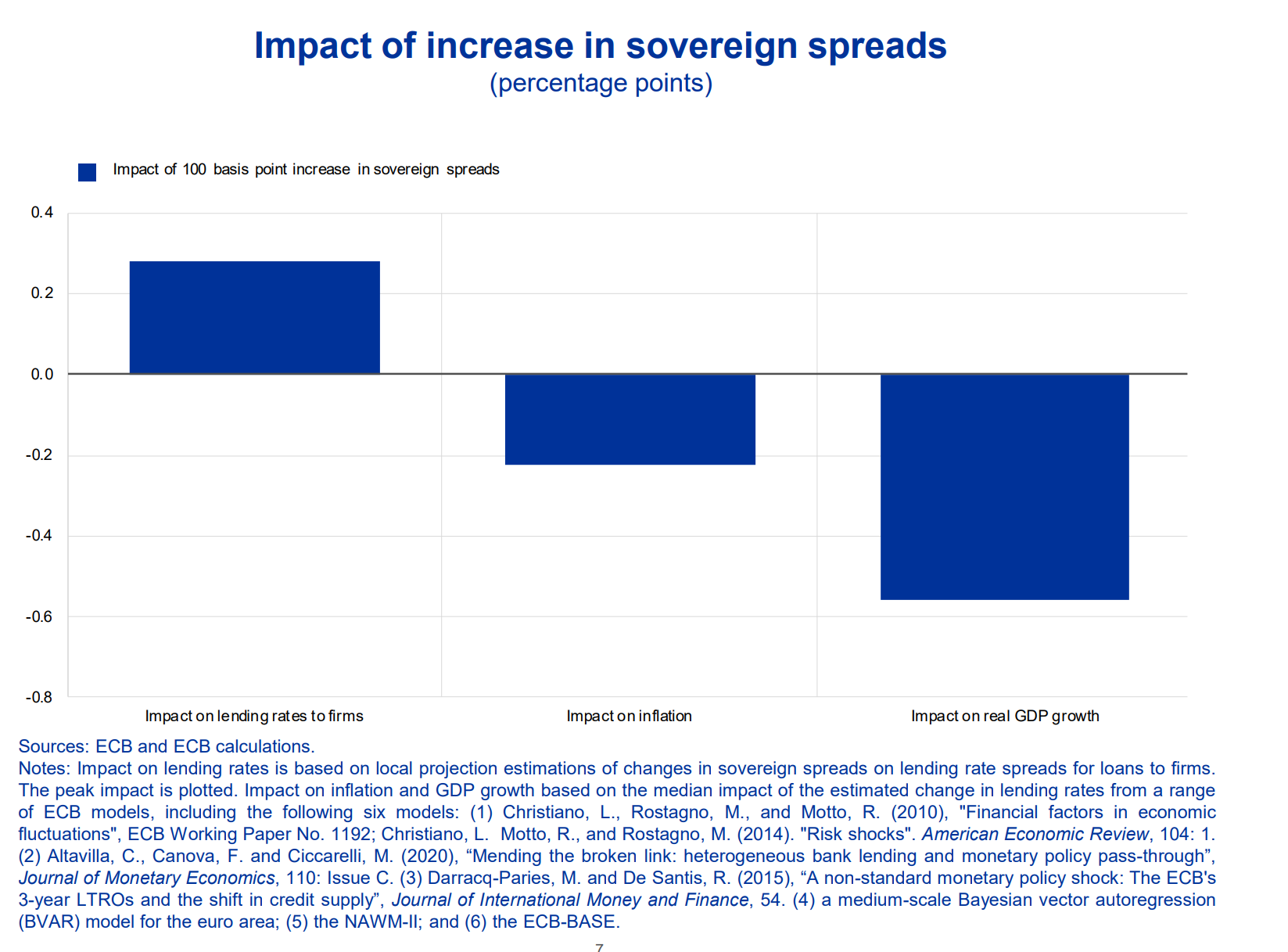
Source: ECB’s Lane, 2024 presentation
ECB Lane’s 2024 presentation considers a less periphery-centric channel. Its rough estimates associate a 100bp increase in 5yr sovereign spreads over OIS with a peak 25-30bp rise in business lending rates. Separate model calculations suggest around 0.2–0.25 percentage points lower inflation and 0.5–0.6 points lower GDP growth. These provide a sense of relevant drivers, rather than a France-specific forecast. Nothing is on that total scale as things stand, but it highlights the importance of the credit and sovereign transmission layer, particularly if France were to further intensify and ‘reverse contagion’ to pick up.
Figure 4: Banks have seen sharp declines though after substantial multi-year rallies
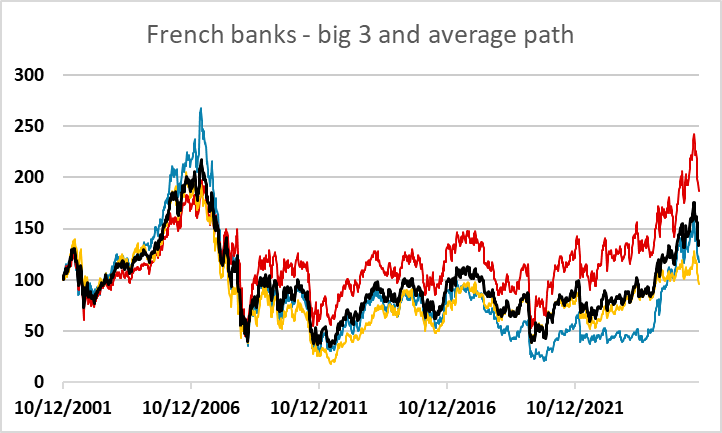
Source: Datastream; rebased to end 2001
The banking nexus is also a key channel. French bank shares have sold off sharply, some -25% since August, albeit - to be very clear - after much more substantial preceding rallies in recent years and with much improved balance sheets. That makes the sovereign-bank relationship worth watching even if not immediately pressing. On the bond side, flow of funds studies suggest that in the short term stress episodes see selling by especially foreign funds, with domestic banks the short term buyers, while in the long term insurers and households are the counterparties to the offloading.
Indirect restraint could also emerge via heightened market focus on and reactiveness to risks, market driven policy inhibited for other sovereigns, and the negative impact of greater economic and policy uncertainty.
From bonds to energy, ‘uncle points’ are starting to appear through social-political and economic channels. The question for Q4 onwards is whether the combination of higher energy costs and tighter financial conditions are part of a change in this year’s dynamics. France may be one part of that broader shift, with implications for core bond demand, ECB pricing and the wider appetite for risk across FX and markets.