U.S. Outlook: Growth Overly Dependent on AI
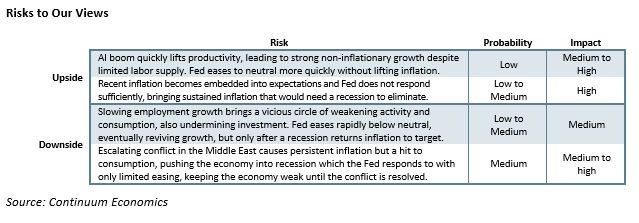
• The US economy is currently showing signs of acceleration with business investment strong led by AI and consumer spending outperforming real disposable income, in part because of AI-assisted strength in equities. We expect continued strength in business investment though a modest slowing could be seen, but strength in consumer spending will be difficult to sustain into 2027. We expect annualized GDP growth to slow to 1.2% in the first half of 2027 before regaining moderate momentum later in the year. For 2027 as a whole we expect GDP to rise by 1.8%, a moderate slowing from 2.2% in 2026. Inflation remains elevated but with limited pressure from wages and the tariff impact having peaked, we expect slowing in core PCE prices close to but not quite on the Fed’s 2.0% target. We expect both core PCE prices and overall CPI to average 2.5% in 2027, down from 3.3% in 2026. Risks from the Middle East, trade policy and a potential dispute of Democratic gains in November’s midterm elections will keep uncertainty high, weighing on confidence.
• Currently the labor market is close to full employment and inflation above target. The Fed looks likely to tighten once more this year, most likely in December unless the data picture changes significantly. Fed dots currently imply no easing in 2027 but we expect some slowing in both the labor market and inflation in 2027, and we expect the Fed to resume easing in the second half of the year, with cautious 25bps easings in both Q3 and Q4 of 2027. This would put the Fed Funds target range at 3.50% - 3.75% at the end of 2027 compared to 3.75% - 4.0% currently. However with the 2.0% FOMC inflation target not expected to be quite reached, we do not expect the Fed Funds target to reach the 3.25% level Fed dots now see as neutral.
Forecast changes: Our GDP forecasts are marginally stronger than in June, with 2026 revised up to 2.2% from 2.0% and 2027 now at 1.8% rather than 1.7%. Our forecasts for overall PCE prices are unrevised from June on an annual basis while core PCE has been fine-tuned only marginally, with 2026 now at 3.3% versus 3.2%, and 2027 unrevised at 2.5%. CPI we have however revised slightly lower, 2026 to 3.3% from 3.5% and 2027 to 2.5% from 2.6%. We now expect the Fed Funds target range to end 2026 at 4.0% - 4.25%, 25bps above its current level and 50bps above the 3.5% - 3.75% we expected in June. We continue to expect the FOMC to deliver two 25bps easings in 2027, though now expect moves in Q3 and Q4 rather than Q2 and Q3. That would leave the target range at the end of 2027 at 3.50% - 3.75%, 50bps above the 3.0% - 3.25% we projected in June.
GDP growth heavily dependent on AI investment
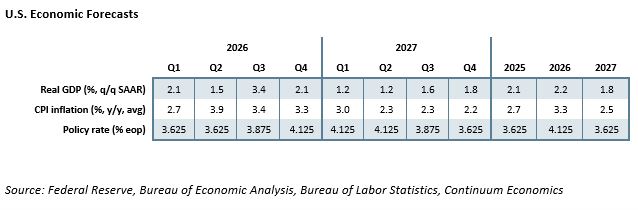
After three straight fairly subdued quarters, Q3 data to date suggest a significantly improved quarter, which we expect at 3.4% annualized with some estimates stronger still. Q2’s 1.5% annualized increase may have been subdued, but final sales to private domestic purchasers increased by 3.3%, the strongest since Q3 2024, and that underlying momentum is continuing in Q3. However, the foundations of this strength are fragile, and heavily dependent on investment in AI. Strength in business investment looks set to persist, though is not without risk given a growing political backlash towards data centers. Consumer spending still makes up almost 70% of the economy and has been running well ahead of real disposable income, which in Q2 was down by 0.1% yr/yr. Excluding the expiry of the post-COVID stimulus, real disposable income has not fallen on a yr/yr basis since Q4 2013. Without a sharp reversal in energy prices, limited employment growth and slowing wage growth will keep real disposable income subdued. Resilience in consumption is dependent on equity strength, which itself is due in large measure to AI.
Elsewhere in the GDP arithmetic inventories have near term scope for rebuilding though that will fade as a factor into 2027. Government will get support from defense but little else, with little prospect of fiscal stimulus. The housing sector looks subdued and vulnerable to upward pressure on bond yields. Even surging AI investment has its negative side with net exports starting to deteriorate as imports of computers and parts pick up. Renewed gains in the trade deficit could bring some unhelpful policy initiatives from President Trump. After a healthy Q3, we expect a moderate 2.1% annualized increase in Q4, and for trend to move below 2.0% though 2027. Still, the economy has enough momentum to make a recession unlikely without a major shock. For the calendar year as a whole, a 1.8% increase in 2027 would be only a modest slowing from 2.2% in 2026. We expect slowing to be most pronounced in the first half of 2027, with an annualized pace of 1.2%. By the end of 2027 we expect the economy to be growing near potential.
Inflation to fall, but not quite to target
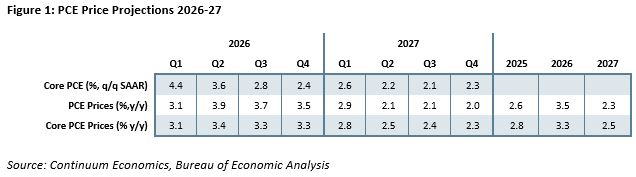
The inflation picture is not all bad. The labor market is generating little inflationary pressure. Unit labor costs rose by a modest 1.4% yr/yr in Q2 though strength in non-labor costs has the implicit deflator of the productivity and costs report at a three-year high of 5.0%. While the current situation with Canada shows Trump maintains plenty of potential for disruption, the tariff impact has probably peaked. While AI investment is lifting inflation in some sectors, the biggest inflationary concern is potential of feed through of energy prices into core inflation. We expect core PCE prices, which increased by near 4.0% annualized in the first half of 2026 to rise by less than 3.0% in the second half of 2026 and to get close to but not quite on the 2.0% target in 2027, by when overall PCE prices should no longer be running ahead of the core rate. One thing to watch for is annual revisions to PCE price data due on September 30. Fed Governor Waller has suggested these could be negative on some non-market prices, which could reduce a recent unusual outperformance of PCE prices relative to CPI. We expect 2027 as a whole to see gains of 2.3% in overall PCE prices, underperforming a 2.5% rise in CPI. Revisions are also due on September 30 to GDP, personal income and consumption. We will be watching closely to see if the current contrast between consumer spending resilience and weakness in real disposable income persists after the revisions.
Currently the labor market is close to full employment and inflation is too high. This situation is not going to see a dramatic shift in the near term, but going into 2027 we expect some loss of momentum in both underlying inflation and employment. Reopening of the Start of Hormuz, which we cautiously expect by early 2027, would take pressure off headline inflation too. Given the FOMC’s current hawkish tone, one further tightening looks likely this year, more likely in December than October when the meeting comes shortly before the midterm elections. As growth slows more significantly in 2027, and inflation gets close to target, we expect there will be scope for cautious easing, despite FOMC dots currently implying no change. However, we do not expect the FOMC to move until the second half of the year, with 25bps moves in Q3 and Q4 taking the Fed Funds target range down to 3.50% - 3.75%. Given our view that core PCE prices will not quite reach the 2.0% target we do not believe Fed easing will go quite as far as reaching the neutral rate, now seen at 3.25% in the median FOMC dots.
Midterms to see Democrats winning the House, and possibly the Senate
Midterm elections are due on November 3. Trump’s current unpopularity, due in particular to elevated gasoline prices caused by the conflict with Iran, look highly likely to see the Democrats taking control of the House. The Democrats need take control of only one chamber to mean little scope for any significant action on fiscal policy in 2027. This would contrast 2026 when consumers did get some support from tax cuts, though elevated budget deficits may have offset much of that support by contributing to upward pressure on UST yields. The Senate is a much closer call, with a map favoring Republicans weighing against Trump’s unpopularity. The Democrats need a net gain of four seats, and five if they are not to be dependent on Pennsylvania Democratic Senator John Fetterman, who often sides with the Republicans. Fetterman’s seat will not be contested this year. The Senate matters because it needs to approve Trump’s appointments, and if the contest is close Trump may seek to challenge the results. The economic risks of a contested election will be modest, but would add to the weight of a generally risky environment on confidence.
The Democrats look likely to make a gain in North Carolina. There are close races in Maine, Ohio, Alaska, Texas and Iowa, all currently held by Republicans. A strong Democratic wave could put a few other states in play but they are long shots. The Democrats also need to avoid losing states they currently hold, with Michigan and to a lesser extent New Hampshire not safe. The Senate race is a very close call, but we now feel the Democrats have a slightly greater than even chance of taking control.