ECB Review: ECB Stays Put But December Hike Likely
As expected, the ECB kept the deposit rate unchanged at 2.50% but President Lagarde’s comments in the press conference largely paved the way for a 25bp hike in December, unless it is derailed by a further deterioration in financing conditions and a sharp worsening of the growth outlook. President Lagarde noted that the Governing Council had discussed whether a hike at today’s meeting was appropriate but decided unanimously to keep rates unchanged.
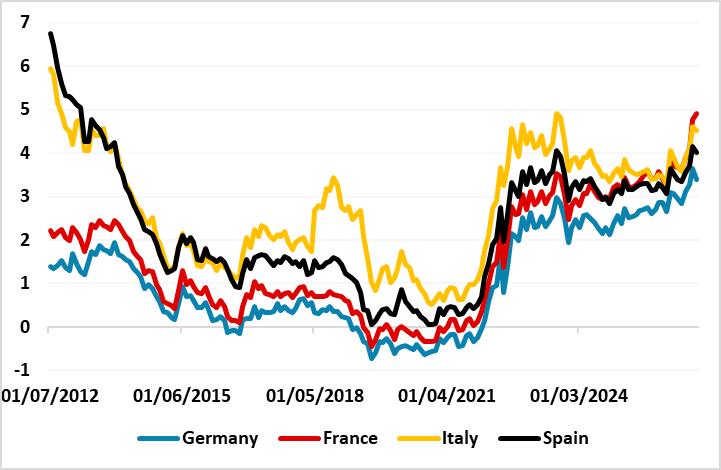
The initial read from the monetary policy statement was slightly dovish in our opinion in that it noted that there were still no signs of second round effects (something that was absent in September’s statement) though it also said that given the extent of the energy shock, inflation was likely to pick up in the near term: “the increased magnitude and duration of the energy shock, as well as the implications for indirect and second-round effects, are likely to drive up inflation and lower growth.” The statement also noted that financing conditions have tightened (that is also new), a reference to the surge in yields and wider government bond spreads. As we highlighted in yesterday’s preview, early signs of the rapid increase in the cost of government borrowing were reflected in the latest ECB Bank Lending Survey (BLS) which noted that it had seen tighter criteria applied by commercial bank officers in their lending to customers, particularly in France. Tighter financial conditions have already done some of the work for the ECB.
Lagarde said the Bank continues to adopt a measured approach to policy tightening but the impact of the energy shock (via higher inflation and lower growth risks) is complicating their policy decisions. That dilemma was underscored by Lagarde’s observation that energy prices have risen since September while there has also been a worsening of financing conditions in the same period. President Lagarde said that they will be watching six indicators over the next few weeks that will inform their December decision: this week’s Q3 GDP, two inflation prints, the ECB Staff forecasts, another negotiated wages report, industrial production data and the PMIs. We expect Q3 GDP to continue to show a resilient eurozone economy while headline inflation will also rise further. Philip Lane, the ECB’s chief economist also noted last week that wage deals being signed at the moment are “quite moderate”.
We expect the ECB to lift rates by 25bp to 2.75% in December and to end the tightening cycle there while the market sees two 25bp hikes to 3% by June of next year. How the ECB responds in coming months will largely depend on 3 factors: the length of the war in the middle east (and its impact on energy prices), the risks of second round effects and the situation in France. The longer the political and fiscal uncertainty persists the more that yields will remain high, tightening financial conditions and thereby reducing the need for the ECB to hike.
Figure 1: Euro countries 10-Year Government Bond Yields
Source: Datastream/CE