China: Debt Surge Problems
· China general government debt/GDP is on an unstable upward trend. China authorities are reluctant to ease underlying fiscal policy more than the already large primary budget deficit, but are also reluctant to consider broadening of income tax or property taxes that would help fiscal consolidation. Even so, financial suppression is strong, which can mean low real yield returns for creditors. The weak link is the 2nd tier of rural and city commercial banks that could see wider problems in the coming years from China debt hangover.
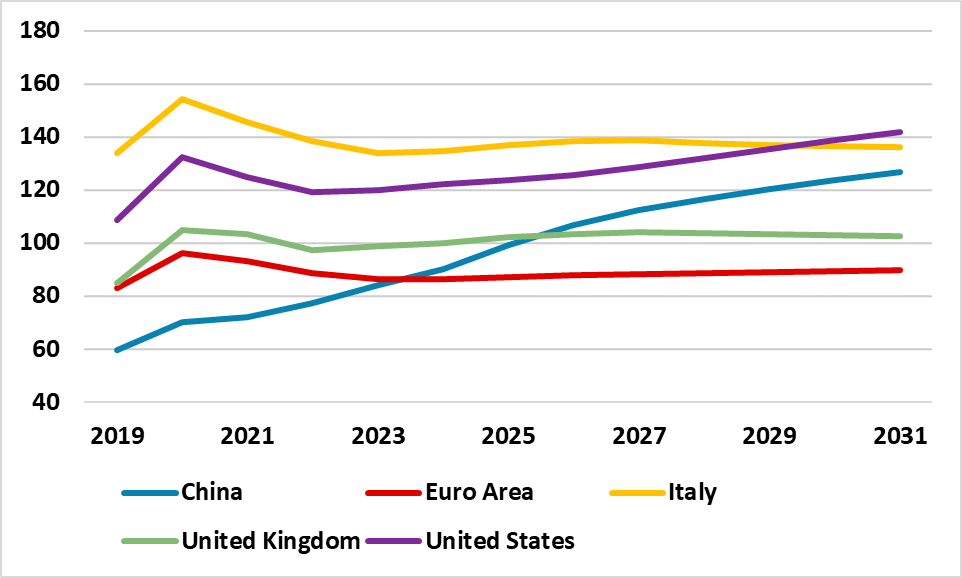
Figure 1: Gross General Government Debt/GDP (%)
Source: IMF Fiscal Monitor/Continuum Economics
China has a government debt problem, with the IMF baseline measure of general government debt surging from 60% in 2019 to 107% in 2026 and projected at 124% in 2030. This measure is wider and larger than the official government projections, but is lower than the IMF augmented debt/GDP measure that includes all LGFV debt and is projected at 154% of GDP in 2030!
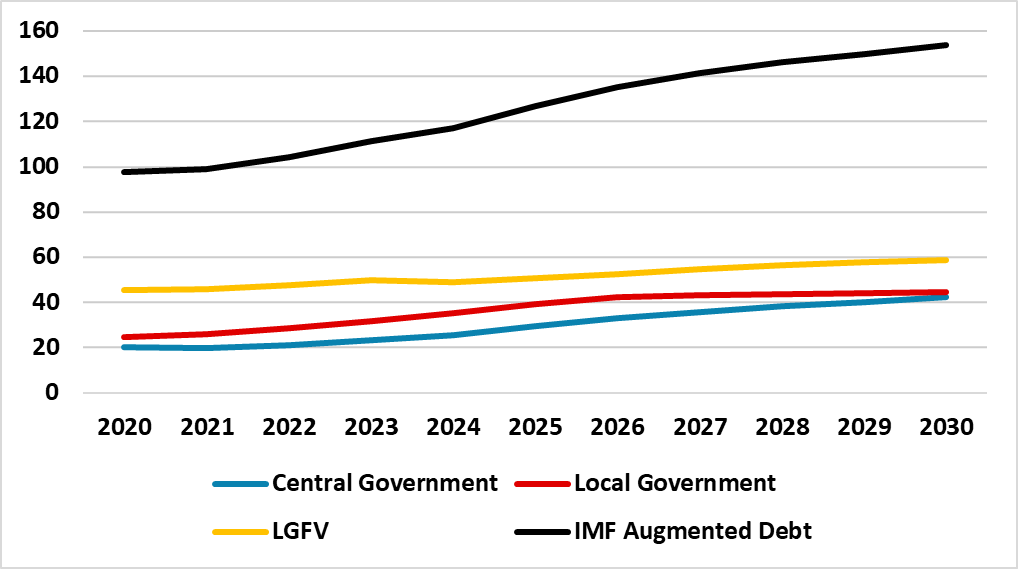
As we highlighted in a recent article the authorities are undertaking a restructuring of LGFV debt (here), which will reduce payments; lengthen debt maturity and convert some debt to local government debt. This is important as LGFV debt is a large portion of the IMF augmented debt measure (Figure 2). This does not remove the debt it just makes it somewhat more manageable. On government debt measures alone, China is a fiscal sinner (here).
Figu Figure 2: China LGFV Debt the Biggest Portion of IMF Augmented Debt
Source: IMF Article IV Feb 2026
The IMF augmented debt does not include state owned enterprises (SOE’s) however, which would push the government overall debt still higher. China households meanwhile, also participated in a separate borrowing binge since 2007 that has now stopped with the residential property bust having persistently dented consumer sentiment.
Overall, total non-financial sector debt/GDP (government/corporates and households) now exceeds the U.S. and EZ on BIS estimates (Figure 3) and is not far short of Japan. It is well above other big EM economies. Equally important has been the surge in this measure from 136% of GDP in 2007 to 300% of GDP in 2025. China fiscal policy feels fiscal restrained, with only a similar scale of fiscal stimulus in March 2026 leaving the general government primary budget deficit at a large 7% of GDP. Fiscal policy stimulus in the coming years will likely be modest, with no net increase in the primary budget deficit unless growth slows in China economy is too quick. We feel that China authorities could accept a 3.5-4.0% growth target by 2030, given population aging and no sign that the AI/tech boom is boosting non tech slowing productivity trend. Even so, China has no fiscal consolidation to reduce the large primary budget deficit. China authorities are reluctant to broaden or reform the tax base (e.g. higher income tax or annual property tax), partially on concerns it would upset households support for the communist party. The unstable fiscal trajectory will continue to grow into the end of the decade.
Figure 3: Total Non-Financial Sector Debt/GDP (%) 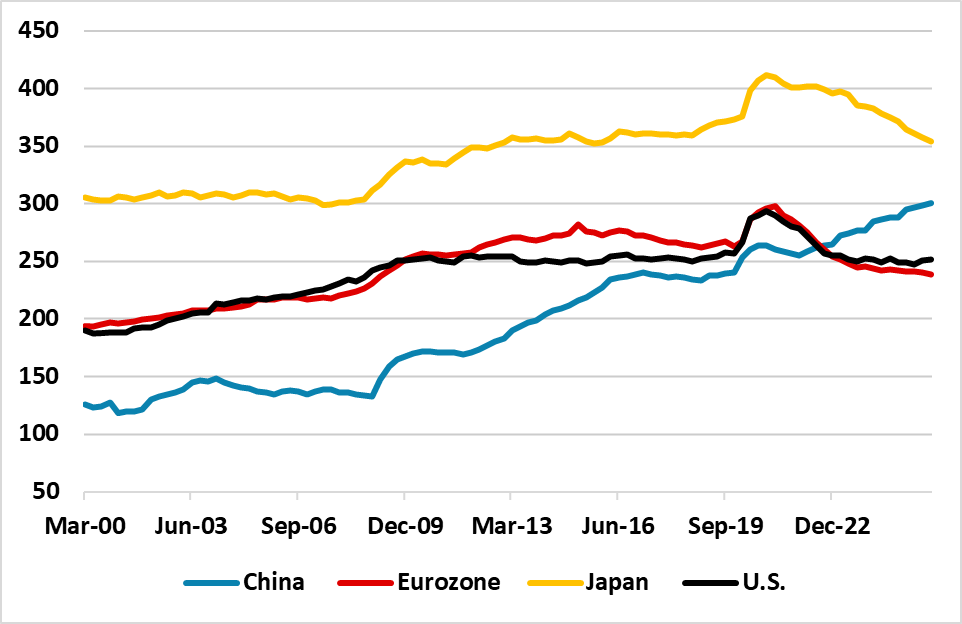
Source: BIS
Even so, China is unlikely to face a debt crisis for a number of reasons. Firstly, the debt is in Yuan and the vast majority owned by China institutions – the IMF estimate that non-resident held only 2.2% of government debt in 2025. Secondly, financial suppression by the authorities is strong, both in forcing creditors to rollover existing debt and loans and also to accept low real yield premia. This suppression is then feeding through the financial system meaning low real yields on bonds and loans for households. This financial suppression has lasted for years and could continue at a minimum for 5 years. Thirdly, China authorities manage failing institutions well via mergers, takeovers and slow winddowns. Even so, China households do have an ability to move deposits and funds from weaker banks to stronger banks, which could accelerate the number of small rural and city commercial banks that run into difficulties as highlighted by the IMF and 2023-24 PBOC financial stability review (here). The 2023 PBOC financial stability stress test showed that the 19 D-SIB, accounting for 71% of total banking assets, were largely fine in the 2023 mild and modest stress tests, but 1347 smaller non D-SIB’s could see widespread capital shortfalls on a mild risk scenario of a 100% rise in NPL’s. This is a 2nd tier banking crisis waiting to happen.