UK Inflation Still an Energy Story. No Sign of Broadening Out
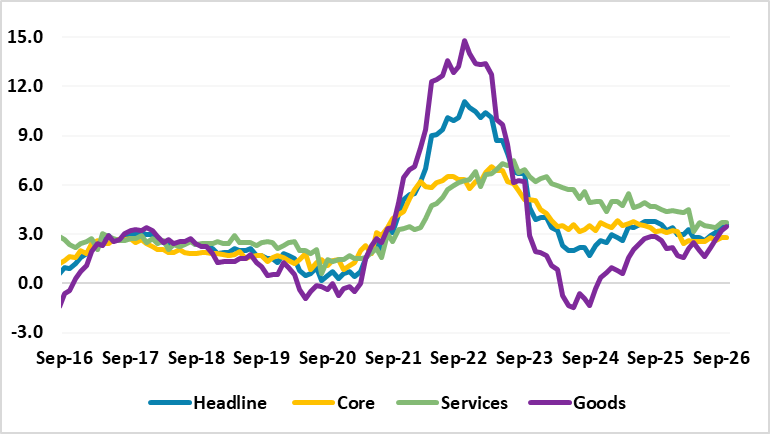
Headline annual inflation rose 3.6% in October from 3.5% in September, broadly in line with expectations with transport, particularly motor fuels, making the largest upward contribution to the month-on-month CPI. Core was unchanged at 2.8%, with goods ticking higher to 3.5% from 3.2% while the larger service sector saw inflation unchanged at 3.7%. As in recent releases, today’s number continues to reflect the energy shock with little sign that is broadening out to other parts of the economy.
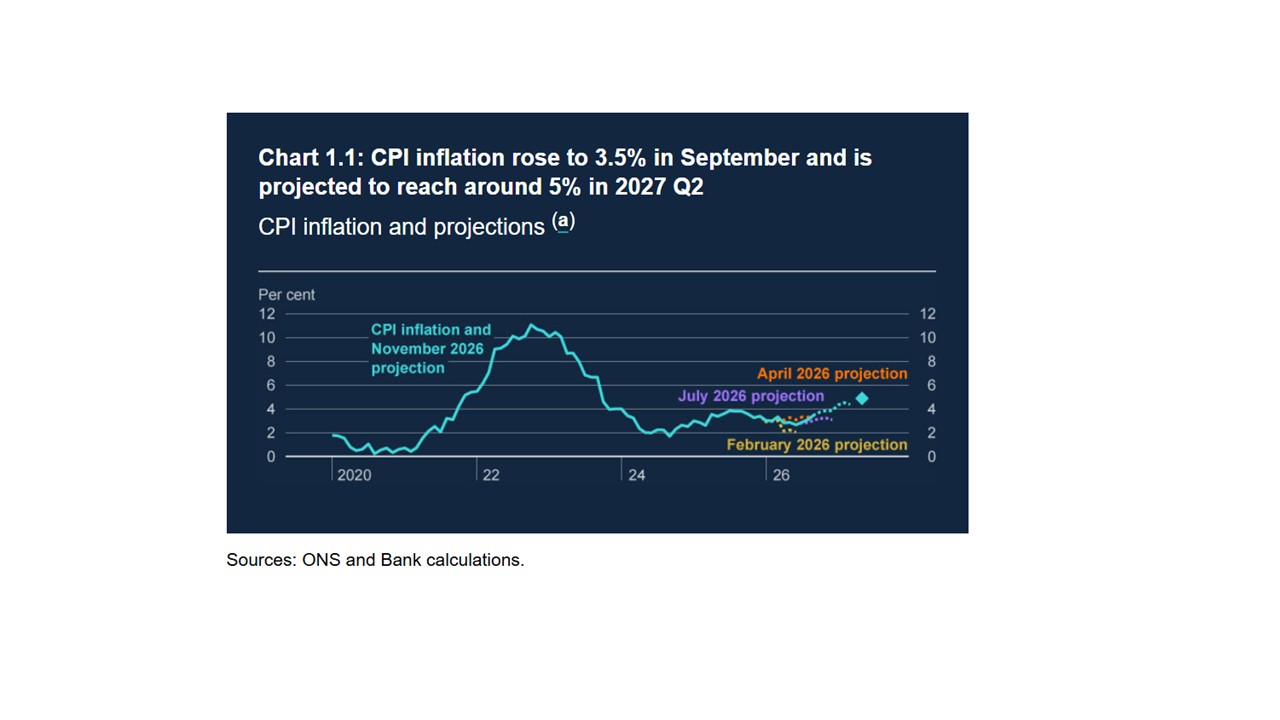
Headline annual inflation rose 3.6% in October from 3.5% in September, broadly in line with expectations with transport, particularly motor fuels, making the largest upward contribution to the month-on-month CPI. Core was unchanged at 2.8%, with goods ticking higher to 3.5% from 3.2% while the larger service sector saw inflation unchanged at 3.7%. As in recent releases, today’s number continues to reflect the energy shock with little sign that is broadening out to other parts of the economy. October’s number is also broadly in line with the inflation path published in the BoE’s November Monetary Policy Report (MPR) (Figure 2) which shows CPI heading to just under 4% before this year is out and to 4.5% by end Q1, peaking at 5% in Q2.
On a month-on-month basis, today’s increase was 0.5% (following 0.5% and 0.4% in August and September) partly reflecting the 4% increase in Ofgem’s price cap (a move that allows energy companies to charge more for electricity and gas). A further and larger price cap increase is expected at the start of next year and that will be the basis for the jump in headline inflation forecast by the BoE and others. Ofgem will formally announce the new energy price next week (25th November) and will cover the period of 1st January to 31st March 2027. Major energy suppliers and industry analysts (including EDF, British Gas, and E.ON) project a significant rise - with forecasts pointing to an increase of roughly 23% to 26% for typical dual-fuel households. That will push up headline inflation roughly to where the BoE currently forecasts.
Higher energy costs are having limited impact on overall consumer prices partly because there has been limited pass-through of higher wholesale energy prices to firms’ costs (see our preview). Where costs have increased these are being absorbed in firms’ lower profit margins according to the most recent BoE survey, Decision Maker Panel (DMP). We expect the energy price cap increase and the higher costs of borrowing to hurt households' pockets and thereby reduce overall spending making it less inflationary on the economy as a whole. Wage growth remains weak in a subdued labour market and higher inflation is unlikely to trigger a price-wage spiral. The market has priced in an 80% chance of a December hike with the next 25bp move expected later in February.
Figure 1: UK Inflation By Key Categories (%Y/Y)
later Source: Datastream/CE
Figure 2: BoE Inflation Forecast Path - Dashed Line Shows Forecast Up To Q1 2027
Source: Datastream/CE