Contrasting UK Labour Market Still Consistent With No Second Round Effects
Today’s labour market data showed mixed signals with potential implications for future BoE MPC decisions. The ONS reported a falling unemployment rate (easing to 4.6% from 4.7%) - which at face value might be a reflection of the economy’s ongoing resilience. The data also showed a slowdown in wage growth. Falling unemployment would suggest that “slack” in the economy is being reduced and hence a potential upward driver of wage growth in coming months. In principle, lower-than-expected labour market slack might keep wage growth elevated and fuel second-round inflation effects. There are several qualifiers to this statement and we continue to think that the Bank will not hike as much as the market expects.
Today’s labour market data showed contrasting signals with potential implications for future BoE MPC decisions. The Statistics office (ONS) reported a drop in the unemployment rate (easing to 4.6% from 4.7%) which at face value might be a reflection of the economy’s ongoing resilience. The data also showed a slowdown in wage growth. Falling unemployment would suggest that “slack” in the economy is being reduced and hence a potential upward driver of wage growth in coming months. In principle, lower-than-expected labour market slack might keep wage growth elevated and fuel second-round inflation effects.
There are several qualifiers here. Firstly, the drop in the unemployment rate (measured as the number of unemployed divided by the total labour force) fell in the 3 months to September because of survey methodology changes and a stagnant "low-hire, low-fire" job market rather than a booming economy.
The ONS explicitly stated that the decline in the unemployment rate partly reflected changes in the Labour Force Survey sample (the denominator in the unemployment rate definition); the group of respondents rotating out of the survey had unusually high unemployment and low employment compared to the new group entering the survey, which mechanically pulled the headline jobless rate down.
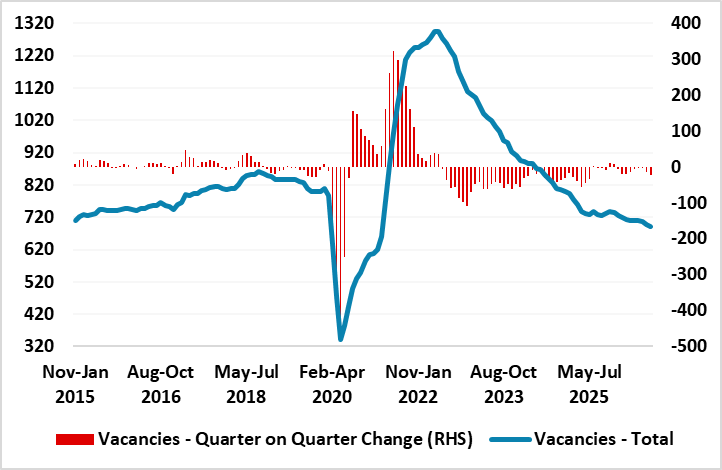
Secondly, today’s data also showed a sharp drop in job vacancies (Figure 1). For the quarter ending October, available vacancies dropped by 22,000 to 690,000, marking the lowest level since 2014 (outside of the pandemic). The ONS noted this drop was concentrated in smaller businesses struggling with higher labour and operating costs.
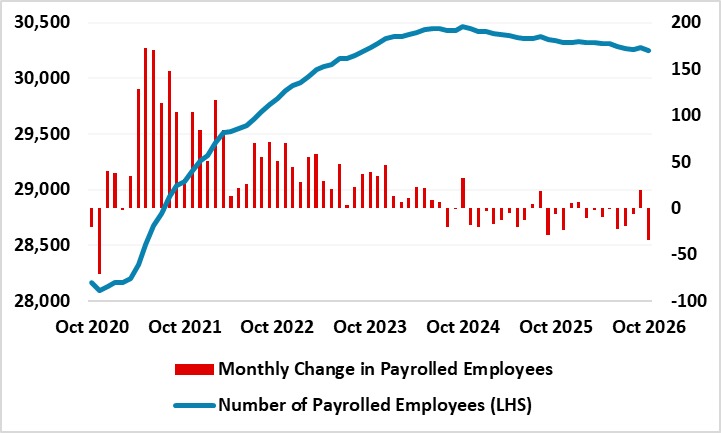
Thirdly, HMRC tax data (Figure 2) showed a provisional drop of 34,000 in the number of people on company payrolls in October, signalling that the underlying demand for labour is softer than the headline unemployment rate would suggest.
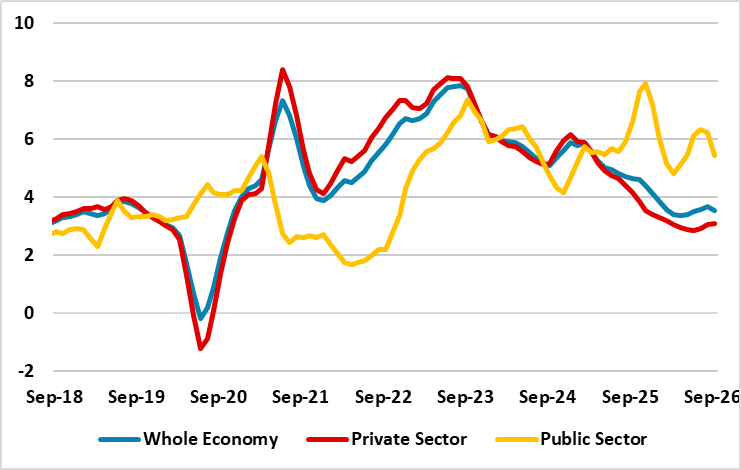
Earnings data also slowed after a short-lived upward blip over the summer. UK average regular earnings growth (excluding bonuses) slowed to 3.5% y/y in the three months to September 2026, down from 3.7% in the previous period (Figure 3). The slowdown in overall wage growth was heavily influenced by a normalisation in public sector pay, as the baseline effects of previous government pay awards faded out of the annual comparisons. Public sector regular pay was 5.4% in September compared to 3.1% in the private sector.
For hawks on the MPC, such as Greene and Pill, the average earnings report is not the only measure of wage growth they are focusing on. They are also looking at the Bank’s own Decision Maker Panel (DMP) which showed wage growth of 3.9% in the three months to October 2026 and expected year ahead wage growth of 3.4%. For the hawks, a figure of that magnitude is inconsistent with meeting the BoE 2% inflation target. Analytical work undertaken by the Bank (highlighted in the February 2026 Monetary Policy Report) suggested that wage growth of 3.25% is consistent with meeting the CPI target and anything higher might prove to be averse to inflation dynamics. However, this simple rule of thumb makes a number of unrealistic assumptions including optimistic labour productivity growth and an assumption that companies pass on every penny of higher wage costs directly onto consumers (see Box A here) and as such it should be seen as a guideline rather than a magic number.
To us, the labour market remains soft and cooling with wage growth also slowing. The data does not suggest there is an imminent risk of second round effects and we continue to think the Bank will not hike as much as the market expects.
Figure 1: Job Vacancies Total (Thousands of People) and Change in Vacancies (%Q/Q)
Source: Datastream/CE
Figure 2: HMRC Payrollled Employees (Thousands of People and %M/M)
Source: Datastream/CE
Figure 3: Average Weekly Earnings (%Y/Y, 3 month Average)
Source: Datastream/CE