ECB Preview: October Hold but Markets to Focus on Response to Widening Spreads
The ECB is widely expected to keep rates on hold this Thursday with financial markets instead focusing on the tone of the statement and President Lagarde’s comments in the press conference. In particular, analysts will be keen to hear whether September’s hawkish language has changed given France’s evolving fiscal and political crisis. Back in September, President Lagarde described the 25bp hike as “a no brainer” with the Governing Council assessing that the risks to inflation were “tilted to the upside and those to growth as tilted to the downside”. The general impression back then was that the Bank would hike once more before the year is out, possibly in December when new Staff forecasts are released. Tighter financial conditions could yet challenge that view.
Any hike at this meeting would come as a big surprise to markets given recent comments by ECB members such as hawkish Bundesbank President Nagel who noted that second-round effects are yet to appear; markets are also pricing just an 11% chance of a hike. The focus of financial markets will instead be on ECB communication and the Bank’s response to the widening of French government bond spreads - the 10-year OAT-Bund spread has widened to just below 160bp from roughly 90bp at the time of the ECB’s September meeting, and French 10-year yields now trade just under 5%, higher than those of Italy and Greece.
The ECB’s job at this meeting will be to strike a fine balance between acknowledging the risks to financial conditions while avoiding any impression that it stands ready to backstop a country that is not currently complying with EU fiscal rules. We expect President Lagarde to say that the ECB is monitoring markets closely and that it has the necessary tools to counter disorderly market dynamics, while stressing that those tools come with conditions. We don’t expect the ECB to be specific on the potential tools at its disposal whether that is Transmission Protection Instrument (TPI) or a halt to QT. The ECB is also likely to repeat that inflation risks remain tilted to the upside while refraining from any pre-commitment.
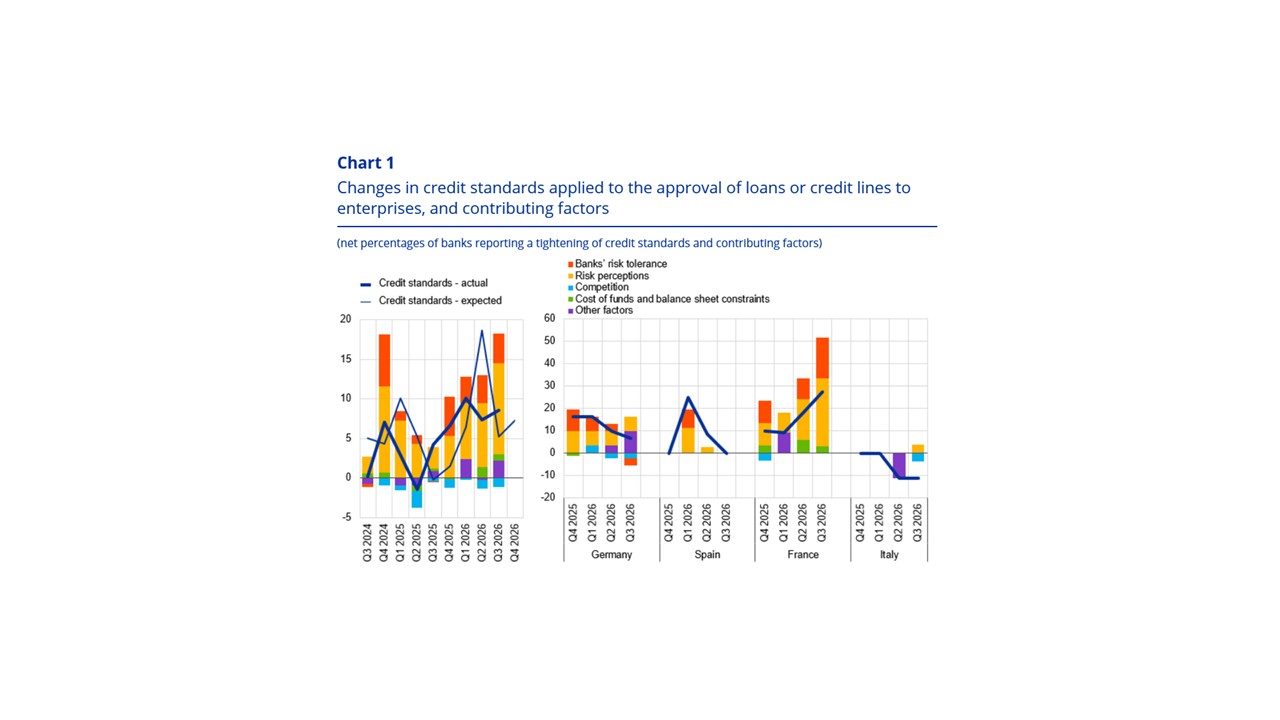
To a large extent the ECB has been overtaken by events. The rise in yields has already done some of the tightening for the Bank and the urgency to hike has moderated. A general rule of thumb is that the surge in German bond yields since the September meeting has already had roughly the same impact on growth and inflation as an additional 25bp rate hike. For France, it’s closer to a 50bp hike. While September’s actual bank lending figures still look healthy, the latest ECB Bank Lending Survey (BLS) pointed to some early signs of tighter financial conditions, suggesting that eurozone credit growth could moderate in coming months. In particular, the survey noted that commercial banks in France had reported “the largest tightening impact from risk perceptions since the fourth quarter of 2020, with a particularly large contribution from the industry-specific or firm-specific situation.”
Figure 1: ECB Bank Lending Survey Points to Tighter Lending Standards
Source: Datastream/CE
The bank lending survey also showed a strong net decrease in demand for housing loans, “the most pronounced decrease since the third quarter of 2023” and that outcome was stronger than banks had expected in the previous quarter. The banks noted that “rising interest rates, declining consumer confidence and worsening housing market prospects weighed on demand for housing loans”.
We maintain our call that the ECB is likely to hike once more, and likely in December, taking the deposit rate to 2.75%. But any further significant tightening in financing conditions between now and December could change that view. Markets are currently pricing 3 hikes by December of next year while we continue to see 2.75% at the peak of the current tightening cycle.