UK BoE Preview: One and Done?
The BoE is poised to lift policy rates to 4% this week with polls suggesting the vote will be 7-2 in favour of a 25bp move. The Bank will also update its macroeconomic projections to show a higher peak in inflation. Two external members, Taylor and Dhingra, are once again expected to vote to keep rates on hold - given their view of spare capacity in the economy - while the three members who voted to hike in September (Pill, Green and Mann) will likely do so again. That means that just 2 of the remaining 4 members (Governor Bailey, Breeden, Ramsden and Lombardelli) are needed to flip the outcome in favour of a hike.
Breeden and Ramsden have made comments which suggest they would side with the hawks. Breeden said that it would be "increasingly appropriate" to respond to growing inflation risks by raising interest rates while Ramsden also said “were upside pressures on the inflation outlook to continue to build, there could be a case for increasing Bank Rate.” Governor Bailey has also shifted his position noting the “loss of urgency to find solutions” to the Iran conflict and the disruption to energy supplies, and that if the conflict persists “as appears to be the case, and the risk of second-round effects emerging increases, it is likely that policy may have to tighten.”
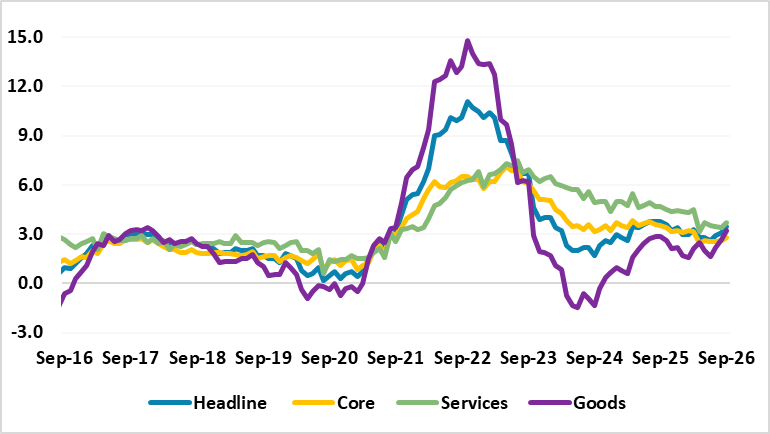
So far there has been little sign of widespread inflationary pressures beyond the headline CPI rate. But with inflation already at 3.5% the peak looks set to top 4% given the spike in natural gas prices and the expected 25% increase in the energy cap (the decision on whether the cap is lifted will be on 25th November).
At 3.75%, the BoE already has policy rates in somewhat restrictive territory, allowing it to be more patient than other central banks. But given the lags in monetary policy, which affect the economy some 12 to 18 months after an increase in policy rates, the Bank has to act sooner if it wants to have any meaningful impact on activity. Past research by the BoE has shown that a 4% headline inflation rate increases the chances of second round effects though at present wages remain stable with private sector wages growing at around 3% y/y. The Bank is also keeping a close eye on services inflation (which has crept up modestly to 3.7% from 3.2% in April). Prices in this sector are more tied to domestic labour and wage costs rather than global commodity or energy swings.
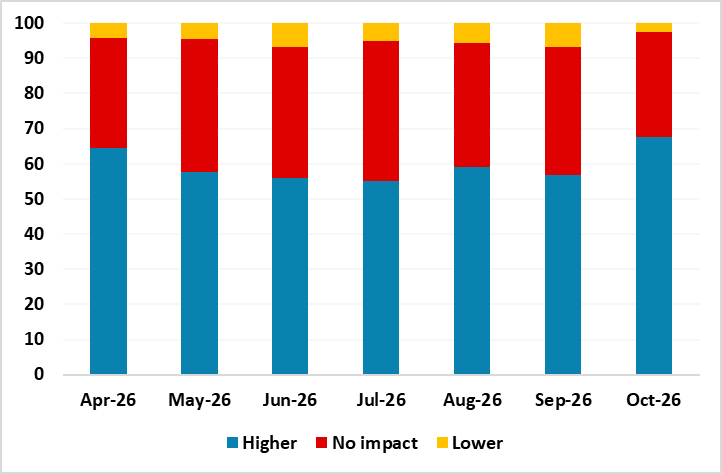
Last week’s Decision Maker Panel (DMP) survey by the BoE was important in that it showed that there increasing pressures on firms as the energy shock persists. In October, some 68% of firms said they expected to increase their prices over the next 12 months, up from 57% in September while 71% of companies anticipated lower profit margins as they struggle to fully absorb soaring fuel and utility costs.
At present, financial markets expect the Bank to lift rates to 4.75% by November of next year but we think this is overdone. Our forecast is for rates to peak at 4% though a one-and-done hike is highly unusual for the BoE. On one occasion - in November 2017 - the Bank famously enacted what many analysts treated as a "one-and-done" insurance move. It raised the base rate from 0.25% to 0.50% to reverse the emergency post-Brexit cut. We will update our BoE view once we have read the statement and the forward guidance therein. But we also expect some of the members (Pill) to question current market pricing of 3 more hikes next year.
Figure 1: Inflation by Main Category (%Y/Y)
Source: Datasream/CE
Figure 2: 68% of Firms Expect Energy Price Increases to be Absorbed via Higher Prices in the Next Year (% of respondents)
Source: Datastream/CE