BoE patience on inflation outlook will be tested the longer conflict goes on
Recent comments by BoE members continue to show a divergence of views between those who prefer a pre-emptive rate hike and those who want to see evidence that the initial oil shock is spreading to the rest of the economy. The three members who voted for a hike last month (Pill, Mann and Green) warn the Bank risks falling behind the curve if it doesn’t act soon enough given that monetary policy takes more than 12 months to exert its full effect on inflation and economic activity. Doves like Taylor, on the other hand, point to scant evidence of second-round effects at present and noting that the current policy rate at 3.75% is already “sufficiently restrictive". Other doves such as Ramsden acknowledge that the longer higher energy prices persist, the greater the risk that indirect effects build and that inflation expectations, wage bargaining and price-setting behaviour begin to adjust in response. Some of the doves are effectively hedging their views making the November 5 meeting a live one.
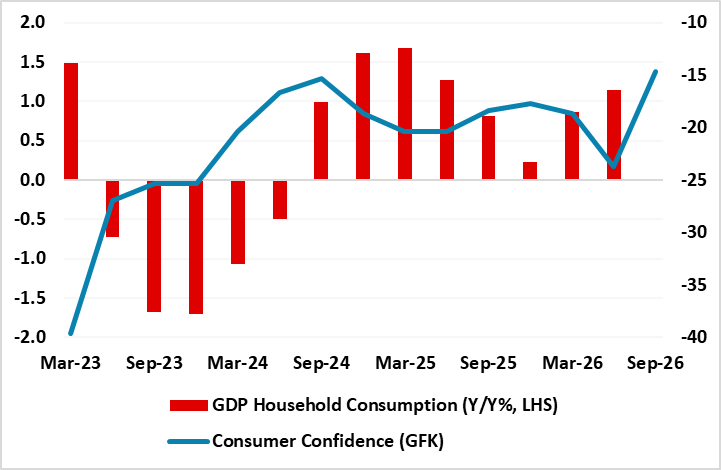
Recent data shows few signs that UK economic activity is being affected by the oil/natural gas price shock while simultaneously showing signs of higher inflation, at least in the headline inflation rate. Last week’s upward revision to Q2 growth was a reminder of the economy’s resilience in the face of rising energy costs even if the outlook remains highly uncertain. At surface level the upward revision to Q2 was good news, with GDP growth 0.5% q/q, instead of the previous estimate of 0.4%, with other modest upward and downward quarterly revisions over 2025 and 2026 essentially cancelling each other out. Part of the reason for the better outturn was the warm weather and the football world cup but also the fact that consumers were insulated from the rise in household gas and electricity bills. Lower levels of energy demand during the summer and the Ofgem energy price cap provided a cushion for households. Consumer confidence also recovered as households grew more optimistic about their personal finances.
Signs of a slowdown are evident in some indicators but not overwhelmingly enough to change the picture of resilience just yet. The consumer, for instance, appears to be holding up but for how long if households continue to be affected by the rising cost of credit and rising inflation. Employment is also slowing and wage growth is easing.
Figure 1: Household Consumption and Consumer Sentiment
Source: Datastream/CE
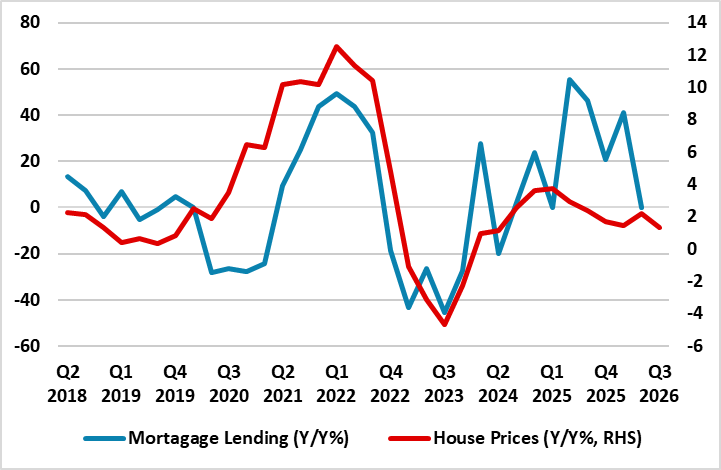
One clear sign of the impact of higher borrowing costs is the slowdown in mortgage borrowing. The number of residential mortgage approvals dropped to its lowest level since late 2023 as the cost of borrowing and living costs weighed on housing demand. Inflation concerns, potential rate hikes and the uncertain economic outlook are weighing on the housing market with house price growth moderating.
Figure 2: Mortgage Lending and House Prices (Nationwide Index)
Source: Datastream/CE
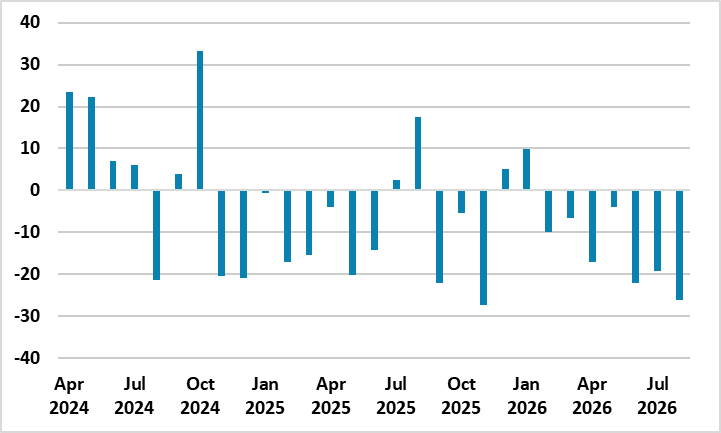
The labour market is also softening. Estimates for August suggest that the total number of payrolled employees in the UK economy eased to 30.2 million, had some 145,000 fewer employees in the past year. Job vacancies have also slid toward multi-year lows (around 707,000) and regular pay growth has moderated to around 3.5%. The latest PMI release for the UK also said that the jobs market “remains mired in an extended slump marked by continuous workforce reductions”.
Figure 3: Employment Changes (Thousands, HMRC data)
Source: Datastream/CE
At the same time, inflation has been rising but that is an inevitable response given to the oil price shock. What we have seen so far are first round direct effects of that shock, an immediate impact manifested in the energy CPI component of overall CPI with little sign of inflationary pressures in the large service sector component. Indirect effects, on the other hand, have been slower to emerge with little evidence that firms are passing higher energy costs to the prices of other goods and services.
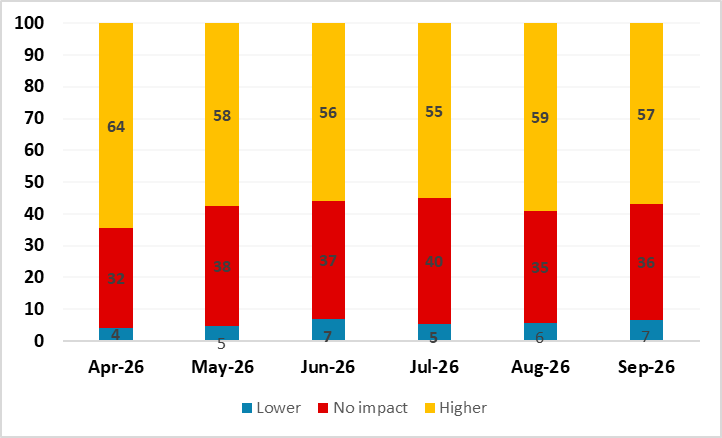
One of the surveys the Bank is looking at for signs of the oil shock spreading to the rest of the economy is the Decision Maker Panel (DMP). The most recent survey found that businesses appear to be absorbing these higher costs for now perhaps because they see the Iran conflict as being short lived. The September DMP showed that higher prices and lower profit margins remained the most common forms of adjustment.
Figure 4: How are UK firms' prices expected to react to the oil shock in the next year
Source: BoE/CE
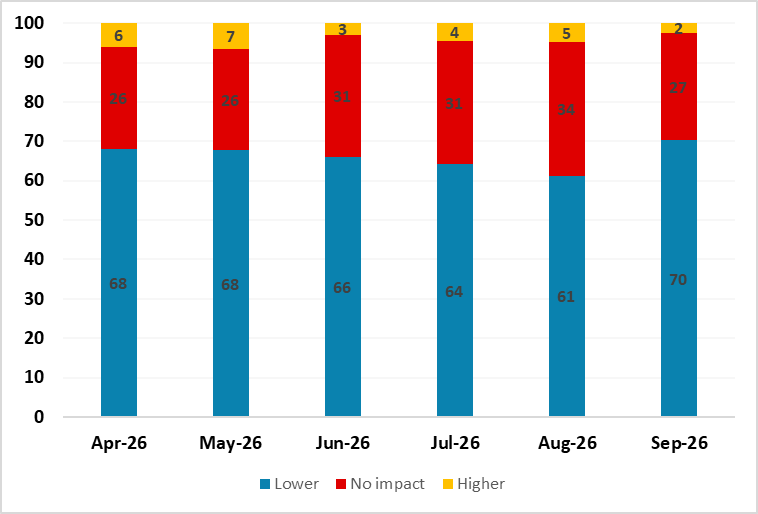
The DMP survey showed that some 57% of firms expected to increase prices (but that was 7 percentage points lower than in April, in Figure 4), while some 70% of firms expected lower profit margins (Figure 5), 2 percentage points higher than in April. How firms adapt to the oil shock will of course depend on how the conflict evolves.
Figure 5 How are UK firms' profits expected to react to the oil shock in the next year
Source: BoE/CE
The longer energy prices remain high and volatile, the greater the risk for pass-through more widely into wages and prices. So far there has been no evidence of that happening as suggested with wage growth expected to remain around 3.5% for the year ahead (from the DMP survey).
For some on the MPC, the lags in monetary policy mean that the Bank may not be able to afford to wait for actual evidence of higher wage growth. The current state of the labour market suggests that the chances of a price wage spiral are limited at this stage.
The Bank will be watching closely for evidence of inflation propagation in surveys, hard data, and considering changes to the policy rate on a meeting-by-meeting basis. As MPC member Lombardelli suggested in a recent speech, the key issue is not the spot price of energy but the interaction of the underlying economy, higher energy prices, and the nature of their transmission. But the longer the conflict goes on, the higher the chances the Bank may have to react. Two of the three MPC members who voted for a hike in September (Green and Mann) are due to speak this week and may provide some direction on the November meeting. Governor Bailey will participate at a panel discussion in Istanbul though UK economic matters are not on the agenda. The September MPC minutes also made clear that some of the 6 that voted for no change may reconsider if Iran war shock become more prolonged. This still makes the November 5 MPC meeting a live meeting.