BOE September Preview: No 2026 Hike
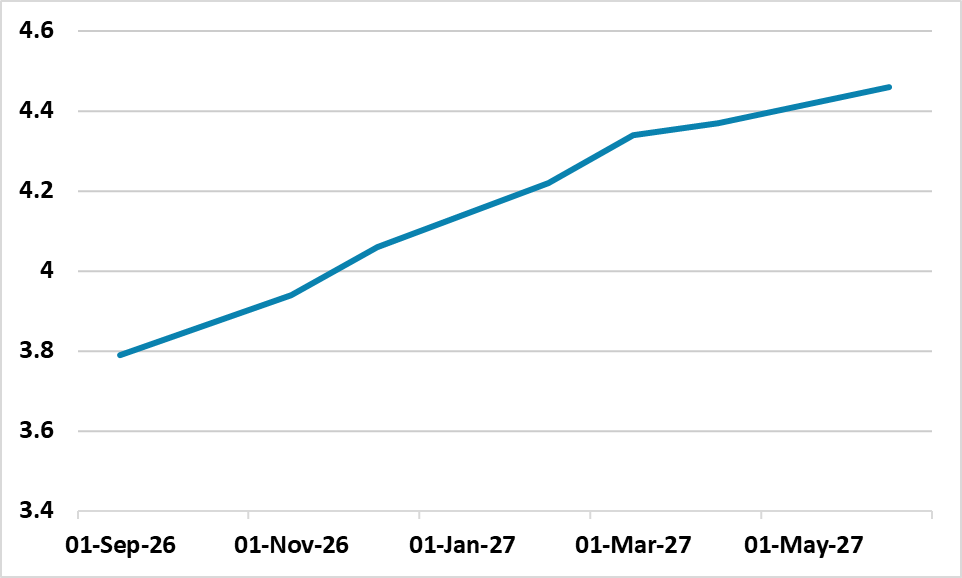
· BOE Bailey at Jackson hole highlighted the quite subdued 2nd round effects from the Iran war surge in energy prices, which suggests that the bulk of the MPC will likely not vote for a hike at the September 17 MPC meeting. A risk does exist of a Q4 hike, though our central view is for no hike this year. Additionally, money market expectations of a further 25bps hike in H1 2027 to 4.25% are highly unlikely due to UK labour market weakness and expected fiscal tightening.
Figure 1: UK Money Market Futures Implied BOE Policy Path (%)
Source: Refinitiv/CE
In contrast to expectations of a 25bps ECB hike on September 10 and a high risk of a Fed move on September 16, money markets are not really discounting much of a risk of a BOE hike on September 17, with only a 20% probability. Key points re the BOE
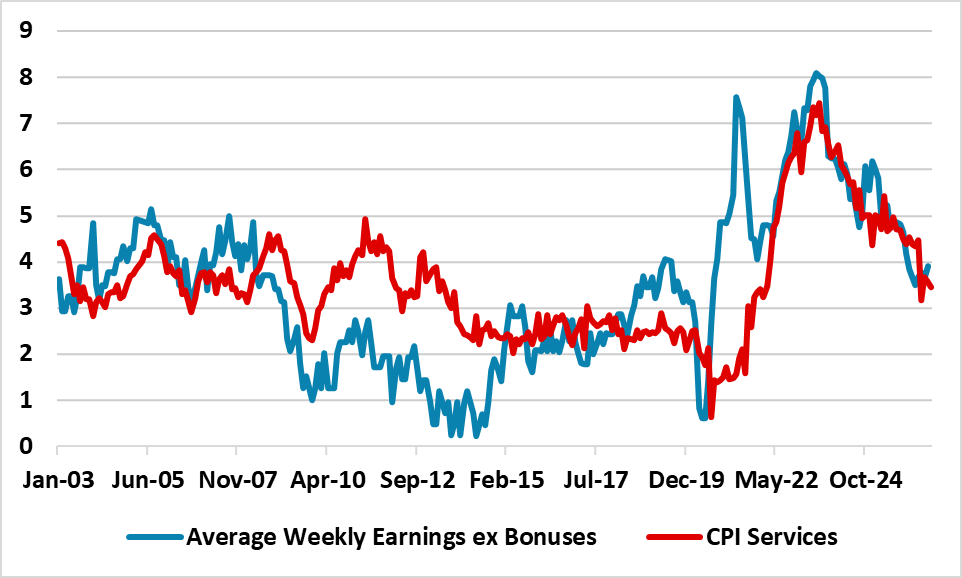
· BOE Bailey and little 2nd round effect. BOE Bailey at Jackson Hole provided an update that 2nd round effects are quite subdued from the Iran war energy price shock. This reflects two issues. Firstly, the UK labour market is the softest of the G7 economies, with employment falling using the key HMRC data; unemployment rising and private sector wage growth continuing to slow. Wage data is already consistent with a 2% inflation trajectory provided energy prices stop increasing and partially reverse into 2027 (as discounted in oil and gas futures curves). This also suggests that CPI Services should come down further (Figure 2). Secondly, UK households are expecting further fiscal consolidation, given the recommitment of PM Burnham to the fiscal rules and given the limited fiscal headroom that currently exists. This is impacting household behaviour and restraining consumption and house purchases.
Figure 2: Average Weekly Earnings Ex Bonuses and CPI Services (%)
Source: Datastream/Continuum Economics
· 6-3 MPC split. The July MPC meeting saw a 6-3 split with Bailey and others voting for no change in rates based on the rationale above and also that higher yields were already causing some restrictiveness in monetary policy (alongside a policy rate already 50bps above neutral). It is difficult to see the gang of 6 changing this steady view at the September 17 meeting and the odds are on a further 6-3 split. The BOE November 5 meeting will see new inflation projections, which makes this more of a live meeting with an 80% probability of a 25bps hike discounted in the money market. Even so, based on our macro forecasts, we still see no hike this year.
· 2027 tightening expectations. Figure 1 also shows that the market fully discounts a 25bps hike at the December 17 MPC meeting and then a further 25bps hike to 4.25% at the March 18 MPC meeting. This is at odds with the energy future curves that looks for an easing of oil and gas prices through 2027. It could be expectations that 2nd round effects will feedthrough and force the BOE hand, but the weak labour market in the UK and a pick-up in fiscal consolidation in 2027 are headwinds. It could also be spill over from expectations that the BOE will follow the ECB and Fed with a lag. This is possible in terms of one 25bps hike in the autumn, but a 2nd hike in 2027 is highly unlikely. Indeed, our baseline is that economic pressures on Iran and the U.S. will be enough to get a 2nd ceasefire and a pick-up in energy shipments through the Straits of Hormuz. This will likely mean energy prices in 2027 that are somewhat below current futures curve and some extra disinflation. This makes it highly unlikely that we will see a 25bps hike from the BOE in 2027 and we still feel that it’s more likely that two 25bps cuts will be delivered by the BOE in 2027.