France’s Fiscal and Political Challenges Grow. Could Le Pen Fix It?
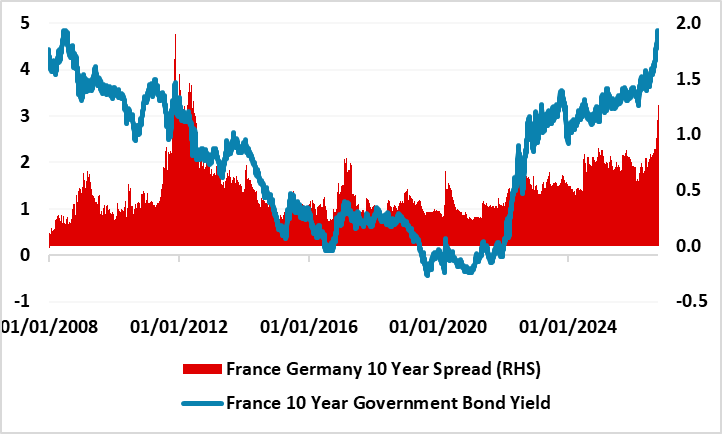
France’s 10-year borrowing costs have climbed above 4.9%, reaching their highest level since the 2008 global financial crisis (GFC) with the OAT/Bund spread widening to around 130bps, the highest level for 14 years. The combination of intense domestic political fragmentation, rising fiscal concerns and broader global factors are making financial markets very nervous right now. In presenting the new budget, the French government forecasts that the public deficit will reach 5.0% of GDP next year, a worse position than the 4.6% objective set at the start of the budgetary process, but just below the expected outturn of 5.4% in 2026. Without the corrective measures announced on 1st October, France’s deficit would have reached 6.5% of GDP in 2027 as interest payments, pensions and other expenditure continue to rise. The deterioration in the fiscal position means that public debt is now forecast to rise from 119% of GDP in mid-2026 to 122% in 2027. Can Marine Le Pen fix France's fiscal woes if she wins next year's election?
Concerns over the fiscal outlook are likely to linger for a while since the governing centrist minority government lacks a clear parliamentary majority, making the passing of the 2027 Finance Bill an immense challenge. Parliament is effectively gridlocked into three competing factions - the far-right, the centre, and the left-wing bloc. The National Assembly will have until mid-December to pass both the budget and a separate bill covering the financing of the social security system. It is possible that the next few weeks could see a lot of horse trading resulting in a modified budget, but one which may not receive enough support for a formal vote.
In that potential scenario, the government could use Article 49.3 of the constitution, which allows it to pass the bill without a formal vote, unless an absolute majority of MPs vote to bring down the government. A successful no-confidence motion might even force the government to resign and prevent the budget from being adopted through Article 49.3. That seems unlikely. It would not be in the oppositions’ interest, since prolonging the political turmoil would leave the winner of the 2027 presidential election facing an even more urgent fiscal problem. And the potential winner of that election is increasingly looking like it might be Le Pen.
Figure 1: Yields Rise, Spreads Widen
Source: Datastream/CE
French Politics Could Get Messier
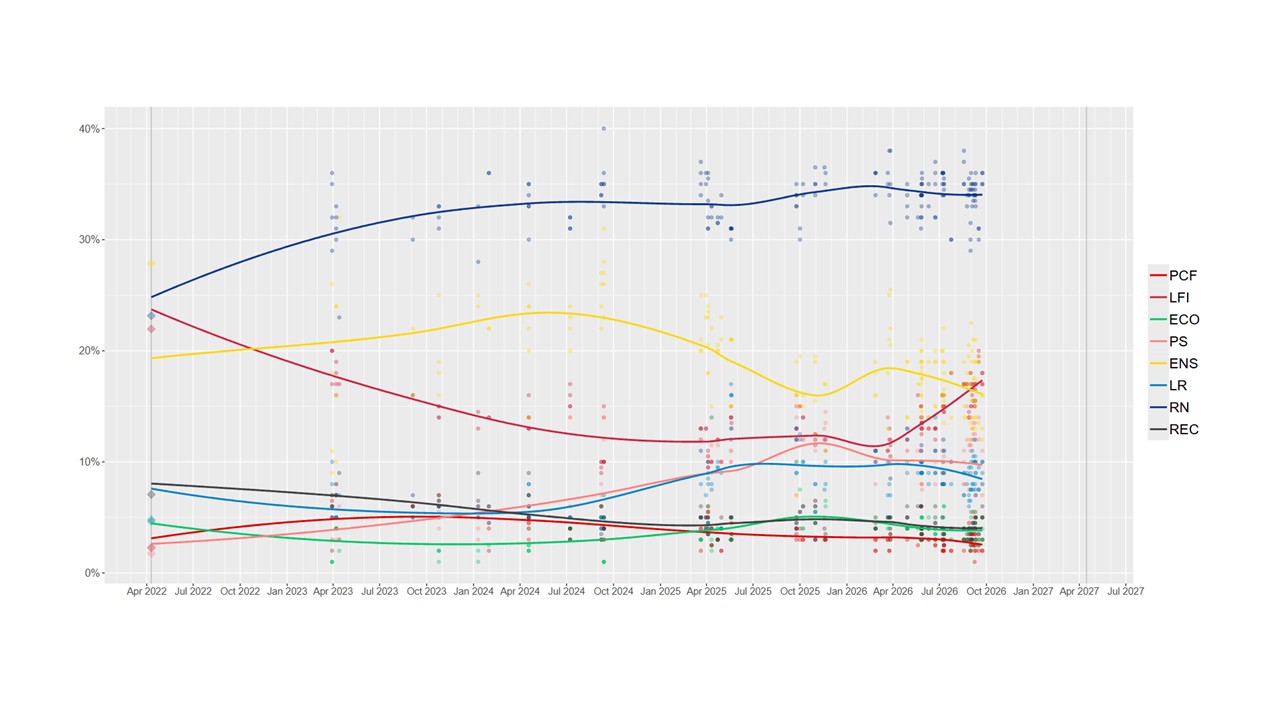
The latest polls suggest that French voters could face a potentially thorny choice between two extremes, the far-right National Rally (RN) candidate Marine Le Pen or the far left La France Insoumise (LFI) contender Jean-Luc Melenchon. The French electoral system requires an absolute majority (50% + 1) of votes in the first voting round on 18th April 2027. If no clear majority is obtained a second round is held two weeks later between the two candidates who received the most votes. Polls suggest that Le Pen would win 35% in the first round, Melenchon 17% and leading centrist hopeful Philippe winning 13% to 16%, not enough to reach the run-off. As polls stand, Le Pen would beat both Melenchon and Philippe in the second round. She would win 69% of votes against Melenchon and 57% against Philippe.
Figure 2: Polls Show Le Pen as the Clear Favourite in the First Round
Source: Harris, Ipsos, YouGov
Could a Le Pen Government Rise to the Fiscal Challenge?
Le Pen has shown that she can evolve and accommodate on fiscal and economic policy as part of her strategy to broaden her appeal. In recent months, she has dropped her long-standing pledge to pull France out of the Eurozone and return to the Franc; she now promises to reform the bloc from within. She talks of social welfare expansion but also mentions large state efficiency cuts designed to signal fiscal discipline. She has also tempered her populist spending promises with talk of fiscal responsibility. Le Pen has pledged to introduce a "golden rule" to lower deficits to 3%, but at the same time promised to undo Macron's unpopular pension reform by rolling back the retirement age to 62 from 64, a move that would add significant structural expense to France's already strained pension system.
To offset these costs, Le Pen has proposed a sweeping plan to cut €125bn in public spending with analysts suggesting her plan relies heavily on curbing immigration and reducing social benefits for non-citizens. A key pillar of her deficit-reduction plan would also involve halving France's financial contribution to the European Union budget, a move that would violate EU treaties, likely spark legal retaliations, and lead to severe friction with Brussels.
Her shift toward a more business-friendly posture has caused some internal friction within RN. Jordan Bardella, Le Pen’s running mate and likely choice for prime minister, has pushed for more liberal, pro-business policies to court mainstream industries a stance that has occasionally clashed with the party’s traditional "old guard" economic advisers who favour state interventionism and heavy protectionism.
Back to today, Le Pen has signalled that passing the current budget is necessary - even if imperfect - given the potential for a debt crisis. According to Le Monde, RN would prefer to enter 2027 with an imperfect budget that could later be amended rather than inherit no full budget and have to prepare an emergency one after the election. The rapid deterioration of public finances means no future president will be able to avoid harsh trade-offs. Even if the RN today says that it intends to exercise fiscal restraint, a post-election fragmented parliament could still force compromises, causing further fiscal slippage.
I,Robert Sierra, the European Economist declare that the views expressed herein are mine and are clear, fair and not misleading at the time of publication. They have not been influenced by any relationship, either a personal relationship of mine or a relationship of the firm, to any entity described or referred to herein nor to any client of Continuum Economics nor has any inducement been received in relation to those views. I further declare that in the preparation and publication of this report I have at all times followed all relevant Continuum Economics compliance protocols including those reasonably seeking to prevent the receipt or misuse of material non-public information.