BOE Preview After CPI: Hawkish Noises
• The BOE will likely maintain a hawkish bias on July 30, but are unlikely to signal a September hike. The June CPI did not really change this picture, with the core unchanged at 2.6%. Though BOE Bailey recently noted the unstable process (in the Straits of Hormuz and for energy prices), he also noted that economic data pointed to limited impact on UK inflation and this argues against signalling a September hike. We remain of the view that a soft economy will stop the BOE from hiking and that policy rates will be cut in 2027 (here).
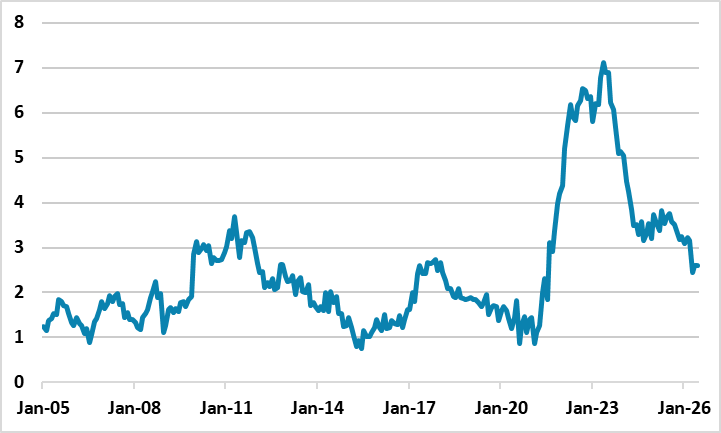
Figure 1: UK Core CPI Yr/Yr (%)
Source: Datastream, CE
• The latest CPI figures in the UK provide little surprise for the BOE. Headline came down as expected given the lower oil prices at the time compared to May, while food prices were also soft. However, core inflation at 2.6% Yr/Yr was unchanged compared to the May outcome. Nevertheless, Tuesday labour market data does suggest that underlying inflation pressures should ebb, with May average earnings ex-bonus at 3.4% and HMRC June payroll change at a soft -3k.
• This all feeds into the BOE thinking, with the July 30 monetary policy report and MPC minutes providing extra insight into the MPC forward guidance. Money market futures are discounting that a 25bps hike will be delivered at the November meeting followed by a further 25bps to 4.25% in March 2027. BOE Bailey comments to the Treasury Select committee last week suggest that a hawkish bias will remain, but is unlikely to signal a September hike. Bailey noted that the 4 days of clashes between Iran and the U.S. at that stage mean that we could be left with an unstable process (in the Straits of Hormuz and for energy prices) for the foreseeable future. This argues to keep a hawkish tone. Even so, gas prices have reacted less than oil prices at this stage and this makes the latest Iran/U.S. tension less of a worry – we also see economic pressures sees Iran and U.S. cool the recent hostilities and going back to negotiations (here). Bailey also noted that economic data pointed to limited impact on UK inflation and this argues against signalling a September hike. We remain of the view that a soft economy will stop the BOE from hiking and that policy rates will be cut in 2027 (here).
• Meanwhile, the BOE is widely expected to slow the pace of QT at the September meeting from £70bln pa to £50bln pa. Bailey will likely be asked about this, but could prove non-committal and this would be read as acknowledgment that the slowing of QT will only be modest. Some speculation exists that the BOE could commit to not selling long-dated gilts, as a £50bln target would still require moderate gilt sales in the short and medium parts of the curve where demand is better.