BOE Keeps Rates Unchanged but November Meeting a Close Call
As expected, the BOE kept rates unchanged with the committee voting 6-3 in favour of staying at 3.75%. MPC members Green, Mann and Pill voted to increase rates by 25bp, as they did in July. Today’s monetary policy statement is essentially unchanged from the July statement, with the focus still on the energy shock but with a modest difference in tone. While the statement notes that there is “little evidence so far of material second-round effects in price and wage-setting…...the risk of such effects, against which policy needs to lean, is greater the longer higher energy prices persist or are more volatile.” Importantly, 2 of the 6 members who voted to keep rates on hold raised concerns that the risk of second-round effects would increase in the absence of a lasting resolution of the conflict. This raises the possibility that the vote could be tilted towards a hike if these members switch sides. The November rate decision is likely to be a close call.
The optics don’t look good with headline inflation at 3.1% (though core remains steady), oil back above a USD100pb and the energy cap in January 2027 likely pushing headline inflation towards the 4% mark. The statement confirms this saying that “a mechanical update to Bank staff’s short-term inflation projection suggests that CPI inflation could now reach slightly over 4% in early 2027”.
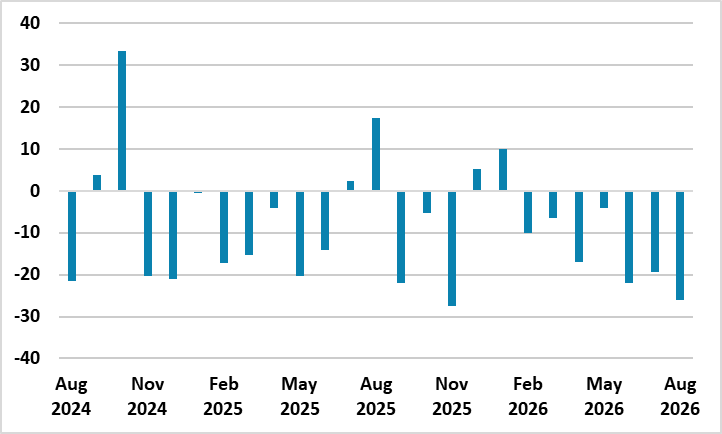
But as the Bank suggests, and we have argued in our commentary, there is no sign of an increase in domestically-generated inflation pressures, ie in the services sector. This week’s labour market data continued to suggest a gradual increase in slack, with payroll employment falling again in August (Figure 1). Tighter financial conditions following the global bond sell-off are also doing some of the work for the BoE.
Moreover, at 3.75%, the BOE already has policy rates in restrictive territory, above its estimated neutral rate range of 3.25%-3.50%. And October’s Budget may yet have some surprises in store for households.
The Bank “also voted unanimously to reduce the stock of UK government bond purchases held for monetary policy purposes, and financed by the issuance of central bank reserves, to zero”. This will be conducted through a multi-year plan, such that the remaining stock is unwound at an annual average pace of £46 billion by the end of 2034, through annual sales of £20 billion alongside maturing gilts.
Current market pricing for 100bp of hikes looks overdone to us given the soft labour market and lack of any broadening price pressures. Hence, we maintain our call that rates will remain on hold at 3.75% for the remainder of the year. That said, the statement today showed that of the 6 members who voted to keep rates on hold 2 stated that “the risk of second-round effects was growing in the absence of a lasting resolution of the conflict”. Governor Bailey also said there continues to be very limited evidence of emerging second-round effect though it is still early days but noted that “if the conflict in the Middle East persists for an extended period, as appears to be the case, and the risk of second-round effects emerging increases, it is likely that policy may have to tighten. We therefore expect the November meeting to a be close call.
Following today’s decision, the 2yr Gilt yield is down 7bps reflecting that markets had got ahead of themselves with the 10yr also down as the QT plan announced to 2034 has reduced uncertainty over scale of future gilt sales.
Figure 1:
Source: Datastream/CE