Turkish Economy Grew by a Below-Expectation 2.5% y/y in Q1
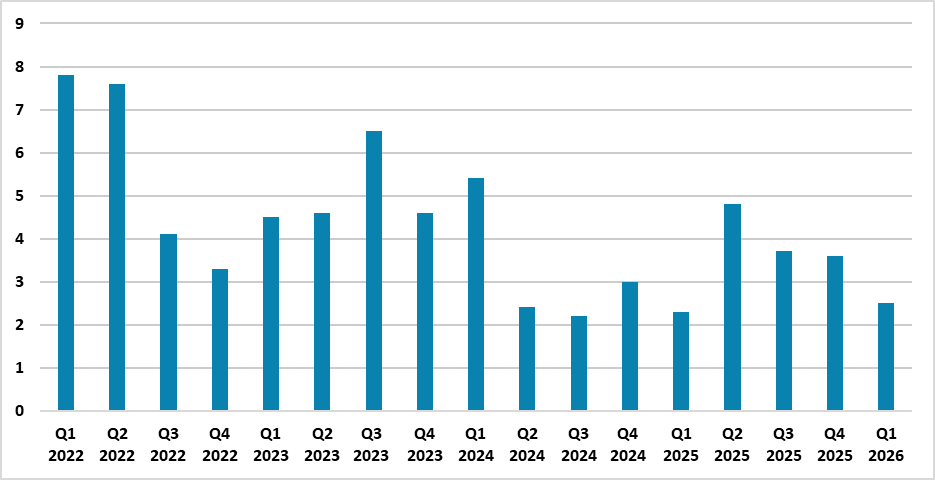
Bottom Line: The Turkish Statistical Institute (TUIK) announced Q1 2026 growth figures on June 1. Turkish economy expanded by a below-expectations 2.5% y/y in Q1. The main drag came from net trade as annual exports and imports shrank by 12.7% and 2%, respectively, while industrial sector contracted 0.8% y/y dragged down by Iranian tensions. Looking ahead, robust consumer spending is expected to sustain GDP growth, though major downside risks such as high interest rates, tight fiscal measures, and the war in Iran remain prominent. We anticipate that the conflict in Iran will be a deciding factor, as economic activity may pick up later this year provided regional tensions subside and geopolitical risks steady.
Figure 1: GDP (%, YoY), Q1 2022 – Q1 2026
Source: Continuum Economics
The Turkish Statistical Institute (TUIK) announced Q1 2026 growth figures on June 1. Turkish economy expanded by a below-expectations 2.5% y/y in Q1.
The main drag came from net trade as annual exports and imports shrank by 12.7% and 2% in Q1, respectively, while industrial sector contracted 0.8% y/y dragged down by Iranian tensions. Despite this, TUIK data showed that domestic demand remained a key driver of economic growth. Household consumption climbed 4.8% y/y, gross fixed capital formation grew by 3%, and government spending rose by 2.1%.
A y/y breakdown of sectoral components showed that annual growth was strongest in information and communication at 9.5%, followed by other services (5.2%), agriculture (4.6%), and trade and hospitality (3.7%).
Treasury and Finance Minister Simsek indicated on June 1 that Q1 growth figures as evidence of the economy's resilience amid global uncertainty and regional tensions; and attributed the contraction in industrial output to global economic conditions and calendar effects. Simsek noted that Turkiye has maintained uninterrupted growth for 23 consecutive quarters despite multiple shocks.
Looking ahead, we think GDP growth will continue to be supported by resilient household consumption, infrastructure projects, and government spending while downside risks such as Iran war, high interest rates and contractionary fiscal measures remaining strong. We anticipate that the conflict in Iran will be a deciding factor, as economic activity may pick up later this year provided regional tensions subside and geopolitical risks steady.