South Africa Inflation Quickens to 4.0% y/y in April
Bottom Line: South Africa’s annual inflation climbed to 4.0% in April, driven by surging fuel and transport costs following the outbreak of war in Iran, according to StatsSA's May 20 announcement. Consumer prices also rose by 1.1% month-on-month. Given South Africa's reliance on fuel imports, inflationary pressures are projected to worsen in the coming months if the conflict remains unresolved.
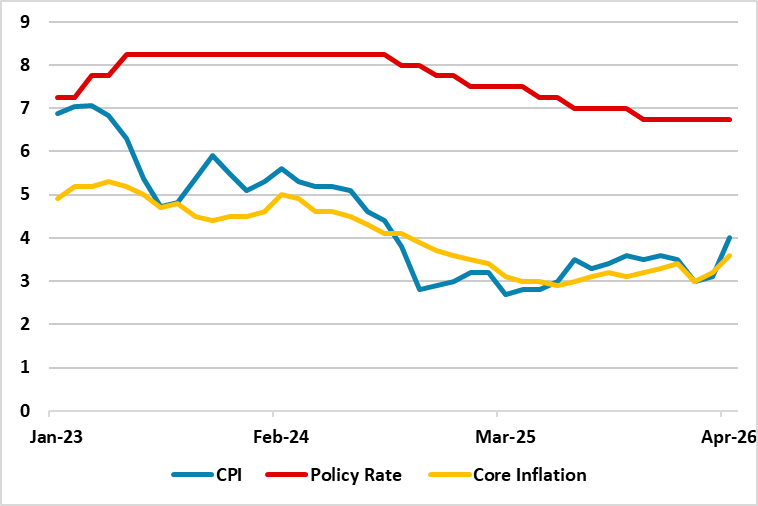
Figure 1: CPI, Core Inflation (YoY, % Change) and Policy Rate (%), January 2023 – April 2026
Source: Continuum Economics
After surging to 3.1% y/y in March, South Africa’s inflation edged up to 4.0% y/y in April reaching its highest level since August 2024. This uptick was driven by rising energy costs, a weaker ZAR, climbing transportation and fertilizer costs resulting from the conflict in Iran.
According to the StatsSA announcement on May 20, prices increased by 1.1% on a monthly basis and core inflation came in at 0.5% m/m (and 3.6% y/y) in April, slower than the previous month’s 0.8% reading. The index for fuel rose by 18.2% from March, the steepest monthly increase since 2008. The passenger transport services index climbed by 3.1% between March and April, the largest monthly rise since July 2022. In contrast to the fuel and transportation prices bruising, annual inflation for food & non-alcoholic beverages (NAB) decreased for a third consecutive month, from 3.6% in March to 2.9% in April.
The ongoing Iran conflict continues to threaten South Africa’s inflationary outlook since the country imports most of its petroleum products and exposed to swings in global energy prices. While we anticipate inflation could partly ease in Q3/Q4 as the Iran conflict potentially subsides, the recovery will be gradual. (Note: We foresee average inflation will hit 3.8% and 3.5% in 2026 and 2027, respectively).
Despite concerns following the outbreak of war in Iran, South Africa’s national utility, Eskom, announced on May 16 that the country has achieved 365 consecutive days without power interruptions. With only 26 hours of load-shedding recorded across April and May 2025, the stabilized power supply remains a positive buffer against inflationary risks.
We think the Iran conflict will remain a critical factor for the South African economy. Returning to the 3% inflation target range will likely be a slow process unless the conflict loses momentum, geopolitical risk premiums dissipate, and oil prices decline in line with shifting market dynamics.