French Bonds: Global Spillover or Fiscal Crisis?
Overall, the current French government bond widening could partially reverse short-term on U.S. Treasury yields becoming less worried about Fed tightening and also hopes that the 2027 French government budget plan could actually pass. Some ECB officials could also note the existence of the Transmission Protection Instrument (TPI), given the tightening in financial conditions in the last month for France, Italy and a lesser degree Spain (we feel that bar to actually using TPI remains high for the ECB due to German resistance). However, non-resident holdings remain massive and any failure of the 2027 budget deficit in the National Assembly could reignite fiscal concerns and non-resident investors reducing holdings of French government bonds.
The French bond spread blowout last week was serious reaching new post GFC highs. What happens next? Figure 1: 10yr France and Italy Government Bonds versus Germany (%)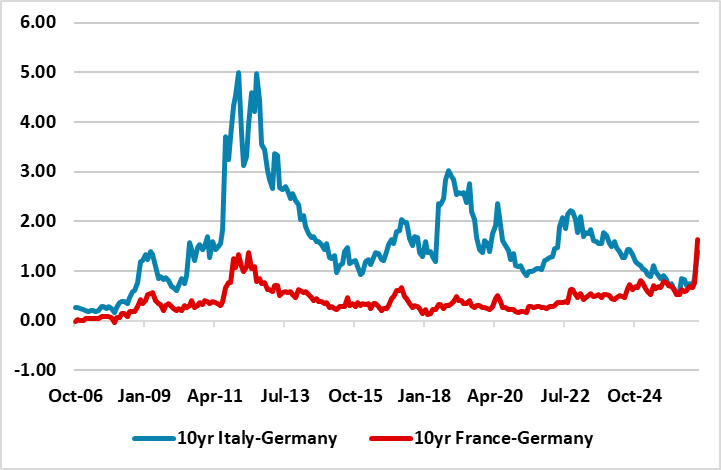 Source: Refinitiv/CE
10yr French government bonds are at their widest spread in the post GFC period (Figure 1) and are now 25bps above Italy. What is happening and what will happen next?
• Global bond tensions. The surge of U.S. 10yr yields above 5% has prompted a rise in 10yr DM government bond yields throughout September, as the Iran energy crisis drags on and threatens greater 2nd round effects into 2027 and more central bank tightening. However, Figure 2 shows that 10yr French bond yields have risen quicker than the U.S. France is also under pressure from rising 10yr JGB yields as well. The sharp rise in JGB yields by July had narrowed the 10yr spread to a mere 83bps and now French yields need to be more competitive to attract Japanese investors that are also looking at a rebounding JPY v EUR. French fiscal tensions are also evident.
Figure 2: 10yr France versus Japan and U.S. (%)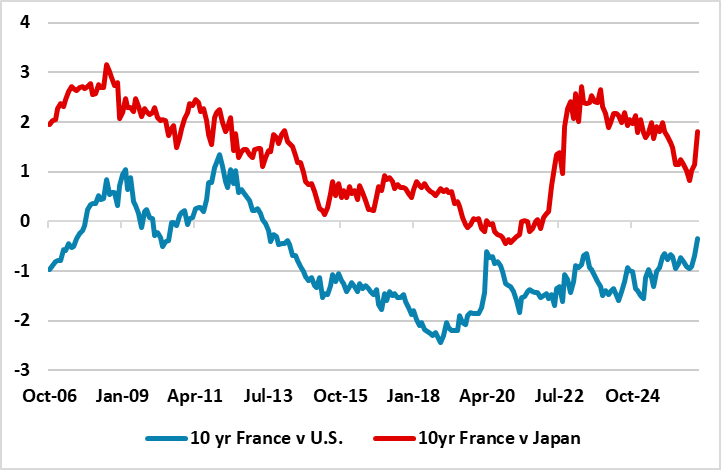 Source: Datastream/Continuum Economics • French fiscal tensions. The French government 2027 budget last week calls for a reduction in France’s fiscal deficit to 5% of GDP in 2027 from 5.4% in 2026. Fiscal tightening measures are close to 1% of GDP due to debt servicing and defence cost increases. The risk is that this budget plan gets watered down in the next few weeks and the actual fiscal consolidation will be more modest. The government does not have a majority to gets its fiscal plans through the National Assembly, without some concessions ahead of the French presidential elections in April 2027 (second round May). Views in Paris is that the 2027 budget could pass with support of other parties, unlike the 2025 and 2026 that required a special law to rollover the previous budget (a 2027 special law would mean a higher 2027 budget deficit than 2026!). Some factions of the National Rally support fiscal consolidation (eg potential PM Bardella here) and even Marine Le Pen has been talking more of fiscal consolidation than the previous populist tones. National Rally could help an imperfect 2027 budget to pass. Even so, French presidential election opinion polls remain fluid meaning uncertainty will persist into 2027, while talk in France is that the National Assembly election could be brought forward from 2029 to June 2027 for a new president to try to achieve more support for fiscal consolidation. The fiscal consolidation needs remains pressing, with the April IMF fiscal monitor only looking for the baseline to come under control in 2031 (Figure 3) when they forecast the general government budget deficit falling below 3%. This could be too long for some foreign holders of French government bonds.
Figure 3: French Net General Government Debt to GDP (%)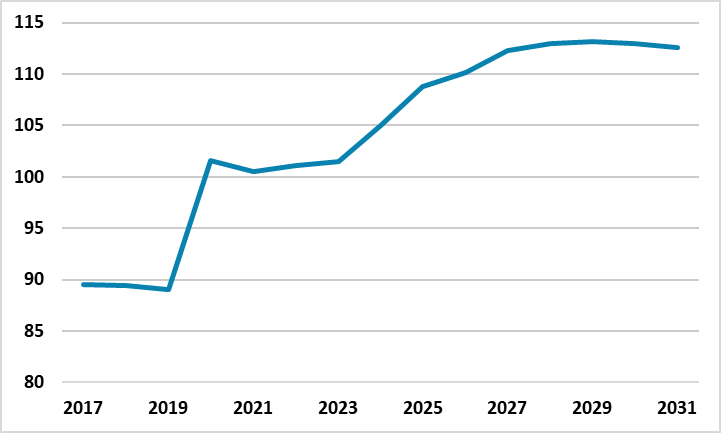 Source: IMF Fiscal Monitor April 2026
• Large Foreign Holdings! The Achilles heel of the French government bond market is the large cumulative holdings by foreigners, with successful multi-year marketing by the French Treasury. Some non EZ investors could be concerned by the summer narrowing of spreads versus Japan and the September competition from higher U.S. yields. However, non EZ and EZ investors will also be concerned that political and fiscal risk is increasing into 2027 and that they need to review their French government bond holdings. EZ holders have no currency risk and insensitive to small to modest bond spread widening, but the blowout of September will be causing serious review of French bond holdings that could amplify selling into the autumn and a volatile 2027.
Figure 4: Breakdown by holder sector of securities issued by residents (total debt and quoted shares) at the end of March 2026 (%)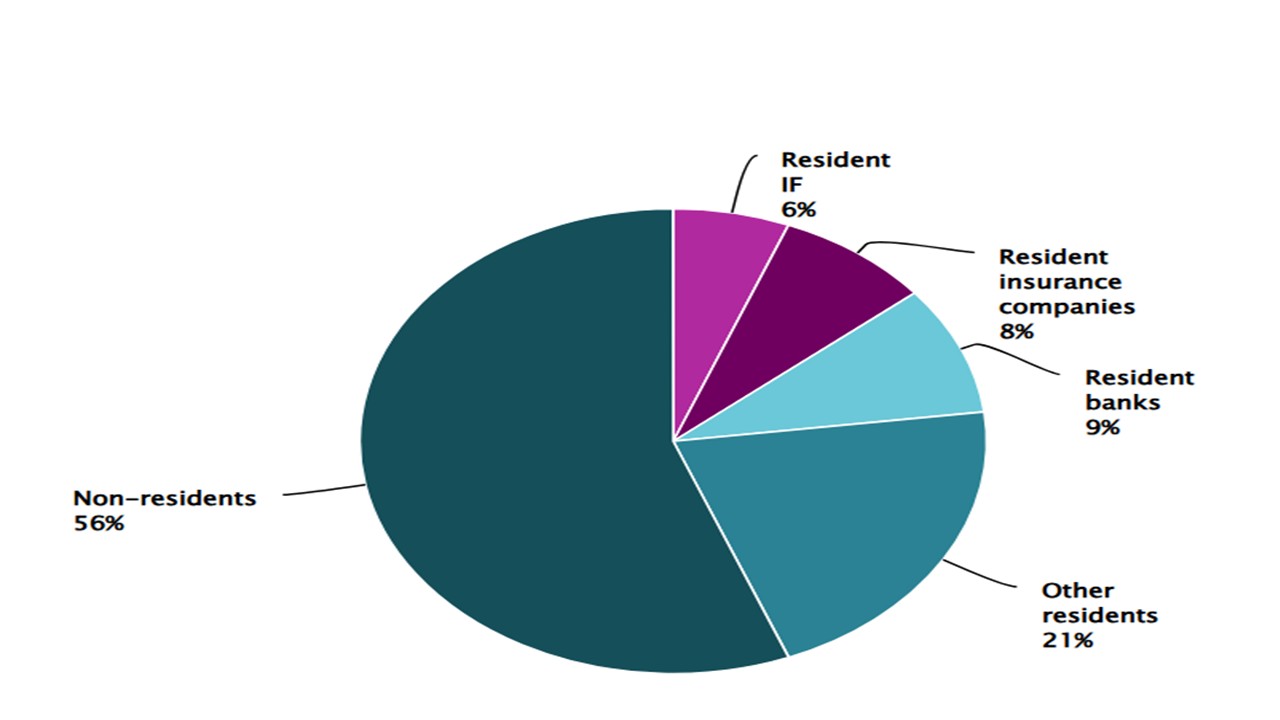 Source: Banque de France (here)
Overall, the current French government bond widening could partially reverse short-term on U.S. Treasury yields becoming less worried about Fed tightening and also hopes that the 2027 French government budget plan could actually pass. Some ECB officials could also note the existence of the Transmission Protection Instrument (TPI), given the tightening in financial conditions in the last month for France, Italy and a lesser degree Spain (we feel that bar to actually using TPI remains high for the ECB due to German resistance). However, non-resident holdings remain massive and any failure of the 2027 budget deficit in the National Assembly could reignite fiscal concerns and non-resident investors reducing holdings of French government bonds.