NBIM’s bond allocation rethink
* Proposal would imply $80bn~ Treasury sell, although little net USD change
* JGBs see marked pick up, presented as method change more than value, but…
* Several peers already follow broader bond mix. Is NBIM just ‘catch up’ or does to speak to wider concerns and incentives?
Norges Bank Investment Management (NBIM) has a big reputation as a global leader in the responsible investment space. The question however is whether its influence extends beyond stewardship and exclusions into broader institutional thinking on asset allocation. That becomes pertinent after the fund’s new proposals to redesign its fixed-income benchmark, fronted by the “government-bond allocation cut from 70% to 50%” headline.
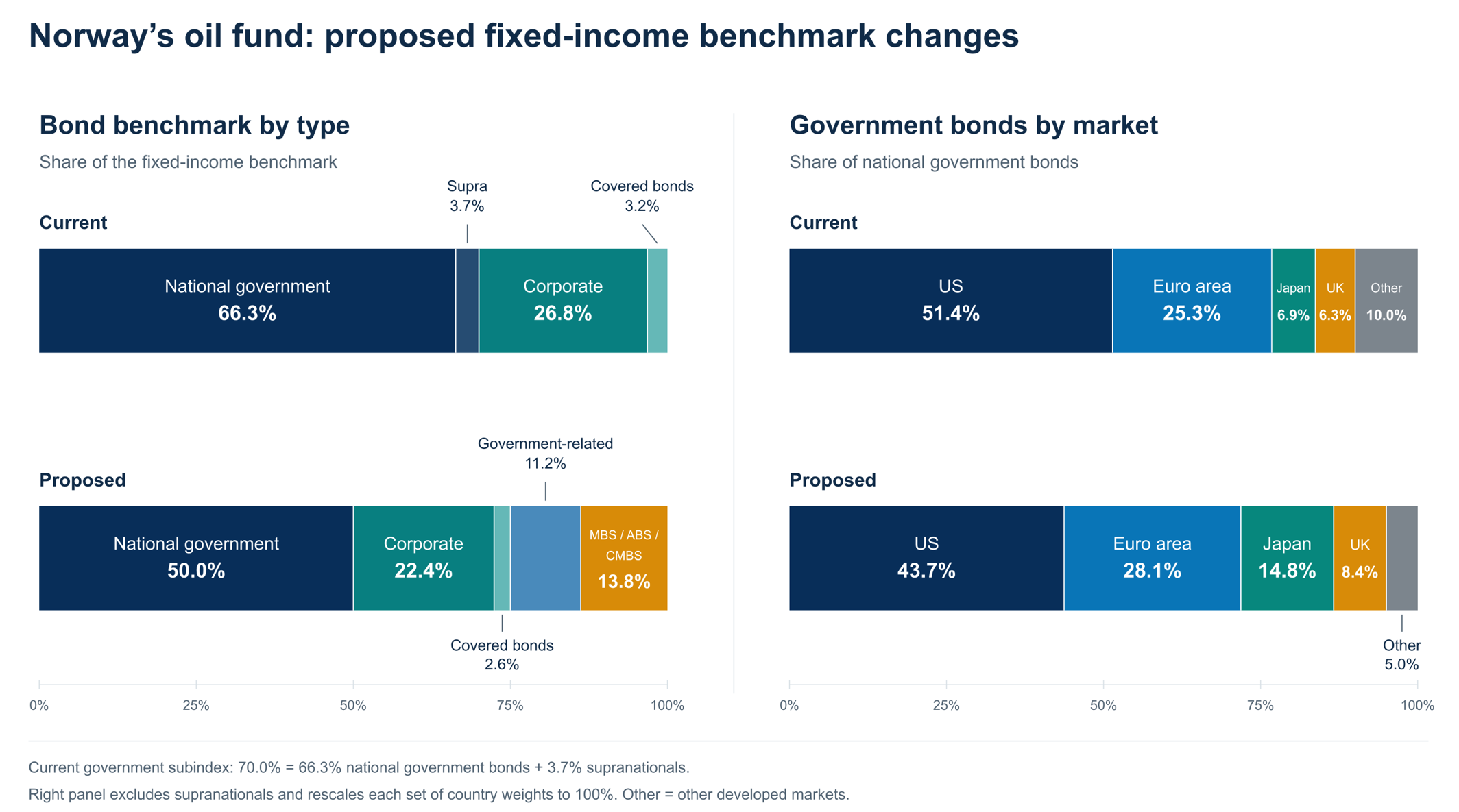
The standout, coming amid renewed background concern over who absorbs rising government debt, is the proposed reduction in US Treasury exposure. Within the bond benchmark, US government bonds would fall from 34.1% to 21.9%. This is less a US exit however than a reallocation within dollar fixed income. US non-government debt would rise from 16.2% to 27.6%, leaving the overall dollar weight only marginally off.
The proposal is framed, at least on the surface, as a long-term review, not a tactical call or a slight on Treasuries and government debt. NBIM argues that a smaller government-bond allocation remains sufficient for its liquidity needs, while agency, MBS and related offer additional long-term diversified returns.
Figure1: Norges Bank Investment Management (NBIM) proposed fixed income reallocations
Source; NBIM ; CE
A second smaller sub-plot is Japan. JGBs would rise from 4.6% to 7.4% of the fixed-income benchmark, lifting Japan’s implied share of national government bonds substantially. It’s tempting to extrapolate and make strong conclusions from that too, but it follows the proposed move from GDP to market-value weighting, removing a longstanding underweight relative to Japan’s outstanding scale. In other words, it is not presented as an explicit judgement that JGBs now offer value or that the yen is cheap, although whether the timing of the method change is coincidental, that is still more of a valid open question. Indeed, NBIM does argue that the fiscal case for a Japan underweight is now less compelling amid more widespread high public debt levels and it does reference the fact that the past underweight performance historically benefited from the weakening yen.
The implied Treasury reduction, in the order of $80bn, is a fair-sized number, if modest relative to the stock of marketable Treasuries and phased in, if the proposal is adopted, to limit market impact and costs.
All that granted, the proposal still raises eyebrows. Model choices are not judgement-free. Might other long-term asset owners be considering the merits of a broader, more diversified mix of non-sovereign debt? Or is this to an extent just ‘catch-up’, with some other institutional peers already pursuing more balanced fixed income splits? And does that matter for the marginal outlook for US Treasury and wider sovereign-bond supply and demand?
For now, there is little evidence that this particular benchmark redesign represents a new institutional trend and indeed it is not uncommon already among some larger public funds. NBIM is also an unusual, or at least niche, brand of real money and can focus more directly on long-term risk-adjusted returns.
That the proposal draws attention, however, arguably reflects both nervousness around the outlook for US Treasury demand at present and general perceptions that JGB and yen buyers might be starting to emerge, locally as well as among overseas investors and SWFs.