China and Brazil Outlook: Geo-Politics and Artificial Intelligence
· China’s growth momentum continued to be sustained by AI/tech and green energy production and investment. Growth is however imbalanced with subdued consumption growth, due to adverse housing wealth effects and slow wage/job growth. Overall, we kept our forecast at 4.4% for 2026 and 4.2% for 2027. China’s fiscal policy easing will likely remain targeted, as policymakers are constrained by the rapid debt build-up since 2007 and wasted financial resources in the past for blanket fiscal policy easing.
· In terms of monetary policy, the authorities’ actions continue to be restrained by concerns that too low interest rates could hurt China’s banking system interest margins and lending. This limits any reduction in the seven-day reverse repo rate in the remainder of 2026 and 2027 from 1.4%.
· For Brazil with still high real policy rates, plus a well underpinned Brazilian Real (BRL), we look for two 25bps cut in Q4 to 13.25% end 2026. A pause could be seen in Q1 2027 as the BCB waits to see fiscal consolidation, before 25bps steps resume cutting to 11.50% by end 2027. This is still high nominal and real policy rates and can keep the BRL underpinned and we still forecast 4.75 for end 2027.
Risks to the Outlook: Energy price rises could be larger than expected, with the ongoing Straits of Hormuz risks, creating low growth and higher inflation than expected. This would place challenges for China’s central bank: On one hand, they need to hike rate to prevent further inflation. On the other hand, they have to cut rate to support growth. A bigger energy price shock also brews larger excess production and labor market slack. A China invasion of Taiwan/blockade will be very high impact, though we still only attach a 5% probability in 2026 and 10% in 2027 to such a high risk event (here).
Our China and Brazil Forecast
| GDP Growth | Inflation | Policy Rates (%) | |||||||
| 2025 | 2026e | 2027e | 2025 | 2026e | 2027e | 2025 | 2026e | 2027e | |
| China | 4.8% | 4.4% | 4.2% | -0.1% | 1.1% | 0.4% | 1.40% | 1.40% | 1.30% |
| Brazil | 2.2% | 2.1% | 1.7% | 5.0% | 4.7% | 4.8% | 15% | 13.25% | 11.50% |
China Risks to Our Views
| Risk | Probability | Impact | ||
Upside | China’s authorities undertake aggressive fiscal and monetary policy stimulation to boost real GDP growth. | Low | Medium | |
| AI and tech cause a quick productivity boom in China and Asia that boosts growth and spurs further business investment. | Low to Medium | Medium | ||
| Downside | China’s residential property market sees renewed slowdown hurting property prices/wealth and consumption growth as well as residential property investment. | Low to Medium | Low to Medium | |
| Geopolitical risks could channel to higher tariff against China by the U.S. | Medium | Medium |
Source: Continuum Economics
Growth: Exports remain the engine
July exports surged 23.9% y/y (beating the 22.2% consensus), following a 27% jump in June. First-half exports totalled USD2.12 trillion, up 17.6%. Growth was broad-based across destinations: ASEAN +34.6%, South Korea +42.6%, EU +18.5%, US +13.9%. The AI infrastructure buildout globally is a key tailwind — mechanical and electrical products (including EVs, lithium batteries, wind turbines) now account for over 60% of total shipments. The July trade surplus hit USD112.5 billion. The trade truce with the U.S. is likely to hold into 2027, though some other countries could take measures over concerns of China export dumping. This is keeping industrial production growth underpinned.
We would also flag that China's K-shaped growth pattern is becoming entrenched — high-tech manufacturing (3D printing +52.3%, lithium batteries +40.2%, industrial robots +28.5%) is booming while traditional consumption and property remain depressed.
Domestic demand is the weak link
Retail sales remains weak with a mere 0.4% Yr/Yr in August, with the trade-in stimulus policy has shifted from tailwind to headwind after front-loading demand in prior years. Consumer confidence remains low, and precautionary savings are high. Fixed asset investment slumped, with only high-tech and export-linked sectors (rail/ships/aerospace +24.7%, computer & electronics +6.5%) attracting capital. On 2027, specific milestones in 2026 come into focus: "3 Trillion-Yuan" Target: Six key ministries, including the Ministry of Industry and Information Technology (MIIT), have committed to an action plan to cultivate three consumer sectors worth 1 trillion yuan each by 2027 alongside 10 specific hot-spot submarkets worth 100 billion yuan each. The state will be actively eliminating structural caps on purchasing constraints (such as vehicle licensing restrictions) to stimulate immediate retail movement in 2027. However, households are downbeat due to the decline in property wealth and slow private sector job growth and until these are reversed, consumption will likely remain soft through 2027.
July data is also mostly downbeat for Q3: manufacturing and services PMI readings undershot expectations, government bond issuance remained below year-ago levels, and car sales tumbled.
Figure 1: China Year-over-Year (Yr/Yr) Retail Sales vs. Industrial Production
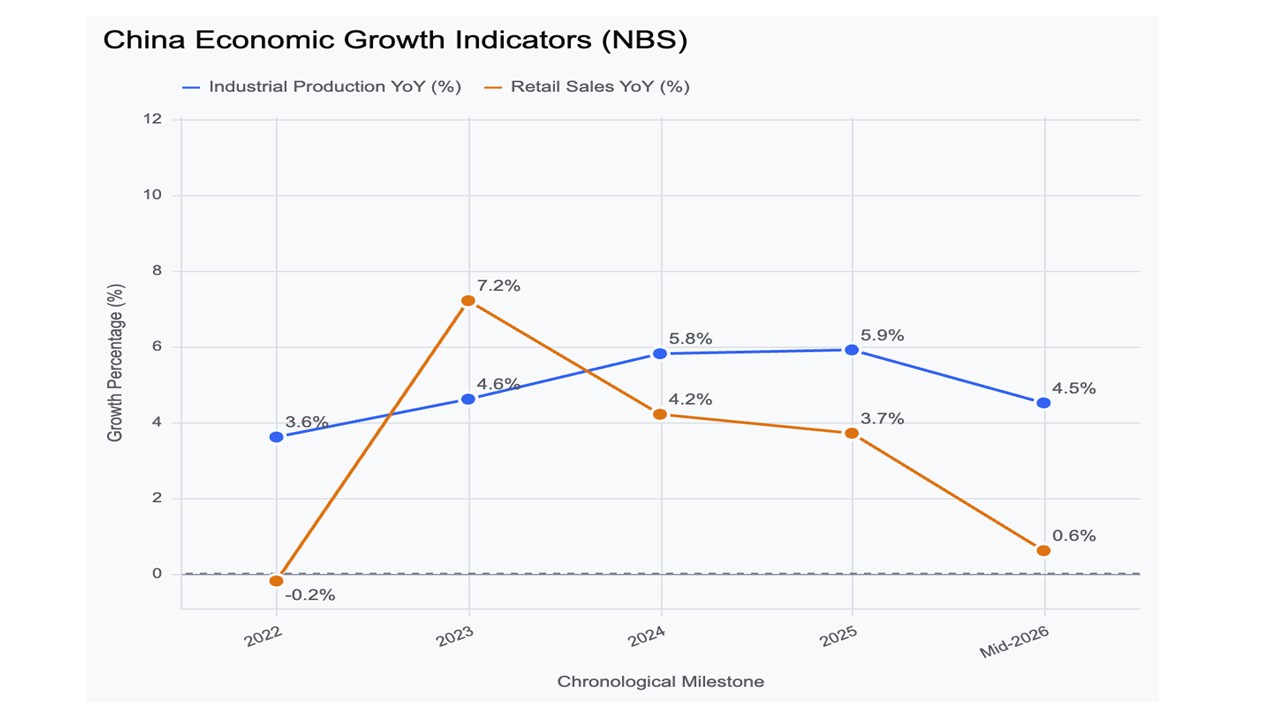
Source: China NBS
The property sector is in its fifth year of contraction
Top-100 developer sales in Q2 were down 13.6% y/y, and even China Vanke — long seen as a resilient name — came under pressure. Market expects property sales, new starts, and investment to decline another 5–10% in 2026. In August, Beijing unveiled a stronger-than-expected overhaul of the property market. Mortgage terms extended from 30 to 40 years. Shift away from the presales model toward completed-home sales with tighter supervision. A "lead-bank" system for project financing, with development loans matched to construction cycles. Developers can raise funds via equity and bond sales. Local governments to purchase unsold commercial housing for affordable housing, resettlement, and dormitories. 1 sentence on 2027 outlook for residential property sector.
Market projects that home prices will drop slightly by roughly 0.3% in 2027. Our take is that Property investment and new construction starts continue to face structural adjustments, though the pace of contraction will be moderating compared to the sharp double-digit drops seen in previous years.
Inflation is expected to remain subdued but could be bottoming out
China’s inflation for Q2 and Q3 2026 reflects a delicate transition. Deflationary pressures are gradually moderating (with the authorities pressuring against excess competition), but domestic consumer demand remains fragile. While factory-gate prices are rising due to global commodity shifts, consumer prices are experiencing a slow, capped rise. In the second quarter of 2026, consumer prices stabilized somewhat, but internal economic factors continued to limit a robust upward breakout. Annual inflation hovered around 1.2% in April and May, before easing slightly to 0.8% in August 2026. Core inflation (excluding volatile food and energy) held steady at 1.0% y/y in August. We have adjusted our 2026 CPI forecast downward from 1.2% to 1.1% for more alignment with our quarterly forecasts and actual figure in Q2. Consumer inflation was heavily suppressed by ongoing property downturn and falling food costs. Food inflation fell for three consecutive months. Producer Price Index (PPI) surge, in sharp contrast to consumer prices, factory-gate inflation jumped. Driven by global supply dynamics, mining, and raw material spikes, China's PPI rose +4.1% y/y in June 2026—marking its fourth consecutive monthly increase and the highest rate since July 2022. Such figure increases by 3.5% y/y, still modest, though lower than the June figure. The boom in PPI supports our thesis that CPI inflation could be bottoming out. However, lower oil imports; inventory rundowns and government energy price constraints have seen only a modest impact from the Iran War in CPI and we forecast the divergence to continue. 2 sentences on 2027 CPI inflation outlook (i.e. lower oil to reduce inflation in your table).
We expect CPI inflation to be at 0.4% y/y for 2027, down from 1.1% y/y this year and also below market estimate of 0.8-1.0% y/y, as the above factors that kept inflation at bay will continue to develop in 2027. Specifically, intense industrial competition and state subsidies—particularly across the electric vehicle (EV), solar energy, and high-tech manufacturing networks—have locked in an environment of hyper-efficient supply alongside soft domestic demand. This dynamic, acts as a strong drag to inflation.
More targeted monetary and fiscal policies are one the way
Market projects strong demand-side stimulus and structural reforms. Market expectations for monetary easing have risen, though a reserve requirement ratio (RRR) cut is seen as more likely than a loan prime rate cut or 7 day reverse repo (currently 1.4%), with possible PBOC action in Q4. Market’s base case includes 20 bps of rate cuts and 50 bps of RRR cuts for year 2026. On fiscal side, market anticipates ~RMB 1 trillion in incremental fiscal stimulus for 2026. We also expect widening of the augmented fiscal deficit.
Beijing explicitly stated it will avoid "policy dependency syndrome" and is not aiming to sustain a particular quantitative growth rate through a broad demand-side package. Targeted, not broad, support will concentrate on: infrastructure, urban renewal, logistics, advanced computing, and early 15th Five-Year Plan projects (the "six networks"). Addressing local-government debt, property overhangs, and small-bank exposures will require tolerating slower headline growth. Targeted monetary adjustments expected around early Q4 — and again an RRR cut is more likely than a policy rate cut that could hurt banking margins and credit supply! We forecast the 2026 and 2027 7-day Reserve Repo rate to be 1.4% and 1.3% respectively.
Figure 2: China General Government Deficit Projections
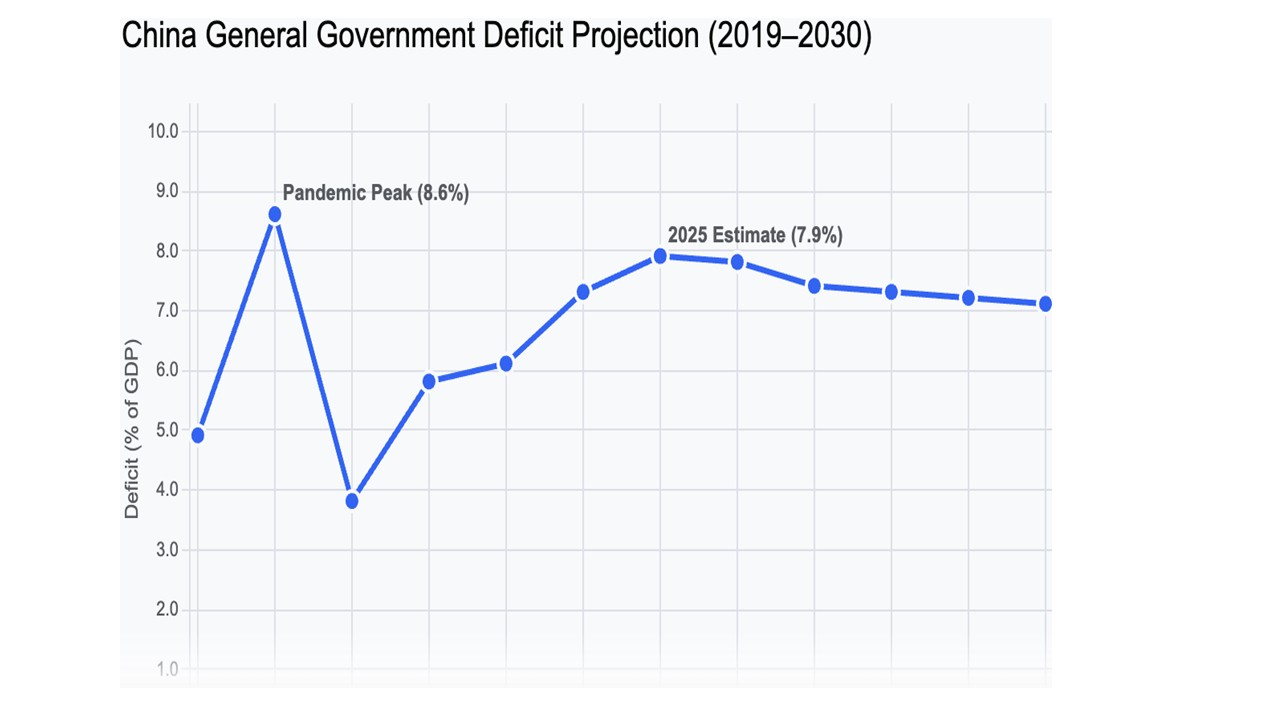
Source: IMF Fiscal Monitor April 2026
Brazil
The BCB cut by 25bps as widely expected. Inflation falling to 4.22% in August Yr/Yr, combined with recent signs of slowing economic momentum are the key drivers, alongside a still high real policy rate. The Q2 GDP showed a 0.4% contraction in household consumption, which is likely a concern. Though this reflects a correction from a strong Q1, it does signal a slowing growth. If the economic numbers continue to show a softening trend, then the BCB will likely cut again by 25bps to 13.5% at the November COPOM meeting.
The BCB statement acknowledged the slowing trend in the economy and this leaves the door open to a cut. Though the BCB marginally increased 2026 and 2027 inflation, it left the policy relevant Q1 2028 at 3.2%. The idea that the BCB would pause after the September 17 cut is now being rethought in the market and the economy could mean a further cut to 13.25% at the December meeting, which is still our forecast.
Figure 3: BCB Selic Rate and Core CPI Inflation Yr/Yr (%)
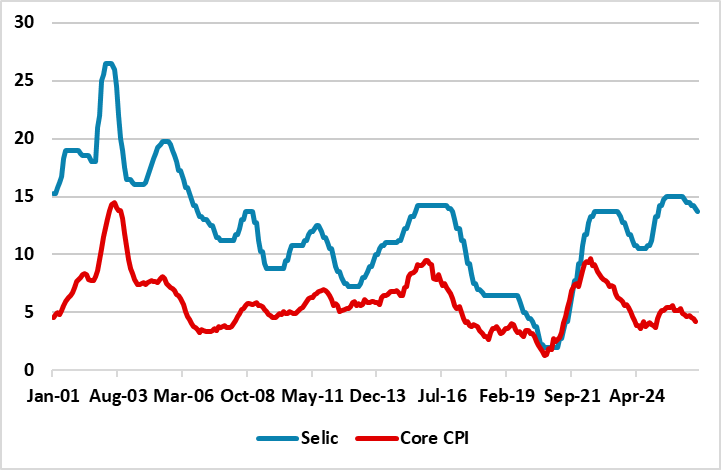
Source: Datastream and Continuum Economics
The BRL is not a restraint. Sentiment towards the BRL remains constructive. Brazil is a commodity safe haven for oil importers with disrupted supplies from the Middle East and grain buyers fearful of higher prices (Gulf fertilizer export freeze and a strong El Nino). Still high policy rates and bond yields provide ample real returns with inflation broadly controlled. The goldilocks macro story is finished with reasonable growth, which provides some scope to weather external storms.
2027 will likely see more BCB cuts to 11.50%, but then lower short and long-term yields help reduce government debt servicing and we would also see some fiscal consolidation. This could see a pause in Q1 2027, as the BCB waits to see the scale of fiscal consolidation. Thereafter easing will likely be at a pace of 25bps through the remaining quarters of 2027. An alternative scenario is that the economic slowdown is greater than expected, which causes more disinflation and increase confidence that inflation hits target. This could quicken the pace of easing in H2 and end up with a 10% policy rate end 2027 rather than our baseline of 11.50%.
Meanwhile, the October presidential election is fast approaching, with an outbreak of bitter infighting among some Supreme court members over their left or right wing leaning. This comes against a backdrop where opinion polls suggest that the 2nd round runoff of the presidential election is too close to call between President Lula and Flavio Bolsonaro – Bolsonaro has recovered over the last 2 months, after being hurt earlier in the year by the Banco Master scandal. So far the Brazilian Real (BRL) has not been hurt, as an election victory for Bolsonaro would be viewed as positive. Bolsonaro is seen as much more likely to enact sufficient fiscal consolidation to ensure government debt does not become unstable – though policy enactment also depends on control of Congress.
Although, the positive drivers for the BRL are quite well appreciated, the real effective exchange rate has only just got to the 10yr average and most estimates of fair value on USDBRL are around 4.50. It is also worth remembering that the BRL can have large countertrend against the USD, which in 2006-08 was 30% during the last major USD downtrend. Current 10yr Brazil-U.S. bond yield spreads are currently higher than this period.
Post-election USDBRL will likely end 2026 at 4.95 if Lula wins, but 4.85 if Flavio Bolsonaro wins, as carry trades become the strong focus once again. Though we see further BCB easing in 2027, an 11.50% policy rate end 2027 would still be high in nominal and real terms. This can all keep the BRL underpinned and we now forecast 4.75 for end 2027. BCB has already tried some FX intervention, but this is unlikely to be effective unless accompanied by aggressive rate cuts.