Spain Heads to the Polls With a Likely Defeat for PM Sanchez
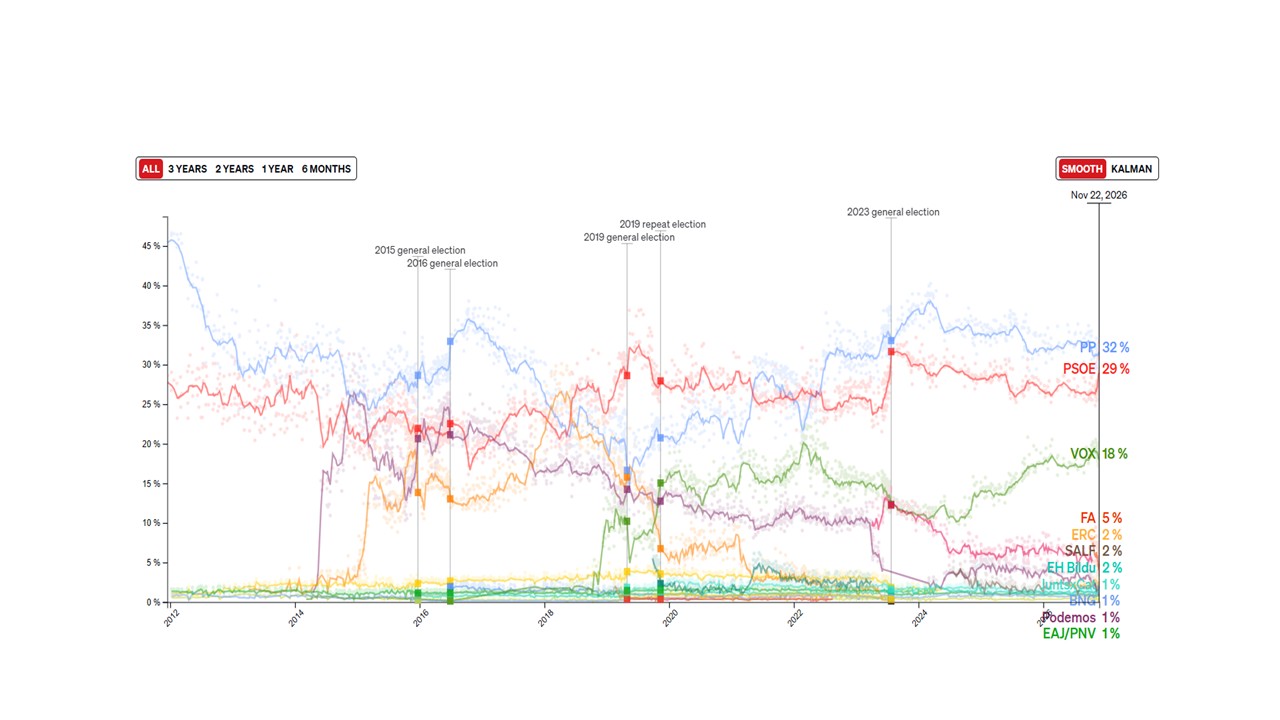
Spain’s snap parliamentary election on 29th November, nine months earlier than scheduled, is likely to have a limited impact on financial markets unless coalition talks become prolonged. In order to form a government a majority of 176 seats are needed out of the 350 available in the Congress of Deputies. If polls are correct, PM Sanchez will bow out after 8 years in power, and a likely coalition between the Conservative PP party and Vox, the radical right-wing party, will be formed. The latest poll puts PP (led by Feijoo) at 31.8%, equivalent to 131 deputies, the PSOE (led by Sanchez) at 30.9% or 124 seats and Vox (led by Abascal) with 17.3% or 57 seats. The primary credit risk stemming from the election is political rather than macroeconomic in nature. Protracted coalition negotiations or budget delays could put some pressure on Spanish bond spreads and equities into 2027.
Spain enters the vote with relatively strong GDP growth and a reduced budget deficit, limiting major near-term macro swings. Stronger economic fundamentals, however, are unlikely to save Sanchez. Catalonia independence won’t be a factor in this election as voters remain particularly concerned with high living costs, the housing crisis and immigration. Should coalition talk result in no candidate being elected two months after Sunday’s vote, parliament will be dissolved and another general election will be called.
The Political Backdrop:
As polls stand, the most likely outcome is a coalition government between the PP and Vox. Back in the 2023 general election, Sanchez secured his second term despite receiving fewer votes than the PP (121 compared to 131 for the PP) but was able to form a government with help from the left wing Sumar Party (with 31 seats) as well as parliamentary backing from several regional and nationalist parties. Despite winning that election, the PP was short of the 176 votes needed to form a government and rejected forming a coalition with Vox because of the latter’s more radical views. Pablo Casado, Feijoo’s predecessor, condemned Vox in 2020 accusing it of being run by populists who use "demagoguery that offers easy solutions to complex problems". Since then, the PP and Vox have moved closer with the former now running four of Spain's autonomous regions in coalition with Vox, and moving towards the latter's rhetoric, policy positions, and governing plans at the national level. Yet significant differences remain, between the two parties remain including Vox’s policy of deportation of illegal migrants and Euroscepticism.
Figure 1: Latest Poll Puts the Conservative party PP ahead of the Incumbent PSOE with Vox a Strong Third
Source: Politico/CE
Could Sanchez’ Gamble Pay Off Again as it did in 2023?
It would appear unlikely for three reasons. Firstly, because the PP and Vox now have a closer working relationship than they did in the 2023 general election. The PP has toughened its rhetoric and adopted elements of Vox on issues such as immigration and opposition to the government, while still maintaining distinct policy position (they differ sharply on state structure, European integration, social policy, and specific economic and immigration measures).
PP leader Alberto Núñez Feijóo has also learned his lesson from 2023 - when he rejected a coalition with Vox and went into opposition. His party has gone from clear rejection to active cooperation with Abascal's Vox party. Three years on, the PP no longer fears losing support because of its association with Vox. The alliances forged at the regional level in recent months have become the norm, and the groundwork has been laid for a future cooperation within the Spanish government.
Secondly, Spain's left-wing bloc is deeply fractured, leaving Prime Minister Pedro Sánchez's Party struggling to assemble a viable path to a parliamentary majority. And thirdly, because the policies of the PSOE no longer appear to chime with voters. Voters are pushing for alternative solutions to deal with the housing problem, advocating stricter immigration controls, and increasing their opposition to the ruling government following several corruption and bribery scandals have taken centre stage. Public scrutiny has also targeted the government's crisis management following two deadly high-speed rail crashes in 2026, as well as a major power blackout.
Housing was the Catalyst for Sanchez’s Election Call
Spain is experiencing one of Europe’s most acute housing affordability crises and this could prove to be Sanchez’s Achilles heel. The issue exploded politically after the forced eviction of an 87-year-old woman who had lived in her Madrid home for seven decades. Her eviction in October triggered large scale demonstrations and renewed mobilisation across Spain. The government responded with two emergency housing decrees but the motions were defeated in Congress exposing the weakness faced by Sánchez’s government since the 2023 election. Spain’s housing crisis stems from a severe supply-demand imbalance, low public housing stock, wage stagnation relative to rising costs, and deep political divides over how to intervene. The country faces an estimated shortage of around 700,000 to 750,000 homes (Bank of Spain estimates), with new building far below household growth.
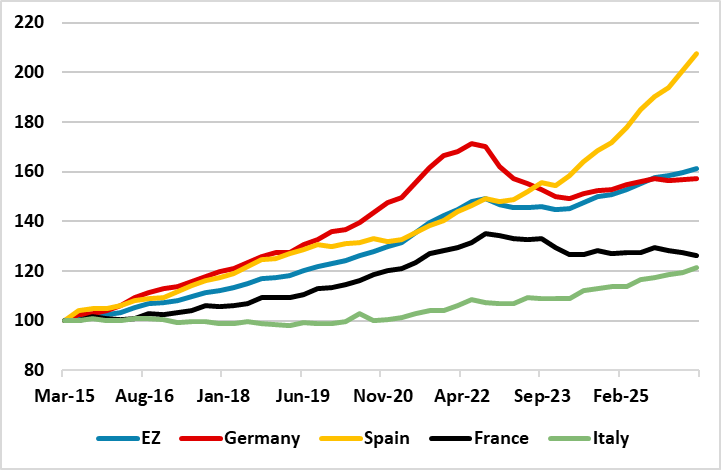
Figure 2: House Price Index (2015=100)
Source: Eurostat/CE
Rapid population growth due to immigration, tight housing supply, tourism, and broader economic shifts are behind the housing crisis. The right blames the crisis on Sanchez and the large numbers of new arrivals and regularisation initiatives - which transitioned undocumented migrants into the formal economy and rental market - and has added demand to lower- and mid-priced urban rentals. But the housing crisis is also due to supply constraints. The Bank of Spain described restrictions on housing supply growth as the principal factor behind the current housing access crisis, citing slow land development, low productivity and small firm size in residential construction, higher construction costs, and a shortage of skilled labour.
House prices have doubled since 2015 and wage growth has failed to keep up; the average Spaniard doesn’t leave their parental home until after their 30th birthday and in some historic centres tourist accommodation accounts for 45% of the rental market.
Stronger Economic Fundamentals Won’t Help Sanchez
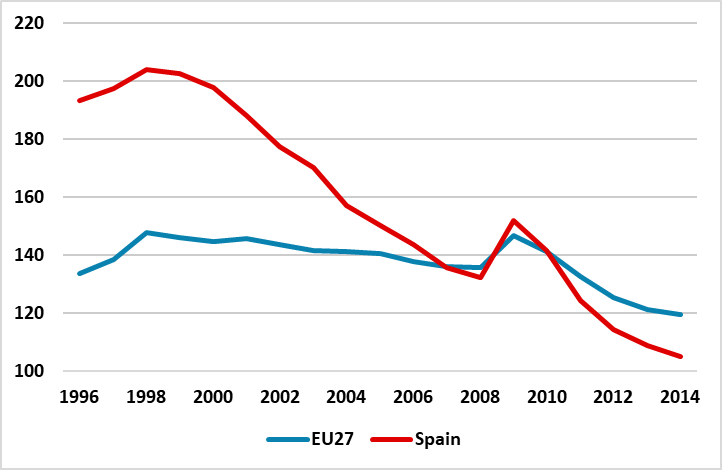
Spain has outperformed its peers in the eurozone with GDP growing at an annual 2.9% rate over the last three years, more than double the EU's 1.1% pace. Private debt (households and non-financial corporations) has roughly halved as a share of GDP since 2010. Spain is a rapidly ageing country but in the past decade, it has still managed to add plenty of workers to its labour force essentially through higher participation among women and older workers. Migration has played a larger role in increasing the size of the labour force. Youth unemployment has roughly than halved since 2016 (from around 46% to a still high 22.8% today) but still above the EU27 average of 15.5%.
Figure 3: Consolidated Households and non-Financial Corporations Debt (% GDP)
Source: Eurostat/CE
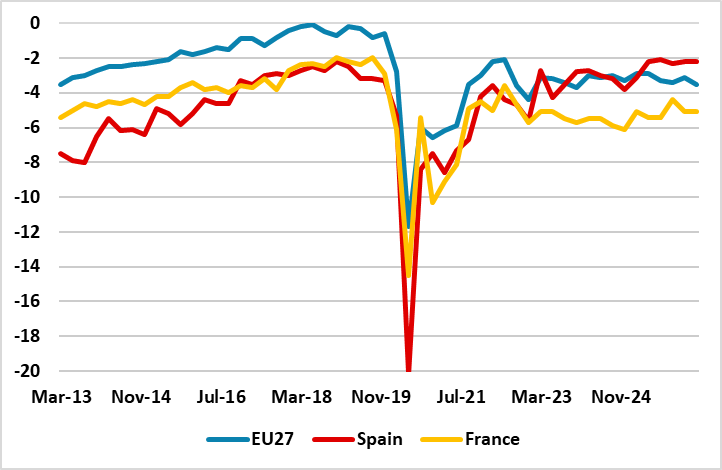
Spain has also lowered its budget deficit primarily through strong economic growth, booming tax revenues, and the phasing out of temporary crisis subsidies, rather than traditional austerity cuts. From a pandemic peak of roughly 9.9% of GDP in 2020, Spain reduced its deficit to around 2.2%–2.4% of GDP by 2025, bringing it below the euro area average.
Figure 4: Government Deficit (Quarterly data as a share of GDP)
Soure: Eurostat/CE
Catalonia Not a Factor in this Election
Although 45% of catalans remain in favour of independence, according to the regional government’s statistics institute, the topic has fallen off their list of priorities, behind housing, immigration and crime. Even Carles Puigdemont, the former Catalan president who led the 2017 secession bid, recently admitted that nine years on, the independence movement is fragmented and weakened.
Both PP and Vox oppose Catalan independence but are not taking a directly confrontational approach on Catalonia. The PP leader recently said that he does not want to centralise; “I’m here to make self-government work and for the Spanish state to have a presence in Catalonia” but also said he planned to repeal the amnesty law that benefited Catalan nationalists. Vox, for its part, rose to prominence on the back of its fierce opposition to Catalan separatism. It has called for pro-independence parties to be made illegal and advocates the dismantling of Spain’s decentralised political structure, which it claims is wasteful and encourages regional nationalism.
Should Sanchez lose Sunday’s election, Spain will join other centre-right, conservative, and populist-right parties currently holding the majority of governmental and parliamentary power across Europe.