UK GDP Review: GDP Upside Surprises Persist?
Perhaps it is a supreme irony that just as business surveys suggest clear weakness, if not fresh contraction, the actual real economy has surprised on the upside, even now into the second month after the Middle East conflict started. Indeed, and in perspective, official GDP data suggest that since Labour took office in July 2024, the economy has grown a cumulative 2%-plus, ie over 1% per year. And providing yet more apparent signs of such economic resilience and, once again exceeding expectations, GDP grew by 0.3% m/m in March 2026, following growth of 0.4% in February and only fell back 0.1% in April. We think this is more an aberration than a better trend and partly a result of poor seasonal adjustments, meaning that we see May GDP falling back further, this chiming with both weak(er) business survey activity (Figure 1) and employment signals and where what growth may actually have occurred likely to be short-lived boost in inventory building. But the data implies a much better productivity backdrop.
Figure 1: GDP Growth Hardly Strong and With Surveys Suggesting Increasing Downside Risks Ahead?
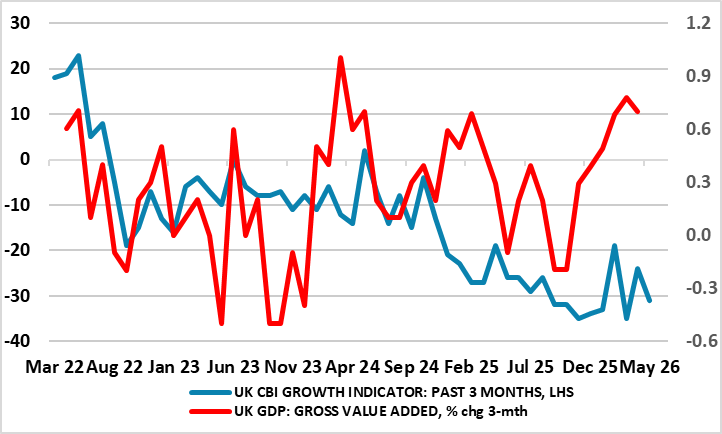
Source: ONS, CE, CBI
To what degree the data may be revised is unclear – at least at this juncture. In this release, there are no periods open for revision. Figures will be open to revisions from Quarter 1 (Jan to Mar) 2024 in our next quarterly national accounts publication on 30 June 2026. These revisions will then be incorporated into our GDP monthly estimate bulletin on 16 July 2026. Monthly real GDP is estimated to have fallen by 0.1% in April 2026, following a growth of 0.3% in March 2026 and a growth of 0.4% in February 2026. This is the first monthly fall since August 2025 (when it fell 0.2%). Services output fell by 0.2%, production showed no growth, and construction grew by 0.1% in April 2026.