Bessent’s Buybacks - bluster, bazooka or brittle bet?
* Bessent’s buybacks – bazooka or peashooter? It depends on whether it’s a slippery slope. On current proposed scale, possibly only absorbs around 10% or so of gross long end Treasury issuance on duration basis
* Mooted TGA use is not a free $1trn money pot, though it could provide some short-term cash smoothing of heavier buys. Ultimately, unless deficit drops, T-bill issuance has to offset, twist like
* Comes in the face of the AI duration wave - doubled buybacks, if repeated over year, possibly only offset a little over 1/3 of that duration impact.
* If this moves from bluster to bazooka, then it plays a dangerous game, shifting duration risk to rollover risk and gambling with market confidence in USTs and the dollar
The market has had a few days to digest the surprise buyback announcement. US 2s30s has slipped back below 100bp, around 15bp off its recent highs, although that has been pivotal flattening, with much coming from a bounce in short-end yields.
Having gone out on a limb, the follow-up has largely sought to battle scepticism over scale and firepower. Bessent initially underscored that the increase represented 'at least' a doubling and that Treasury could do considerably more if needed. Meanwhile, some press reports (‘spoon-fed’ or not) have kite-flown the potential to use ‘excess cash’ in the Treasury General Account (TGA) at the Fed to cash-flow increased buybacks.
The TGA (essentially the government’s current account, managing tax receipts, issuance and redemption flows, and expenditure) currently stands at around $950bn. That is somewhat elevated relative to the roughly $500–600bn maintained under the previous administration.
Some of the increase has provided cushioning around churn in tariff receipts and refunds, although a chunk of those refunds has now been dispensed. It also reflects the elevated size of the gross flows Treasury needs to manage, alongside the perennial need to buffer against debt-ceiling disputes and shutdown risks (though not material until next year).
In theory, Treasury could run it tighter, supported by more active T-bill management. If it chose to reduce its cash buffer by perhaps $100–200bn, possibly more, that could provide significant temporary firepower for duration removal, if not quite the cliched bazooka.
Buybacks are in principle fine, of course - corporates used to do it until the sudden AI cash demand (only half joking). But it’s fine from a position of cash flow strength or to genuinely deal with issue level liquidity. The concern is rather different when they are being conducted from a position of persistent financing need.
The second version of the same idea is to use the TGA primarily as a cash-flow smoother, with more extended buybacks ultimately financed through short-end, and most likely T-bill, issuance. Over a longer period, the two approaches really amount to essentially the same thing unless the deficit is reduced. There’s no free lunch.
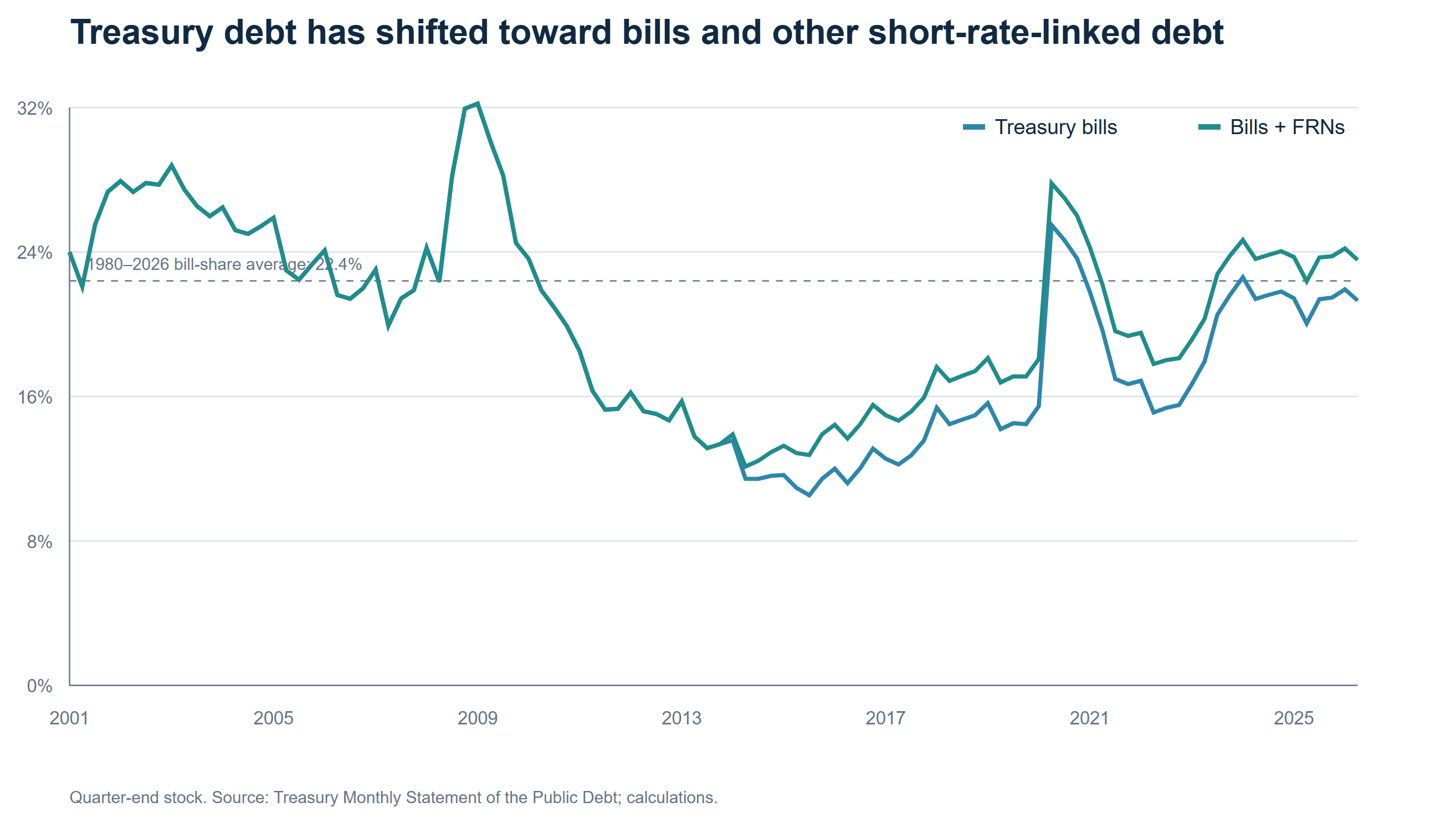
Figure 1: US debt composition by segment
Source: Treasury monthly statement of public debt; CE
Both are essentially Operation Twist-like maturity and risk profile transformations. That creates an uncomfortable blurring at the boundary between fiscal and monetary policy. If T-bills are regarded by many, at least in some context, as “near money”, the distinction between duration and liquidity management on one side, and monetary conditions on the other, becomes less clear, even if not quite QE, at least unless the Fed gets involved.
It is also worth noting that the general idea of using supposedly excess TGA cash has been floating around for some time in consultation. Until now, the favoured proposal has focused more on investing it in the repo market to assist dealer funding and balance-sheet management.
That is a related but distinct policy. Repo investment would provide liquidity against Treasuries while leaving the underlying duration risk with the dealer. A long-bond buyback would remove the holding from private hands. There may be more scope to use the TGA routinely for repo, but it would be greasing liquidity management rather than duration absorption.
In assessing the actions to date, it is worth separating the impact of the limited measures themselves (within the context of existing Treasury issuance and wider duration supply) from their signalling effect. And, most importantly, from any foundations the moves provide for possible scale-up.
Looking at accepted buybacks in these buckets since 2025, purchases in the 10–20-year off-the-run sector have averaged 15.6 years of remaining maturity. Accepted purchases in the 20–30-year bucket averaged roughly 22.3 years.
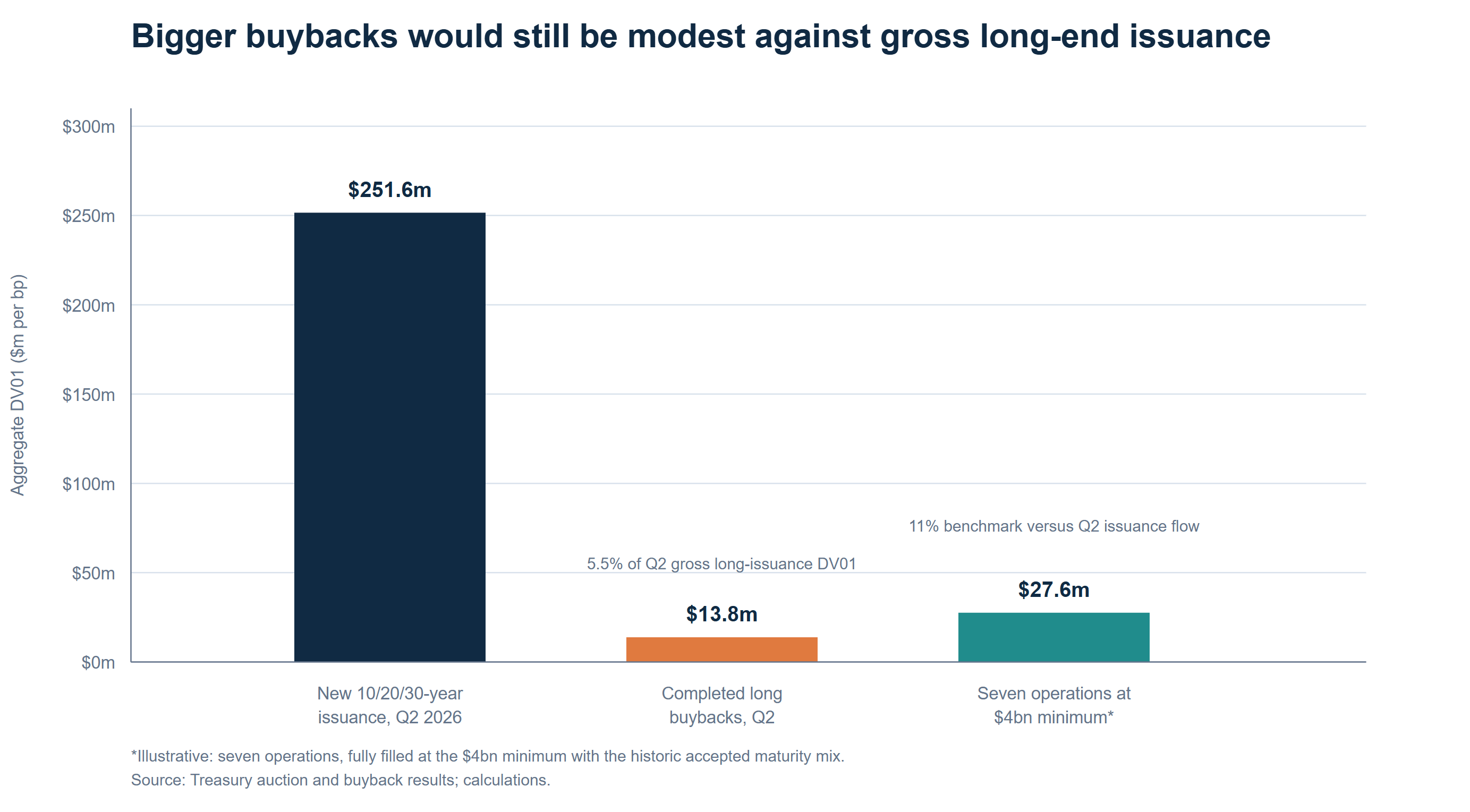
For comparison, gross nominal Treasuries issuance of 10s, 20s and 30s in the latest quarter stood at around $230bn. On rough back-of-the-envelope estimates, that represented approximately $250mn of DV01 (market value change associated with 1bp move in yield).
Conducted long-bucket buybacks removed about 5.5% of that duration risk. Doubling seven comparable operations would take that to roughly 11%, everything else constant (or more like 12.5% if at recent average pace of 8 ops in these buckets a quarter). The figures are broadly similar on a basic par-value basis.
Figure 2: Buybacks vs gross long end issuance, duration basis
Source: Treasury auction and buyback results; CE
This is gross-flow rather than net and doesn’t quite map period to period, but it generally gives a useful sense of scale: that is, helpful for dealer inventories, market liquidity and particular off-the-run sectors, while remaining moderate in aggregate.
AI issuance, particularly its duration, is an important ingredient to the wider framing moreover, highlighting how even enlarged buybacks would provide only a partial offset to the additional duration that's been hitting the market this year.
A recent Dallas Fed paper noted that forecasts centred on around $300bn of AI-related IG issuance in 2026 which, given its long-duration, is around $360bn 10yr-equivalent duration, around an eighth of total Treasury duration supply across the year.
Considering long end ops at the new 'at least' size, four times a year, the resulting buybacks would remove roughly one-third of that - slightly more if at a slightly higher 8 ops rather than 7 ops per period pace. That is not a perfect comparison but is again to give a crude sense of scale.
Dallas Fed also argues that AI financing matters through composition as well as volume. AI borrowers typically want to retain fixed-rate long term funding. If it displaces financial issuance, the market then has to absorb more long-duration corporate paper while losing some of the offsetting Treasury demand that would ordinarily be generated through financial issuers’ swaps hedging.
Proposed enlarged Treasury buybacks would offset only part of the AI duration wave then, while transferring the modest absorbed interest-rate risk into government rollover risk. A more dramatic scale-up financed through TGA reduction or bills would provide more meaningful duration dilution, but only by escalating the ‘hedge fund bet’.
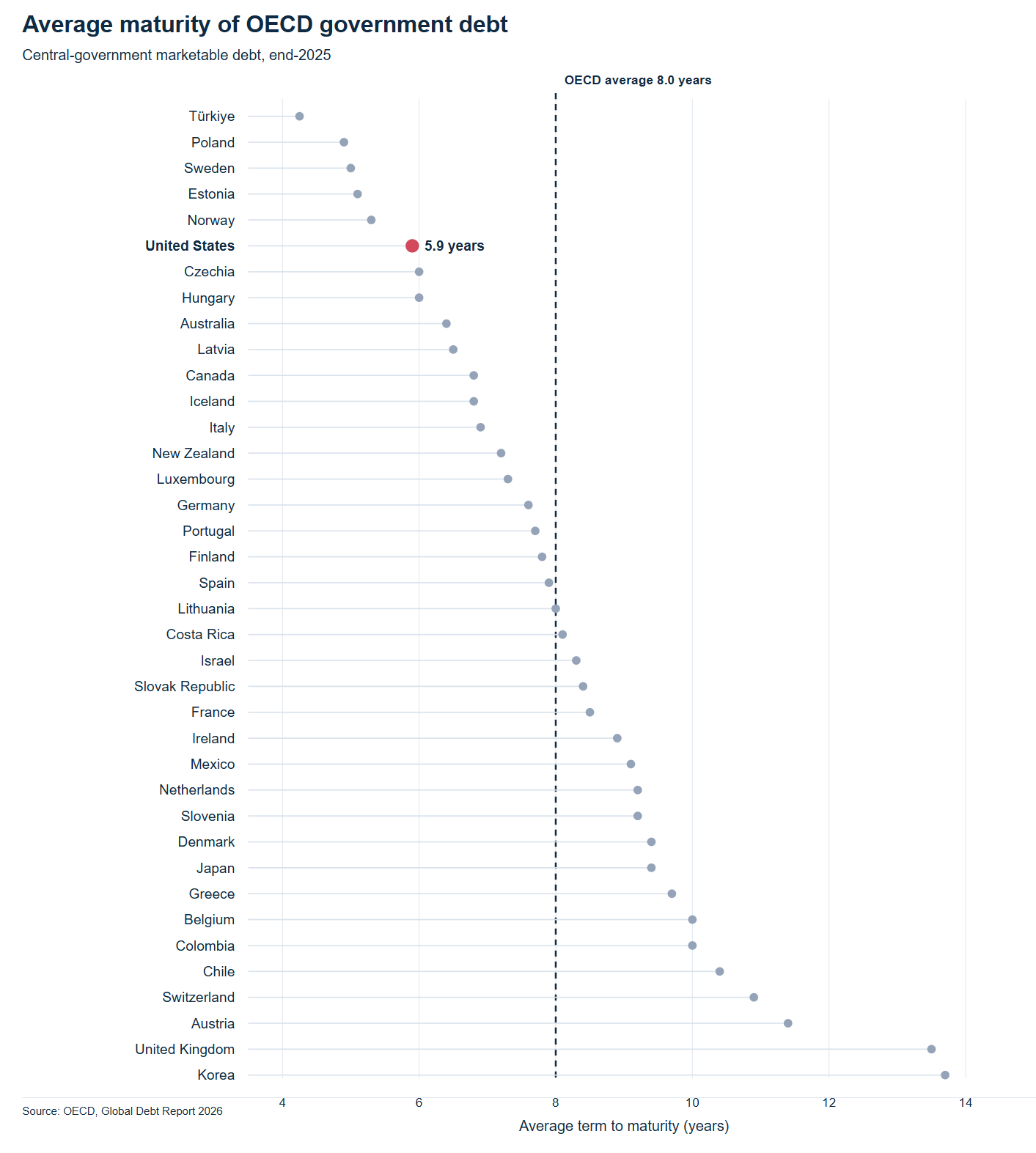
US marketable debt is already back to around 22% in T-bills and approximately 24.3% when floating-rate notes are included. The average remaining maturity of marketable debt stands at around 71 months. That is actually reasonable by US standards (if historically at much lower debt levels), but low by international standards. The OECD put the average at the end of 2025 at around eight years, with the US at around 5.9 years the shortest average maturity in G7. The UK by contrast is exceptionally long at roughly 13.5 years.
Figure 3: Average weighted maturity across OCED/G7 countries
Source: OECD
A shorter maturity profile increases rollover risk and shifts the composition of debt away from fixed-rate coupons and towards bills or short-dated instruments. Action is so far limited in scale, but it comes from what is already a duration-contained starting point and puts machinery in place that could potentially support escalation, particularly if the market considers the move one to sell into rather than piggyback (this market tactical decision might be key to near-term performance in coming weeks).
The wider paradox is that the policy is being rushed out at seemingly non-crisis long-end yield levels, unless the Treasury knows something we don’t, and with a curve that has carry but is not exceptionally steep. Line in the sand considerations also seem a bit premature. Large-scale bill-financed buybacks would therefore represent an aggressive directional bet.
The optics could also become difficult in some scenarios. The Fed itself purchases bills as part of reserve management and has discussed moving towards a shorter-duration Treasury portfolio over time for the balance sheet. Policy clashes, but also synchronisations, can both be problematic, for different reasons.
The Treasury therefore needs to tread carefully. The current programme remains a moderate off-the-run liquidity operation with signalling effects. And that’s fine, so long as it doesn’t backfire and signal the ‘wrong thing’. But any escalation towards bazooka territory would amount to a much larger hedge-fund like aggressive bet on the US rates curve shifting in significantly over the next couple of years and potentially play with fire regarding wider market appetite.
That could prove self-defeating in some circumstances. Concerns about fiscal dominance or maturity risk could add to pressure on the dollar and the yield curve, while encouraging further diversification and hedging by reserve holders.
One of the great ironies is that an administration (and its appointed Fed chair) ostensibly fans of market directed monetary conditions and putting bond holdings back in private hands are micro-managing across the curve in non-crisis times and doing the opposite. That instead is leaving the market with big question marks hanging over what is an apparent pervading ‘curve control mentality’, from Fed funds out to long end.