UK GDP Preview (Jun 12): GDP Upside Surprises To Reverse?
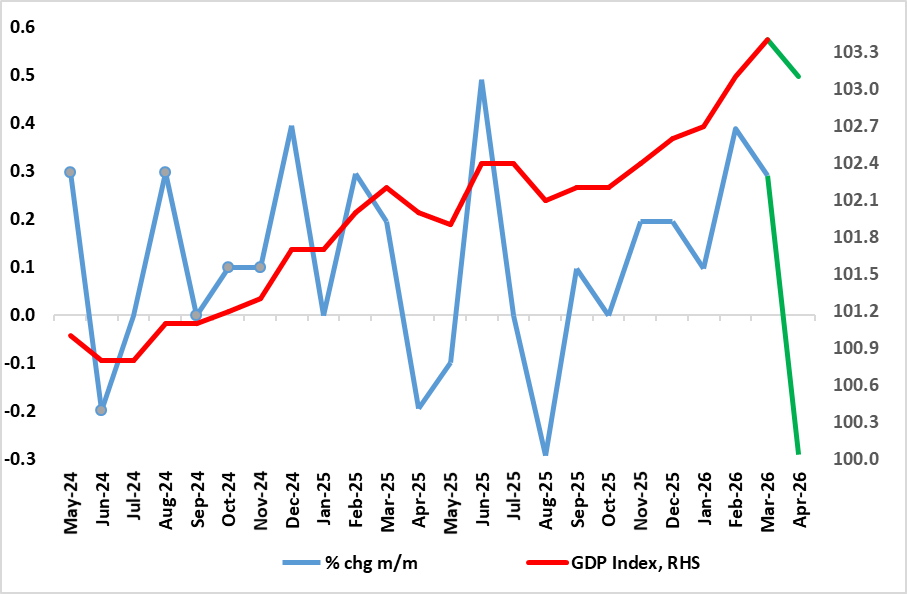
Perhaps it is a supreme irony that just as business surveys suggest clear weakness, if not fresh contraction, the actual real economy has surprised on the upside, even in the first month after the Middle East conflict. Indeed, and in perspective, official GDP data suggest that since Labour took office in July 2024, the economy has grown a cumulative 2%-plus, ie over 1% per year. And providing yet more apparent signs of such economic resilience and, once again exceeding expectations, GDP grew by 0.3% m/m in March 2026, following growth of 0.4% in February. We think this is more an aberration than a better trend and partly a result of poor seasonal adjustments, meaning that we see April GDP falling back 0.3% (Figure 1), this chiming with both weak(er) business survey activity (Figure 1) and employment signals and where what growth may actually have occurred likely to be short-lived boost in inventory building.
Figure 1: GDP Growth Hardly Strong and With Increasing Downside Risks Ahead?
Source: ONS, CE
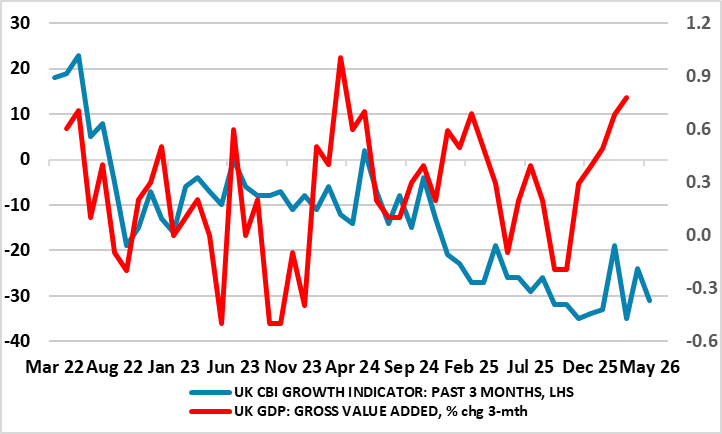
Before the outbreak of the Iran War, there was already a split within the MPC about the policy outlook albeit where such divisions may not be materially accentuated by the much stronger GDP update of late which showed a q/q Q1 rise of 0.6%, the strongest in seven quarters. Indeed, Q1 GDP was boosted by inventories (again) but also by household spending, both probably responsible for a further negative net trade contribution. As for the marked m/m gains of late the question is whether this more recent growth is illusory, not chiming with business survey data (Figure 2) and where it may reflect even further inventory building, most recently prompted by the outbreak of the Iran War. In this regard, the March rise also exceeded BoE thinking. With this in mind, base effects are strong enough to mean anything weaker than even a timid near-zero GDP outcome in the current quarter after the 0.6% Q1 result will be enough to push GDP growth this year to around 1% this year (as opposed to our previous 0.6%). This of course, is based on the heroic assumption that there are not material revisions to back data
But of course, the conflict has changed everything, very much accentuating uncertainty, economic priorities, all shifting the policy debate from the size and speed of further easing to what extent policy needs to be tightened to dampen any second round effects from the current energy prices surge.
Figure 2: Surveys Offering Much Softer Signals?
Source: ONS, CE, CBI
Notably, Governor Bailey does seem to be suggesting that the BoE will be in no rush to hike. Regardless, we do not think this dubious GDP data will change most MPC thinking; Haskell recently mentioned some long-lasting skepticism about the GDP numbers. We very much siding with Bailey’s thinking, noting that even with the surprise momentum the UK may have had ahead of the conflict, it is still very modest compared to that seen four years ago when the Ukraine War precipitated the last energy price surge. This is especially so in regard to the consumer with clear implications for inflation risks. But with somewhat higher baseline energy price assumption, we no longer see any easing this year, instead deferring the easing we envisaged to 2027. Admittedly, rate hikes still seem to be the more likely policy response more implicit in BoE thinking, with some suggestion that without them then the tightening in financial condition seen of late would not be validated. We think this is misplaced, not least as some of the tightening in conditions reflects the likes of political and fiscal risks – NB the OECD is still penciling in the next policy move as a cut and by late-year.