Turkiye Inflation Preview: Inflation will Likely Soften to Around 30% in February
Bottom line: After hitting 30.7% annually in January, we expect Turkiye’s inflation will likely soften moderately to around 30% in February as upside-tilted inflation risks and high inflation expectations will continue to limit the downward trend coupled with rising food prices due to the Ramadan period. Our average inflation forecast for 2026 stands at 26.5%, reflecting fragile pricing behavior and persistent stickiness in food, housing, and education costs. February print will be announced by Turkish Statistical Institute (TUIK) on March 3.
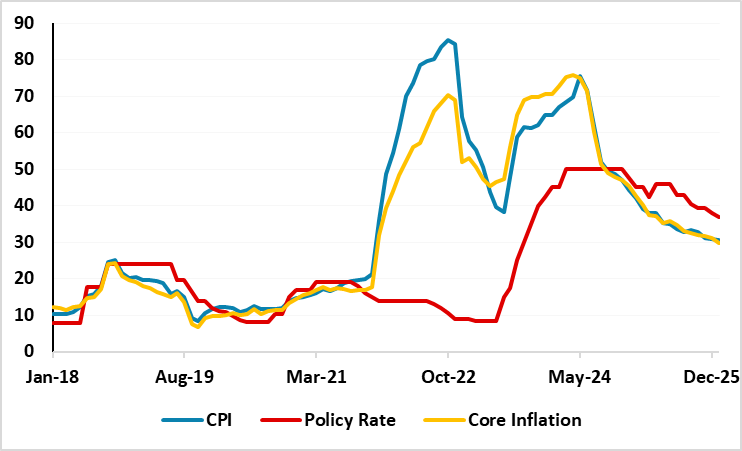
Figure 1: CPI, Core Inflation (YoY, % Change) and Policy Rate (%), January 2015 – January 2026
Source: Continuum Economics
Turkiye’s annual inflation hit 30.7% in February driven by higher food and education prices. We expect inflation will soften moderately to around 30% in February as upside-tilted inflation risks and high inflation expectations will continue to limit the downward trend coupled with rising food prices due to the Ramadan period. (Note: February print will be announced by TUIK on March 3). Despite risks, we think moderate tax increases and 27% hike in minimum wage will continue to support inflation trajectory.
The February data will mark the second inflation reading of the year since TUIK rebased the index, revised basket categories, and adjusted index weights in early 2026. This print will serve as a test of whether the disinflationary trend remains intact or if the trajectory has been skewed by the new mathematical weighting of the basket.
The inflation expectations remain elevated in Turkiye while TRY continues to devaluate against the USD a trend underscored by the CBRT’s release of its inaugural Household Expectations Survey on February 24. This survey revealed that households' 12-month-ahead inflation expectations held steady at 48.8%, while their expectation for the USD/TRY exchange rate reached 51.56 over the same period. Meanwhile, data from separate CBRT surveys indicated a slight softening in other sectors, as 12-month-ahead annual inflation expectations decreased by 0.1 percentage points to 22.1% among market participants and by 0.9 percentage points to 32% within the real sector.
In its first Inflation Report of 2026, the CBRT maintained its official interim target of 16%. However, the regulator notably shifted the forecast range upward to 15%–21% (from the previous 13%–19%). Additionally, the bank raised its 2026 food inflation forecast from 18% to 19%.
Regarding the inflation trajectory, the CBRT emphasized in its Monetary Policy Committee (MPC) statement on January 22 that it will calibrate policy decisions to establish the monetary and financial conditions necessary to achieve the 5% medium-term inflation target. Given the bank's commitment to this goal, we believe the CBRT must navigate interest-rate adjustments with caution, adopting a meeting-by-meeting approach throughout 2026. This prudent stance is warranted by persistent risks, including sticky services inflation and an unpredictable global economic outlook.
Furthermore, potential upside surprises in food and energy prices, alongside any accelerated TRY depreciation, could derail the current recovery. We assess that inflation is likely to remain above the CBRT’s upper forecast band by year-end. Our average inflation forecast for 2026 stands at 26.5%, reflecting ongoing risks such as fragile pricing behavior and stubborn food, housing and education prices.