Commodities Outlook: Brinkmanship
Transit through the Strait of Hormuz remains constrained for the rest of 2026, with a partial reopening most likely in Q1 2027 (60%) and no deal until well into 2027 in the alternative scenario (40%). We see WTI at USD 95 at end-2026 under both scenarios, then USD 70 baseline and USD 85 alternative at end-2027.
Copper’s record price above USD 14,800 reflected a tariff decision Washington keeps deferring, not scarcity. We expect no tariffs, with the option decaying as delay persists and stocks are eventually released. We forecast prices would end 2026 near USD 13,300, rising toward USD 14,500 by end 2027 as the 2028 deficit approaches.
Gold’s recovery from the March selloff rests on the dollar, fiscal concerns and reserve diversification rather than the war, which reaches gold through the Fed’s policy rate. We see USD 4,500 at end-2026 and USD 4,800 at end-2027.
Oil: Nobody Wants to Blink First
Seven months into the Iran conflict and the objectives Washington set out in March remain largely unmet. Iran's missile capability has been degraded but not destroyed, its navy damaged but still operating, and on the point that mattered most, the nuclear programme, there has been little visible progress. Trump’s administration underestimated Iran's ability to contest the Strait of Hormuz and, with it, the impact on energy and other markets. A clear win now looks difficult to achieve, and the question for the oil market is no longer how the war ends but how long the two sides are prepared to hold positions, i.e., the brinkmanship game.
What matters about the hardliners' calculus, which we set out in more detail (here), is that their objectives run on different clocks. Keeping Washington occupied in a low-level engagement is worth sustaining for as long as it deters a larger Israeli or US attack, which could mean well into 2027 on the expectation of a weakened U.S. administration and a divided Israel, while building a nuclear deterrent is a multiyear project that implies intermittent strikes throughout. Only the third objective, converting the pressure into a better settlement that includes the right to charge vessels for passage, has a natural and closer endpoint. Two of the three therefore argue for waiting, which is why the landing zone for a deal is narrower now than it was in June.
Our new baseline, at 60% of probability, is that a deal is struck before the end of Q1 2027 and more shipping moves through the Strait, because both sides have something they want badly enough. Tehran needs the blockade on its energy shipments and export revenue lifted, and the economic pressure behind that has not eased; Washington needs lower pump prices, with sustained gasoline and diesel costs weighing on Republican polling to the point where the House is very likely lost and the Senate is now in question. The problem is that the election generating that pressure also makes the deal harder to sign, since a settlement becomes easier to portray as a climbdown as November 3 approaches, and the President's own reluctance to be seen conceding becomes a constraint.
The important caveat is that any deal would deliver a partial reopening rather than a full one, with Iran likely to retain the ability to levy a fee on transiting vessels, which shipowners would pay and which would add marginally to the delivered cost of oil without stopping the flow. The frictions that follow any reopening are measured in months rather than weeks, since mines and military obstacles must be cleared before shipowners will commit vessels, insurance cover will lag behind that, and the dislocation in vessel positioning built up over the closure takes further time to unwind. Several producers have also shut-in output entirely and restarts are slow, so low flows through the Strait persist well beyond the signing of any agreement.
Until the Strait reopens, Gulf crude reaches the market mainly through the overland routes, the East West pipeline to Yanbu on the Red Sea, Iraq-Turkey pipeline and the ADCOP line to Fujairah, which together carry only a fraction of normal Strait volumes. Those routes are themselves vulnerable, as the drone strike on a pumping station along the East West line in mid-September demonstrated, and with Houthi forces having taken Perim and extended their control over the Bab al Mandab, the Red Sea outlet is exposed at both ends. We expect the damage to be repaired without a lasting loss of throughput, but a sustained outage on that line would remove the main alternative to the Strait and put a meaningful share of global supply at risk. Claims that 17 to 18 mbd is already moving through the Strait, close to pre-war normality, are in any case difficult to reconcile and, outside OPEC, the US, Brazil and Guyana continue to add barrels and marginally offset the Gulf shortfall.
Demand destruction and inventory drawdown have done most of the work in capping prices so far, and both are running out of room. China makes the point, having entered the conflict with estimated reserves above a billion barrels and drawn on them heavily enough to cut imports to a decade low of 7.1 mbd in June, some 4.4 mbd below the 2025 average. Purchases have since recovered for two consecutive months to 8.9 mbd in August, with September tracking a similar level even as crude moved back above USD 100. Moreover, with US and OECD stocks also still falling, the cushion that absorbed the first phase of this conflict is thinner now, making the same capping effect harder to repeat. Working in the same direction, we expect the Fed to raise rates by 25bp this quarter and hold there into Q1 2027, a marginal drag on consumption at precisely the point when supply remains constrained, with two 25bp cuts following in Q2 and Q3 of 2027 that arrive alongside the reopening and support the demand recovery rather than precede it.
In our alternative scenario, at 40%, hardliner objectives prevail and no further ceasefire is reached until well into 2027, or at all. Iran understands that the administration is reluctant to restart a full-scale war and that intermittent talks are sufficient to keep Israel restrained, so Tehran accepts the economic cost in service of the longer objective of a frozen conflict that prevents another full-scale attack while the nuclear programme advances. Gulf supply stays intermittent, with occasional attempts at reopening that do not hold and possible US naval escort of individual vessels, which is not the same as restored transit, while demand destruction deepens and China draws further on inventory. Risks in this scenario run in both directions, including a frustrated partial strike on Kharg Island or renewed Israeli action against nuclear facilities.
Both scenarios leave the Strait constrained through the remainder of this year, so the paths do not separate in 2026 and we forecast WTI at USD 95 at end-2026. They diverge through 2027, with the baseline easing to USD 70 by year end as transit normalises, stranded supply returns and the Fed begins cutting, though not back to where prices sat before the conflict. The drawdown that helped cap the market on the way up works the other way once transit is restored, with US and OECD stocks having to be rebuilt from levels that are now well below normal, and that restocking bid competes for the same returning barrels and puts a floor under the market through 2027. The alternative holds near USD 85 as intermittent disruption persists.
Copper: Tariffs Uncertainty
Copper reached a record above USD 14,800 in September, driven less by the metal than by a decision Washington has not taken. A decision on refined copper tariffs has been deferred repeatedly with no announced date. Behind the delay sits a genuine conflict, with the industrial case for protecting domestic mining running against the costs a duty would impose on the manufacturers who use the metal, and the second consideration has gained weight as affordability has come to dominate the mid-term elections. We argued last quarter that tariffs would not be imposed at that stage, which has proved correct, and our baseline now goes further in expecting that the duty is not imposed at all, with imposition after the November elections the main upside risk.
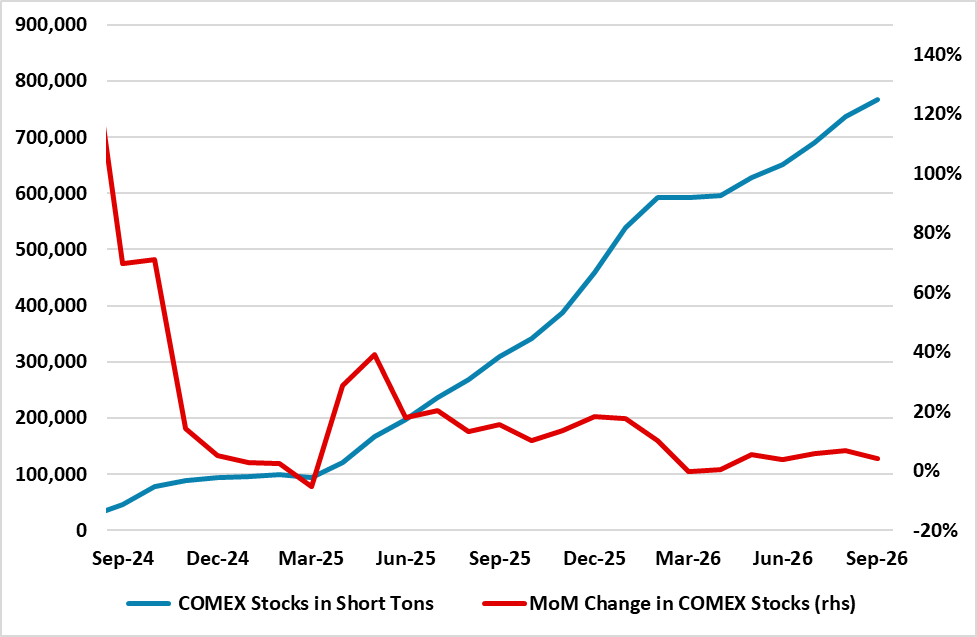
The conventional reading is that unresolved policy keeps metal in US warehouses, since shipping it out forfeits a free option on a 15% duty. That is why COMEX stocks have climbed to 760,000 tonnes as of Q3 2026, tightening availability elsewhere and supporting global prices. Our view is that the option to impose tariffs decays with every deferral, as each postponement lowers the implied probability that the duty ever arrives, so the expected payoff from holding falls while traders keep paying to store the metal. The affordability politics driving the delay point the same way, since a decision postponed because tariffs raise consumer costs is unlikely to be resolved in favour of tariffs. Figure 1 shows the accumulation slowing, which we read as the first evidence of that decay.
Figure 1. COMEX Copper Stocks
Source: Continuum Economics / Datastream
Under this scenario, part of the accumulated stock will be released back to the rest of the world, possibly during Q4 2026 or more likely into 2027, loosening ex US tightness and pulling prices down as the dislocation normalises without any announcement being made. Even if the metal stays where it is, a shift in expectations toward no tariff would be enough on its own to reverse part of the rally, given how much of the premium rests on the expectation rather than on the physical position. The risk runs the other way with equal force, since an imposed tariff would lock the stock in place and send prices higher from an already elevated level.
Away from the tariff question, supply and demand tell a less alarming story than the price does, with mine disruption real enough that the ICSG has revised down output expectations for the DRC, Chile and Indonesia, yet the group still sees the refined market in surplus by 96,000 tonnes this year and 377,000 tonnes in 2027. Consumption is expanding steadily rather than surging, at 1.6% globally this year and 1.9% in China and the direction of long run demand is not in question, with S&P Global expecting AI and defence to lift global consumption by half by 2040 and China’s demand now driven by grid investment and data centres rather than property. The argument is about timing, and we continue to see a genuine deficit as a 2028 story rather than a 2026 or 2027 one.
We expect copper to give back part of the policy premium, ending 2026 near USD 13,300, before rising toward USD 14,500 in 2027 as the demand rotation reasserts itself, Fed easing arrives in the third and fourth quarters, and the market begins pricing the 2028 deficit as demand from data centres, grid investment, and broader electrification increasingly asserts itself.
Gold: Bought for the Dollar, Not the War
Gold's recovery from the March selloff looks like a safe haven reasserting itself, but the money has come back for structural reasons that have almost nothing to do with the Gulf, and that distinction will likely matter more for the forecast than the recovery itself. What is drawing buyers now is the dollar, the fiscal position and reserve diversification rather than the war.
August brought a reversal of unusual size, with roughly USD 18bn moving into gold ETFs globally as reported by the World Gold Council, one of the largest monthly totals the sector has recorded, and the buying concentrated in North America and Europe rather than in EM funds that had led earlier in the year. What drove it had nothing to do with the Gulf. Investors were responding to the dollar, to long term yields and to renewed doubts about the fiscal position, with the August intervention in the Treasury market and the earlier support operation for the yen both feeding the same concern, and the move gathered pace once the price cleared technical levels that had held it back.
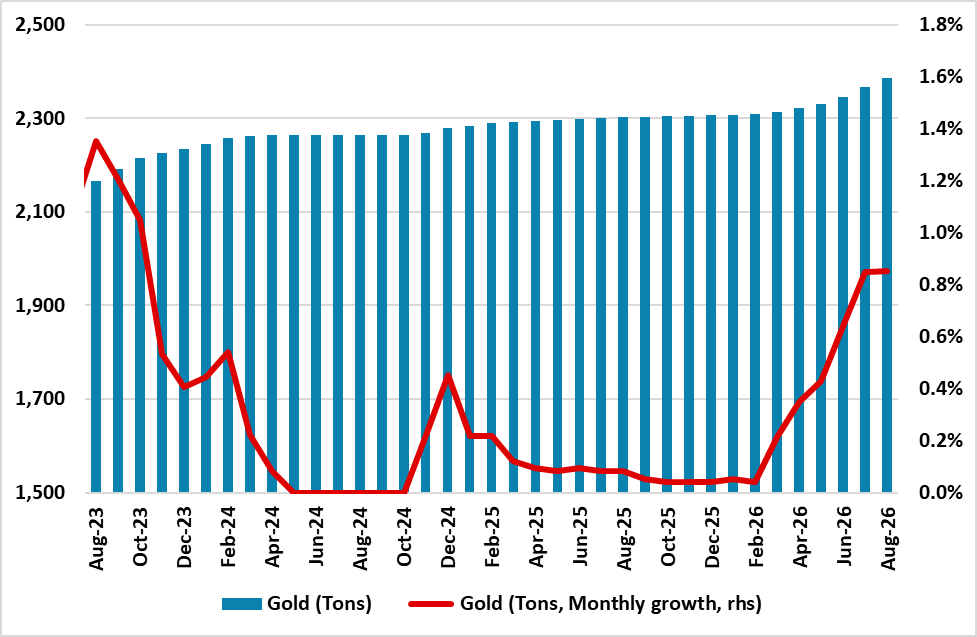
Official demand points the same way, with the PBoC extending its buying to a twenty second consecutive month in August at the fastest pace since October 2023 (Figure 2), so central banks and Western investors have been accumulating gold for much the same reason, as an alternative to sovereign currency and sovereign debt. What is notable is how the price has responded, having reached roughly USD 4,600 in late August before easing back toward USD 4,350, which suggests the rate channel is still capping the metal even as the structural bid builds beneath it, and the conflict reaches gold through that same channel, as in early September when the metal fell while crude rallied on renewed tensions.
Indeed, what the conflict now does to gold runs through the Fed, since higher oil feeds inflation, inflation supports a tighter stance, and a non yielding asset suffers, which is what happened in early September when gold fell as crude rallied on renewed tensions. We expect a further 25bp hike in Q4 to 4.00-4.25% and a hold into Q1/Q2 2027, followed by cuts in the third and fourth quarters, so the rate drag is concentrated in the near term and fades as the easing arrives.
Figure 2. China Gold Holdings
Source: Continuum Economics / China State Administration of Foreign Exchange
Netting a structural bid that does not depend on the war against a rate path that works against it in the short term, we expect a measured advance rather than a run at the January record, with gold ending 2026 at USD 4,500 and reaching around USD 4,800 by end-2027. The main downside risk is a recoupling with the conflict, since our alternative Iran scenario, with crude near USD 85 and intermittent disruption through 2027, would revive the inflation channel and could trigger a second liquidity flush of the kind seen in March, taking gold back toward USD 4,000 or lower.