Time for a holiday from the dollar? (EUR/USD, DXY, AUD/USD)
* Thanksgiving break gives the market a chance to reset; China reaction hopes may also
*Clearance of Nov book close, toughest period for Nasdaq, and eventually pre-discounted Fed may help
*Seasonals are quite strongly and consistently dollar negative last decade
* Rebalancing less visible than earlier noughties, but YTD correction would go with the grain
*With market stretched, worth recognising Dec could see a to-do flows-dominating 'holiday' from the medium-term themes that remain live into 2027
Thanksgiving offers time to stop and take stock. That in itself can often be meaningful, offering a firebreak on heated trend action, encouraging covering activity into the holiday, and giving short-term momentum a chance to turn.
Layer that on top of the November month end and, for some funds, the November book close, with its potential for sizeable position-squaring. As the market moves out of a seasonally testing period for risk towards the often more helpful December and Santa rally, some extremely oversold moves may have reason to catch their breath.
While medium-term themes around tech/AI, commodities, inflation, monetary policy and relative macro and market performances are not going away - and will remain key drivers into 2027 - there are good reasons to step back and consider more prosaic matters heading into December. Speculative positioning is long dollars, the market already has a sizeable hawkish reset priced into the Fed, and risk positioning has become very defensive. November book-closing has historically occasionally brought large thematic squaring moves, sometimes with other traders piggybacking on the flows. It may be a less powerful or less uniform force now, but could still have added to the reversal of the spring tech rally and the wider exit from long tech, Asia and carry. Once that pressure is past, an additional source of selling could subside and even be tactically dip bought, giving December’s dollar seasonality more room to assert itself.
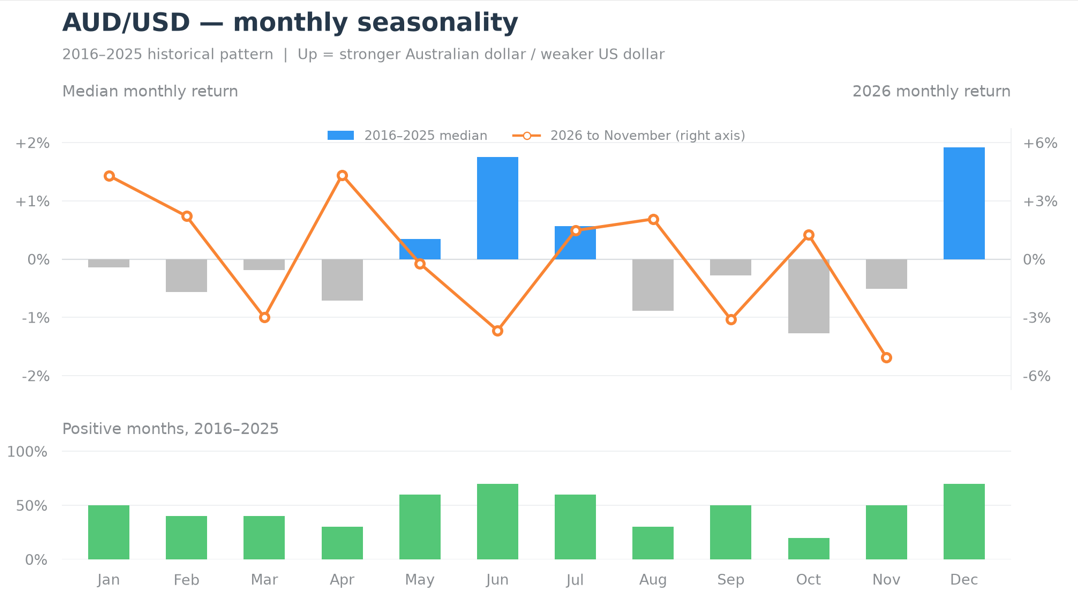
Tentatively, we see some early signs of that in the aussie at least – a spike-low bar showing some potential excess, record net shorts in the broad IMM measure, and a relentless trend-down move that is evidently oversold but which has been happily run. Where shorts are held on a trailing-stop basis, a decent corrective bounce could encourage covering. That provides potential fuel for a move, though our tests give little reason to treat the shorts alone as a reliable turning signal.
Figure1: AUD/USD seasonal trends meet a very short, very in profit market
Source: Datastream; CE
Against that background, China’s increasing agitation at stock market weakness and escalation from easing margin rules to calling in the ‘national team’ (its version of the mythical plunge protection team), alongside pledges to facilitate long-term investors, suggest a greater eagerness to stabilise markets. That could help the near-term risk backdrop. It also raises the vague possibility of a fresh round of broader stimulus following recent weaker data, market action and global developments, though that is more speculative.
There are a few different strands to the December ‘bias’ worth drawing out, some of which are more live than others.
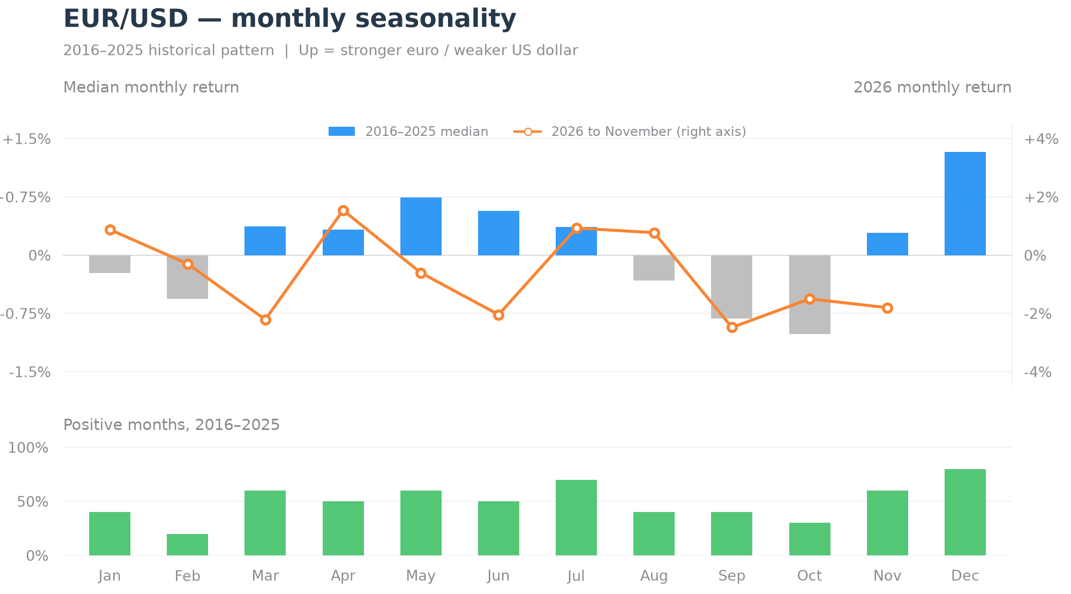
In simple monthly performance terms, December’s dollar weakness has been one of the more distinct FX seasonal patterns over the last decade. DXY fell in 8 of the last 10 Decembers, with a median move of -1.1% and an average of -0.8%. EUR/USD rose in 8 of 10, with median and average gains of +1.3% and +0.9% respectively. December stands out for both the consistency and scale of dollar weakness relative to other months. AUD is fractionally less consistent, rising in 7 of 10 Decembers, but with a larger typical move: a median gain of almost 2%.
The figures dilute over the 20-year window but remain evident for DXY and EUR/USD: dollar weakness in 13 of 20 Decembers, with median moves of -0.9% and +1.2% respectively.
Figure2: DXY has seen the most consistent, large bias in Dec last decade, to a lesser extent last 20yrs
Source: Datastream; CE
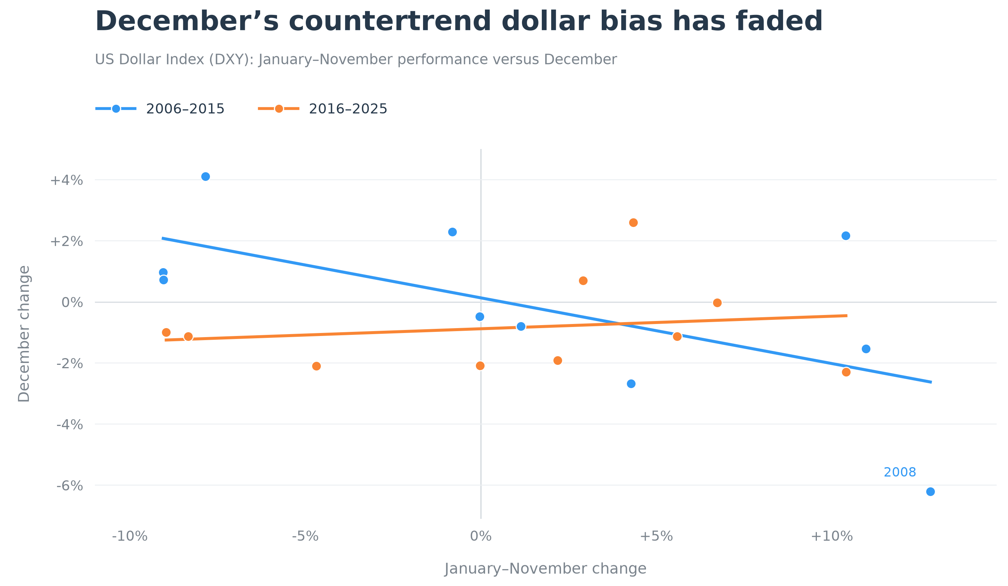
Another broad brush flows influence - countertrend action in December relative to year-to-date return - has been more of a fading force. Reserve rebalancing is one likely conributor to the older pattern, while extreme swings in dollar supply and demand, notably in 2008, also matter. In 2006–2015, December’s correlation with January–November performance was -0.61 for DXY, with reversals in 8 of 10 years. That relationship largely disappears in the decade since. The earlier evidence is consistent with the reserve-accumulation driving dynamic of the period and levelling out in its more mature phase.
Figure 3: Counter-trend Dec move versus YTD has faded as a factor, though would play in favour of downward correction if features
Source: Datastream; CE
Still, if a version of that pattern, perhaps driven more by position and value adjusment by other players, were to make a fresh appearance, this year’s action puts DXY into the ‘greater than 5% dollar gain’ bucket. That is at least with the grain of the generic seasonals, though it adds little evidence of a stronger reversal. Current conditions are far from the crisis-driven dollar funding imbalance wild swings of 2008, but defensive over weight dollar holdings could still be trimmed into the festive holidays. Indeed, while the market may be waiting out the next Fed meeting, an outcome within the current range of reset expectations could allow for an episodic ‘sell the fact’.
The big debates over policy, global macro and the tech asset cycle are going nowhere and will dominate the 2027 outlook. In the meantime, more mundane corporate flows, portfolio adjustments and trader order-book business, alongside very stretched recent moves, could play in favour of some established seasonal norms. A further hawkish surprise or renewed forced selling would challenge that view. Otherwise, there may be room for a bit of forced jollity and Christmas cheer for beaten-up stocks and dollar counterparts.