US Payrolls ‘breakevens’: Why zero is the new 200
- What balanced looks like in terms of US payrolls changes has shifted significantly in recent years
- Demographics, participation and crucially net unauthorised immigration have pushed 'breakevens' to around zero from 200k+
- Makes a significant difference to how one should view payrolls prints in terms of it how it should factor in to Fed policy thinking
Back in the day, for payrolls-watchers, 200k was considered a steady number, just borderline okay but nothing special. Anything sub 100k on a consistent basis might start to be looking towards stall speed. Zero or less would be suggesting a poor, loosening labor market that could be pointing to a downturn.
For a number of reasons, these guiding stars have long since wandered. Heading into this week’s key payrolls, it’s maybe useful to revisit these reference points and take stock of what firm ‘looks like’ in mid-2026.
Markets and the Fed are adjusting to a world where modest to near-stagnant figures now have to be viewed as more relevant from a labor market tightness point of view, albeit with some slack ‘elasticity’ (with major provisos outlined below) coming from the low US prime-age male participation rate.
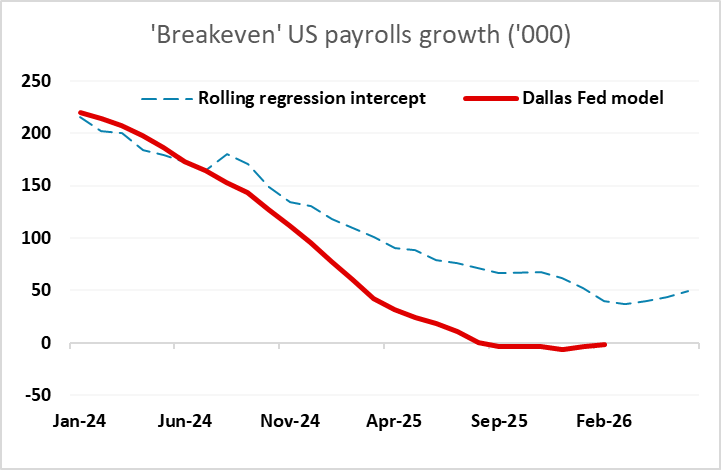
There are a couple of ways to get a handle on this. One is a somewhat crude rolling measure of what steady state has actually played out as in recent months. This is at best ‘back of the envelope’ given that the correlation between payrolls and household survey can wax and wane considerably. Nonetheless, as a rough trend, the rolling regression intercept (the payrolls trend associated with unchanged unemployment) has come in around the 50k region. That’s already a much lower baseline reference for what normal/steady looks like in terms of balanced.
Figure 1: ‘Breakeven’ payrolls changes, regression intercept and Dallas Fed supply-side estimate
Source: CE; Dallas Fed, Break-even employment declines as unauthorized immigration outflows continue, Anton Cheremukhin, Daniel Wilson and Xiaoqing Zhou
The second way is a more robust labour-supply-calculation-driven estimate, and the Dallas Fed gives a good pointer on this. On their calculations, factoring in demographics, participation and crucially net unauthorised immigration, the ‘breakeven’ payrolls change trend dropped sharply and is now centred on around zero as of early this year. That’s a much more dramatic re-centring still.
Since then, the unauthorised migration backdrop has stayed restrictive, though it is not possible to re-run the paper’s micro calculations without its underlying case data (and voluntary-exit assumptions). Border encounters remain comparatively low, while immigration-court removal orders jumped to almost 80k in June, compared with around 50k at the turn of the year. New immigration-court cases have also picked up, which complicates the inflow side but is only a loose proxy anyway (can also reflect enforcement changes and so the outflow side too). The public figures also miss voluntary exits. Altogether, the headline figures are suggestive of a net flow at least as negative as the Dallas Fed’s last estimate, if not more so. Everything else constant, that leaves supply-side estimates of payrolls breakeven as likely still zero and possibly below.
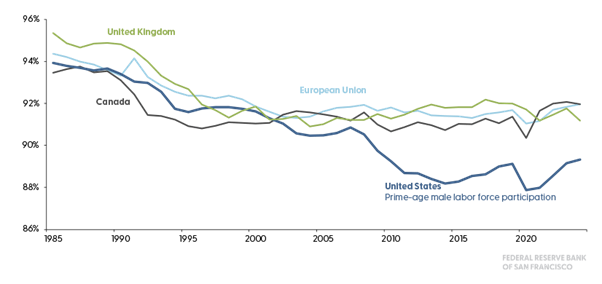
Figure 2: US male prime-age participation rate vs majors
Source: Monetary Policy in a Slow (to No) Growth Labor Market, Mary C. Daly, SF Fed
Labor market tightness can still prove elastic in theory. US prime-age male participation rates are well below other major economies and so potentially responsive to strong labor market conditions. That is, strength in payrolls can, to an extent, self-supply at times. However, that partly depends on labour skills, and skills mismatch can obstruct labour force variability. This is especially relevant when demand is coming from specific areas needing training or specialist knowledge rather than broad based.
The upshot is that labor market data is more nuanced than it once was and a figure in the mid-100s as we expect again this month can be ‘tighter’ than it seems. As ever, or rather more so than ever, payrolls will need to be viewed in context of the unemployment rate, the earnings trends and other supply-demand proxies to get a full picture of how it should factor in to Fed policy thinking.