Mexico: Stable Rates Diverging From The Fed
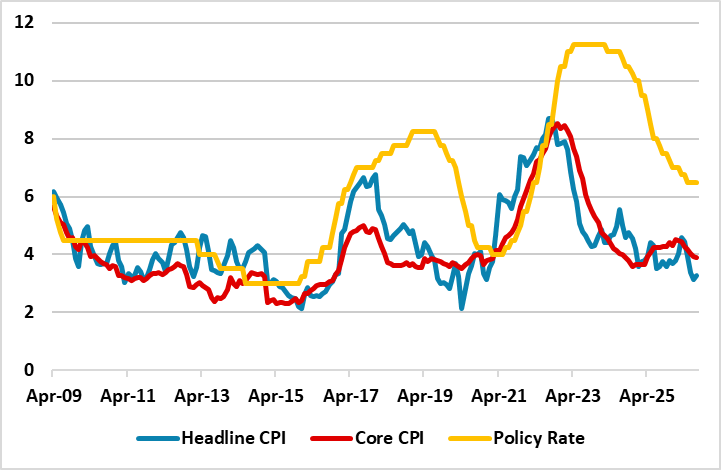
· As expected Banxico left the policy rate unchanged at 6.50%, with the statement clarifying that the Mexican and U.S. economies are different and Banxico will not mechanically follow the Fed. The focus now is on the lagged benefit of easing and the inflation trajectory. Banxico will likely keep the current policy rate through end 2026. Even in 2027 we see stable policy rates as we see no further Fed hike beyond December and the Mexican Peso is supported by high bond yields.
Figure 1: Mexico CPI/Core CPI and Banxico Policy Rate (%)
Source: Datastream and Continuum Economics
The Banxico statement changed to note that “since macroeconomic conditions in Mexico are different from those in the United States, monetary policy would not have to react mechanically to the anticipated adjustments to the federal funds rate”. This makes clear that Banxico sees stable policy rates in the coming months, despite the prospect of a further Fed rate hike in Q4.
The inflation picture does provide some encouragement for Banxico, with the initial effects of the Iran/U.S. war on energy prices having been muted. Indeed, core CPI has continued to come down over the last quarter (Figure 1). However, Banxico will be watchful for the more prolonged effects of higher energy prices still feeding through in Q4 2026/Q1 2027. Additionally, GDP saw a healthy rebound in Q2 with an outsized 1.4% bounce on the quarter and the economy appears to past the worst of Trump tariffs wars in 2025. Despite disinflation from domestic slack in the Mexican economy, Banxico still sees the inflation risks to the upside coming from the energy price shock.
Despite the statement Banxico will also be watchful of the Fed’s tightening on MXN, with the Fed’s 25bps hike likely to be followed by a similar move in December. This would narrow the policy rate spread to 225bps. However, the MXN has remained resilient versus the USD after an initial knee jerk selloff on the Iran war, as interest rate spread are sufficient against the U.S. and Mexico is seen to be a relative safe haven. One supporting factor is the steepness of the Mexican yield curve with the 10yr Mexico-U.S. government bond spread still close to 450bps. On USMCA, USTR Greer in late July indicated his aim was an interim deal by end 2026, which should be straightforward to agree with Mexico. However, Greer guided that tighter rules of origin for autos and labor and environmental regulations would be negotiated in 2027, which should be resolved on the Mexico-U.S. axis but does have some event risk.
For now, Banxico will likely be comfortable in keeping the policy rate steady at the November and December meeting, especially as Mexico is not receiving the inflation impulse from the AI boom unlike the U.S. However, any noticeable weakness in the MXN or further Fed tightening into 2027 would likely make Banxico nervous that they need to rebuild the policy rate spread versus the Fed.