Swiss SNB Preview (Jun 18): Still Keeping a Low Profile
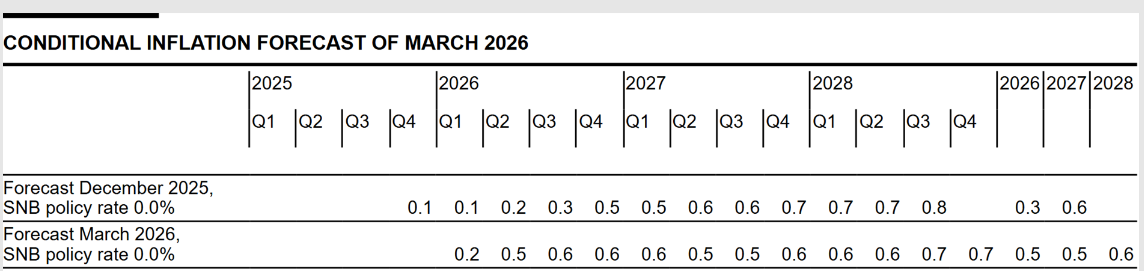
Once again and in line with consensus thinking we see SNB policy being unchanged (ie the policy rate remaining at zero) when it gives its next quarterly assessment this month with little shift in the forecasts for either growth or inflation. Admittedly, the tone of the economic outlook will remain guarded but where it will be underscored that it remains too soon to make material changes to the outlook given current continued heightened uncertainties. The strong Swiss Franc will be mentioned but its current strength needs context. Otherwise, the SNB will adhere to a medium-term inflation at 0.6% (Figure 1) and a gloomy 2026 activity picture with projected GDP growth of around 1% masking the fact that the underlying picture is more sobering given the circa-0.25 ppt boost sports events will provide this year. But with inflation forecast to be within the confines of its target range defined officially as less than 2%, this will be enough to justify stable policy now and for some time. We still see policy remaining on hold until at least mid-2027, with only a slight possibility of a return to sub-zero rates given the high(er) bar seen by the SNB for this to occur.
Figure 1: SNB Inflation Outlook To Remain Little Changed?
Source: SNB
While the currency has played a part, the still-near zero CPI inflation rate (albeit only a notch above SNB thinking) is as much a result of weak domestic price pressures which are slightly negative in smoothed and adjusted m/m measures.
Even so, the clear easing bias (ie an acknowledgement that the policy rate could go negative again) may be diluted somewhat amid a search for a greater assessment of current uncertainties related to the Middle East, tariffs and domestic property prices. Indeed, financial stability issues may feature more in the Board’s discussions as the scheduled summary of this month’s discussion (due Jul 16) may highlight. Notably real estate prices are still very much on a recovery track, if not clearly rising, all very much correlated with the low SNB policy rate, although such issues may instead await the next Financial Stability Report (due Jul 2).
Notably, with the U.S. threat of 39% tariffs have been pared back to the 15% most other countries were facing and this having changed too, this has made the SNB a little more upbeat, even though tariffs may also apply to yet to be confirmed pharmaceuticals which account for 40% of exports. But it will be weaker in 2026 albeit where overall GDP growth of around 1%, meaning that sports adjusted GDP growth this year may be below 1% and thus some 0.5 ppt below potential. However, this likely unchanged growth outlook explains why the inflation outlook was not being altered materially, even with recent undershoots of expectation and which show clearer signs of domestic price pressures receding (as suggested above).
The strong Franc, more recently against the USD, is also unlikely to have had any policy impact. While still pointing to possible FX intervention and a continued willingness to adjust policy accordingly, the SNB was keen to suggest its currency aspirations and actions are not designed to boost Swiss competitiveness. But this seems more talk than action as any overt attempt to weaken the current via intervention or lower/negative rates may be shunned by the SNB for fear it would court U.S criticism and possibly fresh retaliation.
As for the high bar for any return to negative borrowing costs the SNB has been clear this is because of the adverse impact on savers and pension funds. Indeed, SNB President Schlegel stressed in a recent interview adverse impact of negative rates on the likes of savers and pension funds, going on to warn that doing so may need stronger countermeasures later on, this possibly a result of the fresh pick-up in property prices now emerging. The latter is all the more notable given the continue pick-up in real estate prices, this very much correlated with SNB policy. Otherwise, it remains the case that the SNB target being a less explicit sub-2% offers policy makers more flexibility.