BOJ: Future Policy Rate Hikes
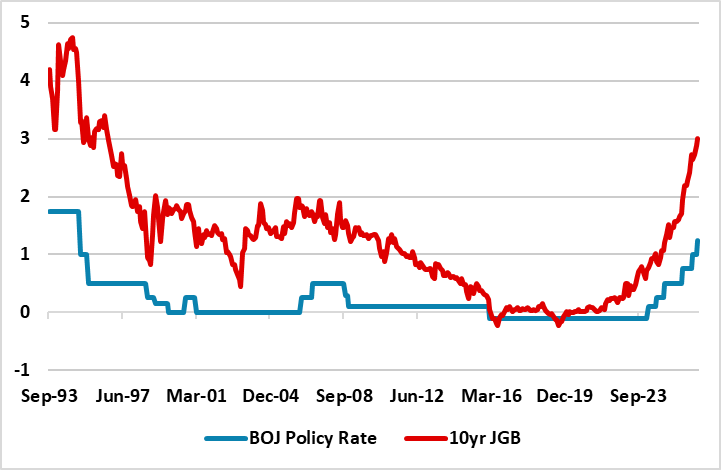
· BOJ voted 7-2 for a 25bps hike to 1.25%, but neither the statement or Ueda press conference suggest a pick-up in the tightening pace. The economy and inflation remain more important than the JPY in BOJ decisions. The lagged feedthrough of the Iran war energy price shocks points to further upward pressure for CPI inflation with a peak likely Q1 2027 around 2.6-2.8%. However, the economy is mixed with exports/production helped by a weak JPY and the AI boom but households weak. The policy rate is also getting close to BOJ neutral rate estimates of 1.75%. All of this suggests to us that the BOJ is unlikely to pick up to a quick tightening pace suggested in the money market. We remain of the view that the next 25bps hike will likely arrive April 2027 to 1.50%. Surging JGB yields and corporate/household loans are a 2nd extra monetary tightening. By H2 2027 this will be enough to delay a hike to 1.75% until 2028.
Figure 1: BOJ Policy Rate and 10yr JGB yields (%)
Source: Datastream and Continuum Economics
BOJ voted 7-2 for a 25bps hike to 1.25%, but neither the statement or Ueda press conference suggest a pick-up in the tightening pace. The economy and inflation remain more important than the JPY in BOJ decisions. Though Ueda did sound a little more concerned about underlying inflation overshooting the 2% target, no precommitment were made in terms of future policy rises. Going forward the BOJ did not provide clear forward guidance, but this is standard in the immediate aftermath of a rate hike. In the absence of clear guidance, the market views the prospects for further rate hikes as highly likely given the broader energy shock hitting Japan from the Iran/U.S. war. A further 25bps hike to 1.50% is discounted at the January 2027 BOJ meeting, then 25bps hikes in June and October 2027 to 2.00% according to the money markets.
However, back months OIS are getting distorted by the rise in long end yields rippling back to the short end and so OIS likely overestimate policy rate expectations. Additionally, the BOJ will also become more careful, as the policy rate reaches the middle of the estimated neutral rate band. BOJ researchers have previously estimated a range of 1.0-2.5% with a middle of 1.75%, which appears reasonable. A recent BOJ paper has an average estimated real neutral policy rate of -0.19% (here), which with a 2% inflation target is also consistent with a nominal neutral policy rate around 1.75%.
The GDP picture is also mixed. Net exports are holding up well, which is likely partially due to the super weak JPY. However, it also reflects the global AI boom spill over to benefit Japanese semiconductor manufactures. The consumption picture in contrasts has been softer, with the Q2 GDP data reflecting the initial impact of higher energy prices. Though government support for households will help, H2 CPI Yr/Yr inflation will likely push still higher and this will be a drag on real wages and also consumption into 2027. The government are also restrained by higher JGB yields in terms of the ability to deliver new fiscal stimulus in 2026. Therefore the mixed GDP forecast of 0.8% for 2026 and 1.0% for 2027.
In terms of CPI inflation, businesses have not fully passed on cost increases and further upward pressures is likely in H2 2026 and we see Yr/Yr CPI inflation pushing up to 2.6-2.8% by early 2027. PPI at 7.6% is not far from the 2022 peak at 10.6%. However, our baseline for the straits of Hormuz remains for a 2nd ceasefire deal to bring energy prices back down in 2027. For 2027, this means a lower quarterly profile of Yr/Yr inflation after the Q1 peak and will help soothe BOJ concerns. It is also not clear that companies will pass through higher CPI inflation into wage inflation in the 2027 wage round, given the squeeze of profitability from the energy crisis. Additionally, we still see scope for the Japanese Yen to appreciate from very low levels in the next 3-12 months.
All of this suggests to us that the BOJ is unlikely to pick up to a quick tightening pace suggested in the money market. We remain of the view that the next 25bps hike will likely arrive April 2027 to 1.50%. A further 25bps hike to 1.75% is possible in autumn 2027, but is not our baseline view due to the steepening yield curve caused by aggressive BOJ QT. Surging JGB yields and corporate/household loans are a 2nd extra monetary tightening. Normally a tightening cycle see less of a rise in 10yr JGB yields than has been seen (Figure 1), but BOJ QT remains at 6% of GDP. This is huge supply for the market to absorb and put further upward pressure on JGB yields. The BOJ has not yet reached the point that it will do a U turn on QT. By H2 2027 though this will be enough to delay a hike to 1.75% until 2028.