Brazil: 25bps Cut For September
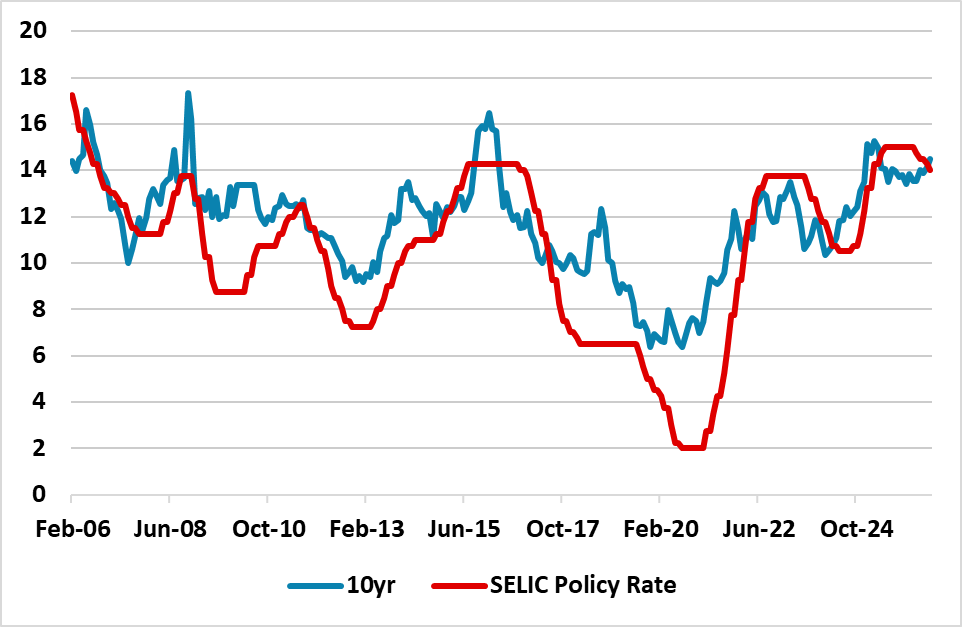
· BCB cut by 25bps to 14%, as widely expected. The statement suggests that COPOM is looking to pause the easing cycle, but we feel the softening of the economy and inflation numbers are enough to deliver one further 25bps cut in September and then the BCB pauses into Q1 2027. We see a consistent pace of BCB easing in H2 2027 with the SELIC down to 12%.
Figure 1: BCB SELIC Policy Rate and 10yr Government Bond Yield (%)
Source: Datastream and Continuum Economics
A couple of points are worth making re the August COPOM meeting.
· No forward guidance. The statement did not signal a pause and thus leaves the door open to a further cut in September. However, the statement did add "The Committee will continue to monitor developments in the scenario in order to keep monetary policy adequately restrictive to ensure convergence to the inflation target". This new sentence is being read by some in the money market as a signal that BCB wants to pause on rates in September. BCB also observed that its inflation balance remains tilted to the upside, though the 18 month inflation forecast is 3.2% for Q1 2028.
· September cut. Despite the statement suggesting that some BCB debate exists about a pause, we see a 25bps cut at the September Copom meeting. Real sector data is showing the impact from very restrictive policy and alongside this slowing has been more controlled inflation numbers. Additionally, we remain of the view that U.S. president Trump wants lower gasoline prices and will concede to get some form of reopening of the Straits of Hormuz. Inventory rebuilding will likely mean USD80 WTI by end 2026, but BCB concerns about a prolonged USD100 plus oil prices will recede.
· Pause then H2 2027 cuts. We then see the BCB going on hold, both to ensure that the inflation trajectory comes down further and to wait for the post-election fiscal consolidation. A Lula victory would like mean insufficient further fiscal consolidation, as occurred after the 2022 election. This would likely mean that the BCB pauses for a longer period into H1 2027 to ensure further disinflation pressures. A Flavio Bolsonaro victory could bring more fiscal consolidation, but this is dependent on the make-up of Congress and then implementation but this could see the BCB restarting the easing cycle in Q2 2027. We see a consistent pace of BCB easing in H2 2027 with the SELIC down to 12%.